Boat and PWC Insurance Sebastian Inlet: Florida Guide 2026

A Saturday at Sebastian Inlet can look calm from the parking lot and still be a problem waiting to happen. One owner is backing down the ramp while the current is pushing sideways, another rider is timing a PWC run through the cut, and somebody else is watching the sky because saltwater weather in Florida turns quickly. That's the setting for Boat and PWC insurance Sebastian Inlet, not a generic marina with easy water and predictable conditions.
Florida does not require boat insurance by law for recreational vessels, but that doesn't make coverage optional in practice. Lenders, marinas, and umbrella carriers often set the rules, and local use patterns matter just as much as the policy form. Around Sebastian Inlet, the difference between a policy that looks fine on paper and one that truly responds comes down to how the craft is used, where it's stored, and what risks the inlet adds.
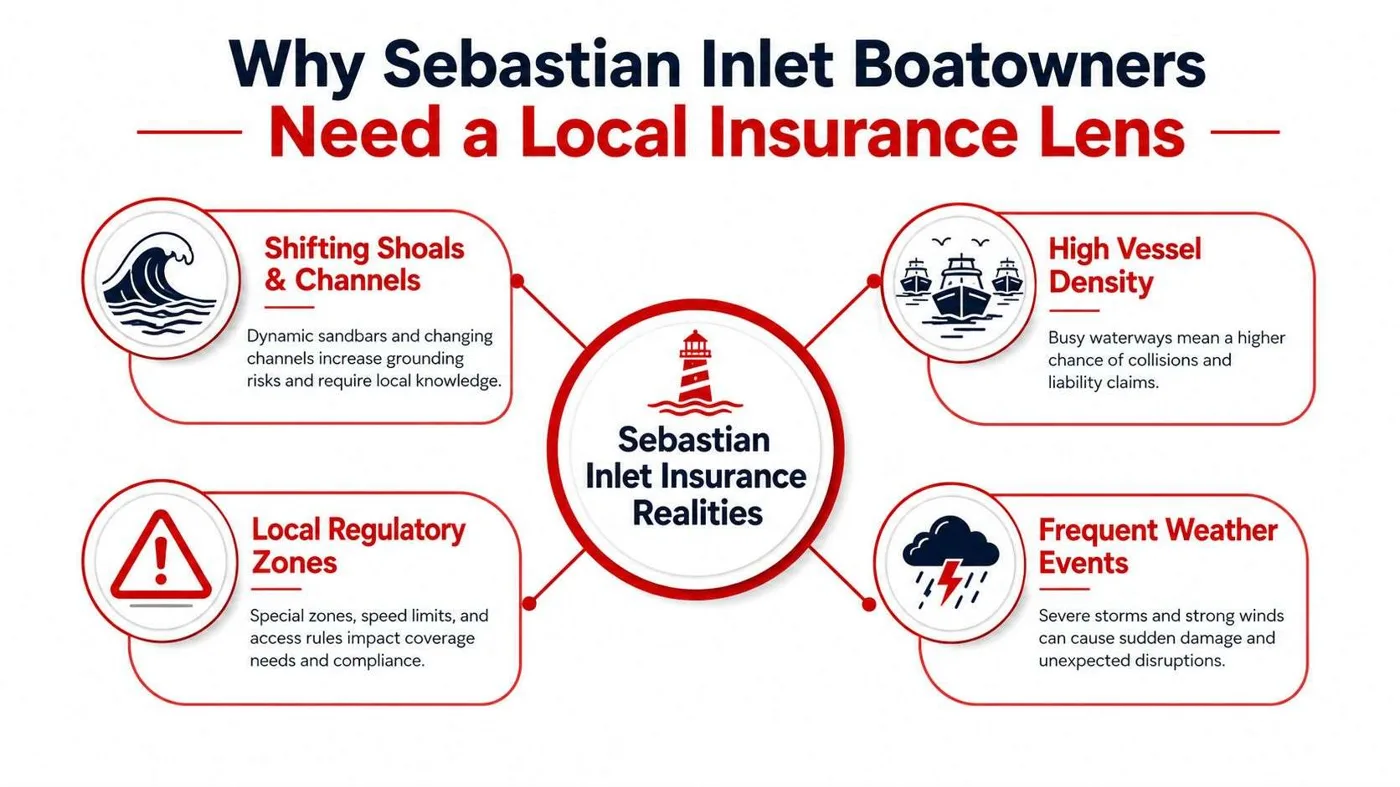
Why Sebastian Inlet Boatowners Need a Local Insurance Lens
A local Saturday on the water starts with details that don't show up in a national brochure. The trailer is staged early, the tide is moving, the chop can turn ugly without warning, and the people sharing the inlet are often farther closer together than they want to be. That's why Boat and PWC insurance Sebastian Inlet has to be judged by the water, not by a ZIP code checkbox.
Florida's lack of a state-law insurance mandate for recreational boats matters less than people think once a boat is financed or tied to a marina contract. One Florida comparison source notes that umbrella carriers in the state often want at least $300,000 in boat liability before they'll extend excess coverage, which tells you how quickly practical requirements rise above the statutory floor. The same source puts the median annual boat premium at $482, with most clients paying $250 to $725 and a statewide average of about $652 Florida boat insurance market data.
What the inlet changes
Sebastian Inlet is not protected-water cruising. It's a tidal pass with fast current, shifting shoals, and heavy vessel interaction, so insurers tend to view nearby boat and PWC use as a more concentrated collision, grounding, and prop-strike exposure than inland use. That's not theory, it's how the hazard profile changes when riders launch through surf, cross moving water, and run in traffic that leaves less room for mistakes.
Practical rule: If the same craft spends its weekends in an inlet instead of a calm lake, the claim potential changes even if the hull, motor, and trailer don't.
That local reality is why one-size-fits-all online quoting falls short. A carrier needs to know how far offshore the craft goes, where it's launched, whether it sits on a lift or on a trailer, and whether the owner knows how to handle crowded channels. The water doesn't care about a standard policy summary, and neither does an adjuster when the damage involves grounding, saltwater intrusion, or a storm-season haul-out decision.
The Core Coverage Types Every Florida Policy Should Cover
A boat policy only works when the coverage pieces match how the craft is used around Sebastian Inlet. That means looking past the premium and asking what happens after a surf launch goes wrong, a tide pushes a boat sideways at the ramp, or saltwater gets into places the owner never sees until later. The right policy is the one that matches those losses instead of just listing a vessel on paper.
Liability pays for damage or injury you cause to someone else. Around the inlet, that can come into play after a prop strike near a crowded channel, a docking mistake at the ramp, or a wake-related incident that damages another vessel or injures a passenger. Collision applies when your craft hits something, including a shoal, a dock, or another boat. Other-than-Collision is the broader physical-damage category for losses that are not a direct impact, including certain storm-related claims or saltwater-related mishaps that the policy covers.
Hull coverage is the physical-damage base, and the valuation method matters as much as the coverage name. An agreed-value policy sets the payout amount in advance, while an actual-cash-value policy usually leaves more room for depreciation disputes. For newer boats or financed vessels, agreed value often fits better because the settlement expectation is clearer if the boat is totaled after a grounding, a hard landing through the surf, or a storm-season loss. If you want to compare how a watercraft policy is structured before you quote, Schneider's watercraft insurance page is a useful place to start.
Medical payments can help with immediate medical costs after a boating accident, even when fault is still being sorted out. Uninsured boater protection matters if the other operator does not have enough coverage to absorb the loss, which is a real concern in busy coastal water. Optional add-ons like towing, salvage, personal effects, and trailer coverage deserve a line-by-line review, because those are often the parts that keep a bad day from turning into a long, expensive recovery problem after a grounding or a saltwater breakdown.
Liability protects other people. Collision protects your hull after impact. The optional coverages reduce the practical headaches that follow a claim, especially when the boat lives around Sebastian Inlet and sees tides, surf, corrosion, and storm-season haul-out decisions instead of calm protected-water use.
What Drives Boat and PWC Insurance Costs in Florida
Carriers don't price a boat policy by guessing. They look at the craft itself, the way it's used, and the kind of loss history that tends to follow that use. Around Florida, the cost conversation usually starts with vessel value, length, horsepower, navigation area, operator experience, storage method, claims history, and safety equipment marine underwriting factors.
Sample Florida pricing anchors
Florida boat pricing varies, but one market source puts the median annual premium at $482, with most clients paying $250 to $725 and a statewide average of about $652 Florida boat insurance market data. For personal watercraft, a Florida-focused source says policies generally run about $150 to $500 per year, while a national cost breakdown for 2026 estimates $200 to $600 annually, with $200 to $400 for entry-level models and $350 to $800 for high-performance units Florida PWC pricing.
| Florida Boat and PWC Insurance Cost Ranges | |||
|---|---|---|---|
| Vessel Type | Typical Range | Median | Notes |
| Boat | $250 to $725 | $482 | Market pricing quoted for Florida boat coverage Florida boat insurance market data |
| PWC | $150 to $500 | Not stated | Florida-focused pricing range for jet ski coverage Florida PWC pricing |
Why the same PWC can cost more at Sebastian Inlet
Two identical PWCs can land in very different price bands if one lives on a lake and the other runs through inlet traffic. The machine isn't just judged by its sticker price, it's judged by the likely severity and frequency of claims. A high-use inlet craft usually triggers more underwriting questions about launch point, how far it runs, whether it's trailered or docked, and who is operating it.
Good quote prep starts with honesty. If the usage is coastal, crowded, and frequent, say that up front. Hiding the real operating area tends to create a quote that looks cheaper and performs worse later.
The most useful move is to have the facts ready before you ask for a quote. Bring the boat's details, the storage plan, and a clear answer on how often it runs in inlet conditions. The quote gets sharper, and the renewal usually gets easier to defend.
Sebastian Inlet Risk Factors That Change Underwriting Decisions
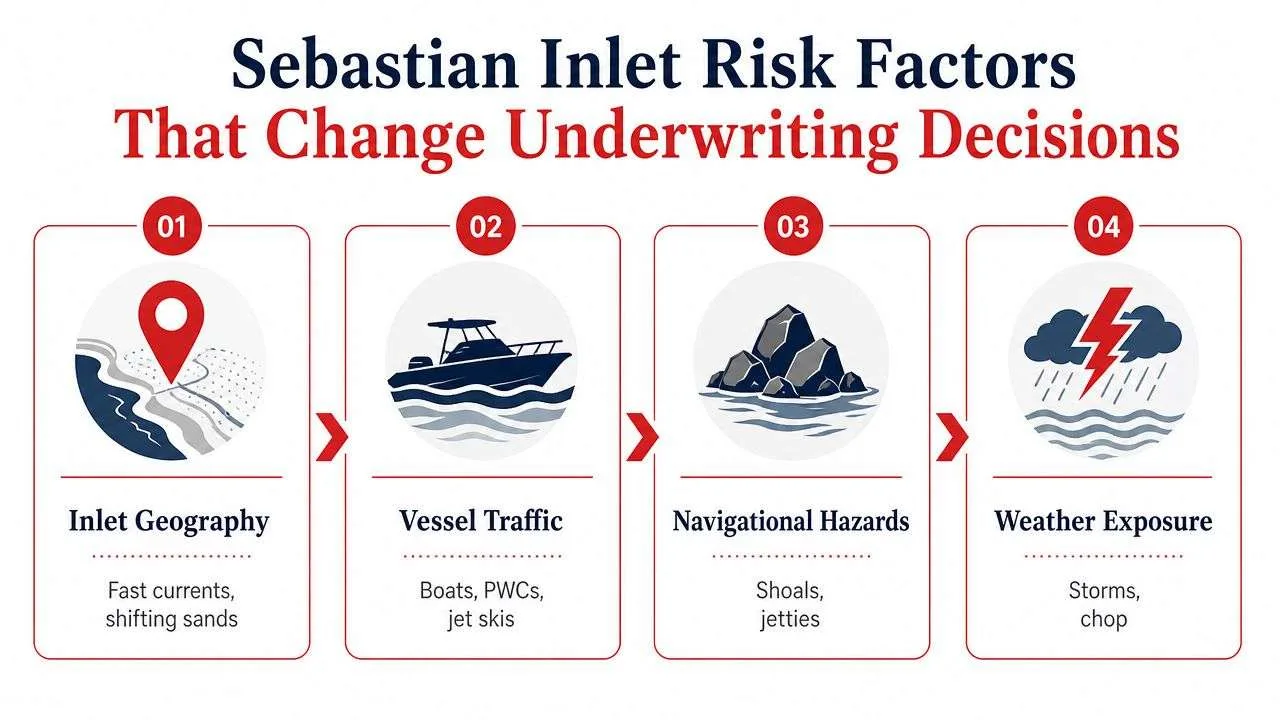
The inlet itself is the underwriting story. Fast current, shifting sand, surf entry and exit, and heavy mixed traffic create a setting where mistakes happen faster and damage spreads quickly. That's why carriers care so much about where the craft launches, where it runs, and how it's stored when it isn't in the water.
What carriers look at in local use
Insurers commonly ask about the launch location, the navigation area, the engine power, and the operator's experience because those details help predict loss frequency and severity marine underwriting factors. At Sebastian Inlet, the current and shoaling make a PWC or boat more exposed to grounding and prop damage than the same unit used in protected water. Surf launches add another layer, because the risk isn't just riding, it's getting safely in and out.
Why storage and storm planning matter
Trailering versus dockage isn't just a convenience question. It affects how a carrier thinks about exposure when weather turns ugly, and it can influence which coverage details matter most at claim time. A trailered boat that's hauled early before a storm is treated differently in practice than a vessel left in the water, especially when storm preparation, transport, and post-storm inspection all come into play.
Hurricane season also changes the mindset. If you wait too long to haul out, the claim argument can get messy because the condition of the boat, the timing of the weather, and the storage decision all matter. The best local policy is one that reflects those choices before the first named storm is even on the radar.
Common Exclusions and Coverage Gaps Florida Owners Overlook
The declarations page can look complete while the protection is narrower than expected. That's where a lot of Florida owners get surprised, because the words “covered” and “covered the way I needed” are not the same thing. Around saltwater and storm season, the fine print matters more than the premium headline.
The exclusions that cause the most trouble
Wear and tear isn't a covered loss, and neither are manufacturer defects or slow-developing damage that doesn't fit a sudden insured event. Racing, sanctioned events, charter use, and other commercial activity can also create a gap if the policy was written for private recreational use. If the boat is damaged during a season when the owner ignores lay-up conditions or storage requirements, the carrier may have questions before paying.
Named-storm limits are another place where surprises show up. Even when a policy covers storm damage, the deductible or sub-limit can make the out-of-pocket cost much higher than the owner expected. Saltwater corrosion is especially tricky because some damage is gradual and some is sudden, and the policy language decides which side of that line the loss falls on.
What to check before you sign
Look closely at the difference between liability and first-party physical damage. A policy can be perfectly fine for a simple collision claim and still leave gaps for marina obligations, storm storage issues, or damage tied to a specific exclusion. If the boat is used near an inlet, that gap matters more because the environment creates more chances for low-speed contact, abrasion, and unexpected water intrusion.
A practical rule is to read the exclusions first, not last. The cheapest quote is the one most likely to disappoint when the boat needs real help, especially in coastal Florida where launch conditions and weather add stress the policy has to anticipate.
Discounts and Bundling Strategies That Lower Florida Premiums
Savings work best when they change risk, not just invoice structure. A safety course can make an owner more credible on the water, while a lay-up arrangement can reduce exposure during the quiet season. Bundling helps too, but it works differently, sometimes it improves convenience more than it lowers the total cost.
The discounts that are usually worth asking about
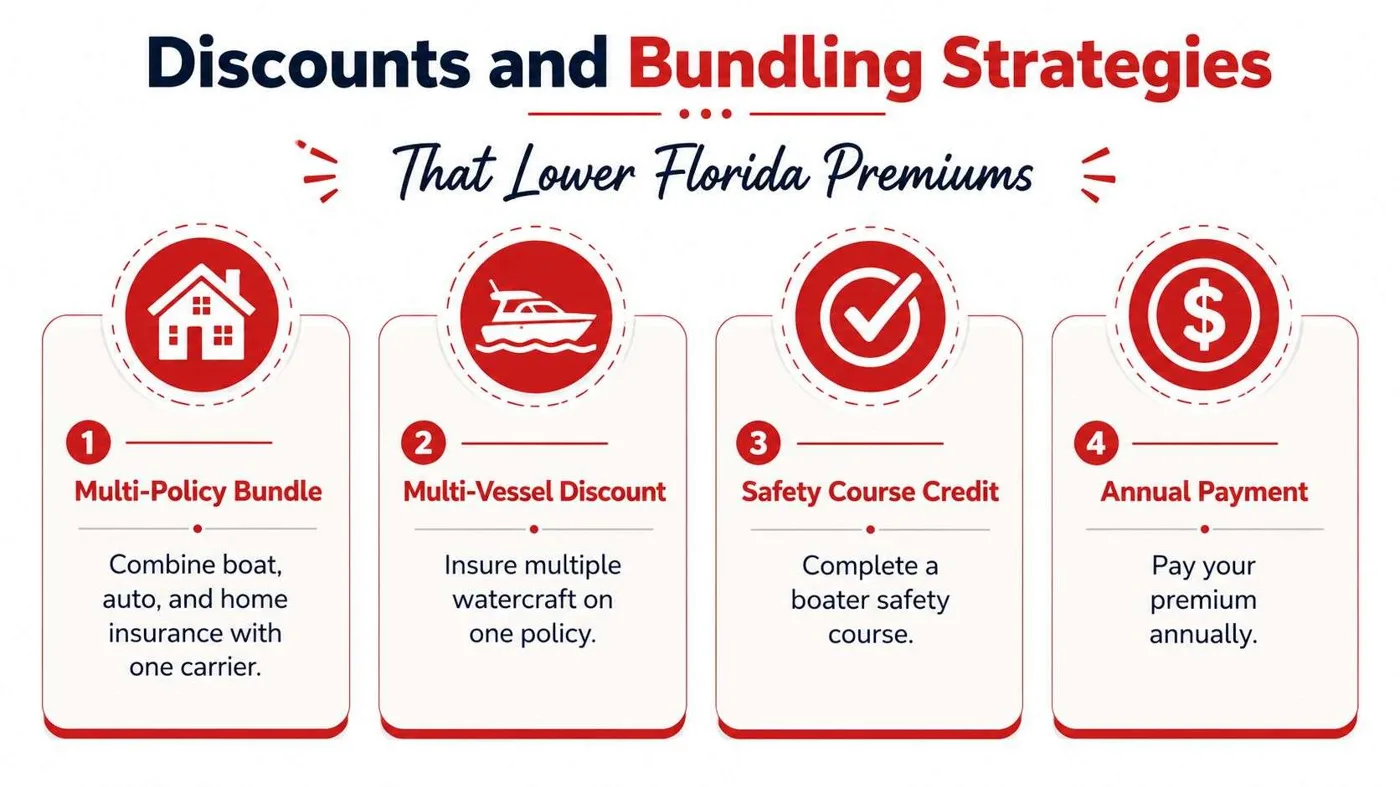
Multi-policy bundling can simplify life when boat, auto, and home coverage sit with the same agency or carrier. Multi-vessel discounts can help if a household insures more than one watercraft, and safety-course credits can reward owners who hold a valid Florida Boating Safety Education ID card. Off-season lay-up arrangements may also matter if the craft is stored during the slow months and not used.
The best discounts are the ones that line up with real behavior. If you store the boat on a trailer, take a boating safety course, and keep usage disciplined, you're giving the underwriter fewer reasons to price aggressively. That's more valuable than chasing tiny credits that only nibble at the total.
What to ask an agent before renewal
- Bundle Intent: Ask whether your boat policy can sit alongside home or auto coverage under one account, because that often makes renewal review easier.
- Multiple Units: If the household has more than one vessel, ask how the carrier treats all of them together.
- Safety Credit: Confirm whether a Florida boating safety course or ID card changes the quote.
- Storage Plan: Ensure your winter or off-season storage method is properly recorded in the policy file, not just mentioned once on the first quote.
There's also a practical difference between discounts that lower loss exposure and discounts that shift where the carrier earns the money back. Around Sebastian Inlet, the first type is the one worth pursuing hardest, because it lines up with how you really use the craft.
How to Get an Accurate Local Quote and File a Claim the Right Way
A good quote starts with clean information. If the agent has to guess at usage, storage, horsepower, or value, the quote can come back off-target and the renewal can turn into a correction exercise. The more local and specific the facts are, the better the pricing conversation gets.
What to gather before asking for a quote
Bring the vessel HIN, year, length, horsepower, estimated value, storage method, navigation area, operator experience, prior claims, and safety equipment. If the boat or PWC is used regularly at Sebastian Inlet, say so directly instead of describing it vaguely as “coastal.” That context changes the underwriting discussion fast.
An independent Florida agent can then place the same submission with multiple carriers and compare the way each one treats inlet use, trailer storage, and named-storm sensitivity. That's especially useful when one carrier likes trailered craft and another is comfortable with dockage but wants different documentation.
How to protect a claim after a saltwater incident
Take photos immediately, before anything is moved or cleaned. Corroded parts, torn hardware, and water intrusion need to be documented while the damage still looks fresh, because adjusters often need to see what failed and when. If a storm is involved, separate the timeline carefully, wind, flood, surge, and storage decisions can all affect what responds first.
For an owner dealing with nearby flood and surge exposure, the insurance conversation often overlaps with broader coastal property planning. The same documentation discipline that helps after a boat loss also helps when water gets into the storage area or dock space, which is why it's smart to keep related records in one place and review them before the season turns rough Florida flood planning for coastal owners.
Claim habit that saves time: Photograph the boat before the haul-out, after the haul-out, and again when the adjuster requests inspection. That sequence makes it easier to prove what changed and when.
The biggest mistake is waiting to report saltwater intrusion or assuming a quick rinse fixed everything. If a claim is going to be paid correctly, the carrier needs a clean record, not a repaired mystery.
Why a Florida-Only Independent Agency Matters for Inlet Owners
A Florida-only independent agency makes sense here because Sebastian Inlet owners need more than a generic quote. They need someone who understands inlet traffic, trailered storage, storm-season timing, and how different carriers read marine risk. That's especially true when the policy has to work with home, auto, or umbrella coverage instead of living in isolation.
One useful way to think about it is like local surf knowledge. A nearby board shop can tell you what the break is doing today, while a distant retailer can only explain the board dimensions. The same kind of local judgment matters in marine insurance, and even a practical resource like local surf shop advice shows why people close to the water tend to trust conditions-based guidance over generic advice.
Schneider and Associates Insurance Agencies is a Florida-only independent agency, family-owned since 2003, and it offers access to multiple top-rated carriers along with a personal insurance lineup that includes watercraft coverage. The agency's Florida focus matters because it can align boat coverage with home, auto, flood, and umbrella decisions without forcing the owner into a single-carrier lane. If you want to understand how an independent agency operates, this explanation of what an independent insurance agency is is the right starting point.
The primary advantage for inlet owners is practical advocacy. When a saltwater claim, a storm claim, or a storage dispute gets messy, the person who sold the policy should know how the carrier thinks and what proof the adjuster will ask for. That's the final layer of risk management, because the right policy only matters if the right person helped place it.
Have questions about your coverage?
Our Newberry and Micco, FL team can walk through your policy and find the right coverage at the right price.
Get a Free Quote