Florida Insurance Guide: Coverage, Claims, and Local Help

Hurricane season has a way of making Florida homeowners look twice at the same stack of papers. A roof can be ready, shutters can be staged, and the mortgage payment can be current, but the key question is whether the policy in the file matches the risks outside the front door. In Florida, that question comes up in coastal neighborhoods, inland suburbs, condo buildings, and small businesses that all face different combinations of wind, rain, flood, and liability.
A useful way to think about Florida insurance is simple. Start with the geography, then map the coverage, then look at how claims are handled when the storm is gone and the adjuster is asking for documents. Florida became the 27th U.S. state on March 3, 1845, and the state's scale, with 21,538,187 residents counted in the 2020 Census across 65,758 square miles, helps explain why one policy conversation can't fit every household the same way Florida history overview. If you're trying to compare home, auto, flood, and business coverage in one place, this guide lays out the logic step by step.
Why Florida Insurance Is Its Own Category
A Florida driver can get caught in one storm and face two different insurance questions at once. The car may be covered for the crash, while the home or apartment takes on water that falls under a different policy. That split is a big reason Florida insurance feels different from insurance in many other states, because the risk is a mix of wind, water, density, and property type.
Practical rule: In Florida, the first policy question is rarely “Do I have coverage?” It's “Which kind of damage did I actually buy coverage for?”
Florida's history also helps explain why the market developed this way. People first entered the peninsula about 14,000 years ago, and hundreds of thousands of Native Americans lived there when Europeans arrived in the early 1500s Florida history overview. That long settlement timeline left the state with deep regional differences, so a homeowner in one county can face a very different insurance conversation than a condo owner a few hours away.
The practical takeaway is simple. You do not need to memorize policy language first. Start with your own risk, then match that risk to the right line of coverage. A homeowners policy may handle part of a loss, while flood insurance has to be added separately. Auto coverage also matters after a storm-related crash, especially if you are trying to navigate post accident coverage rules and you want to avoid buying the wrong limit. If you are also checking Florida minimum car insurance requirements, that review should happen before you assume a basic policy will do more than it actually does.
For Florida households, the goal is control. Once you know which damage belongs to which policy, you can compare quotes, ask better questions, and avoid buying a plan that only looks complete on paper.
The Risk Map That Drives Every Florida Policy
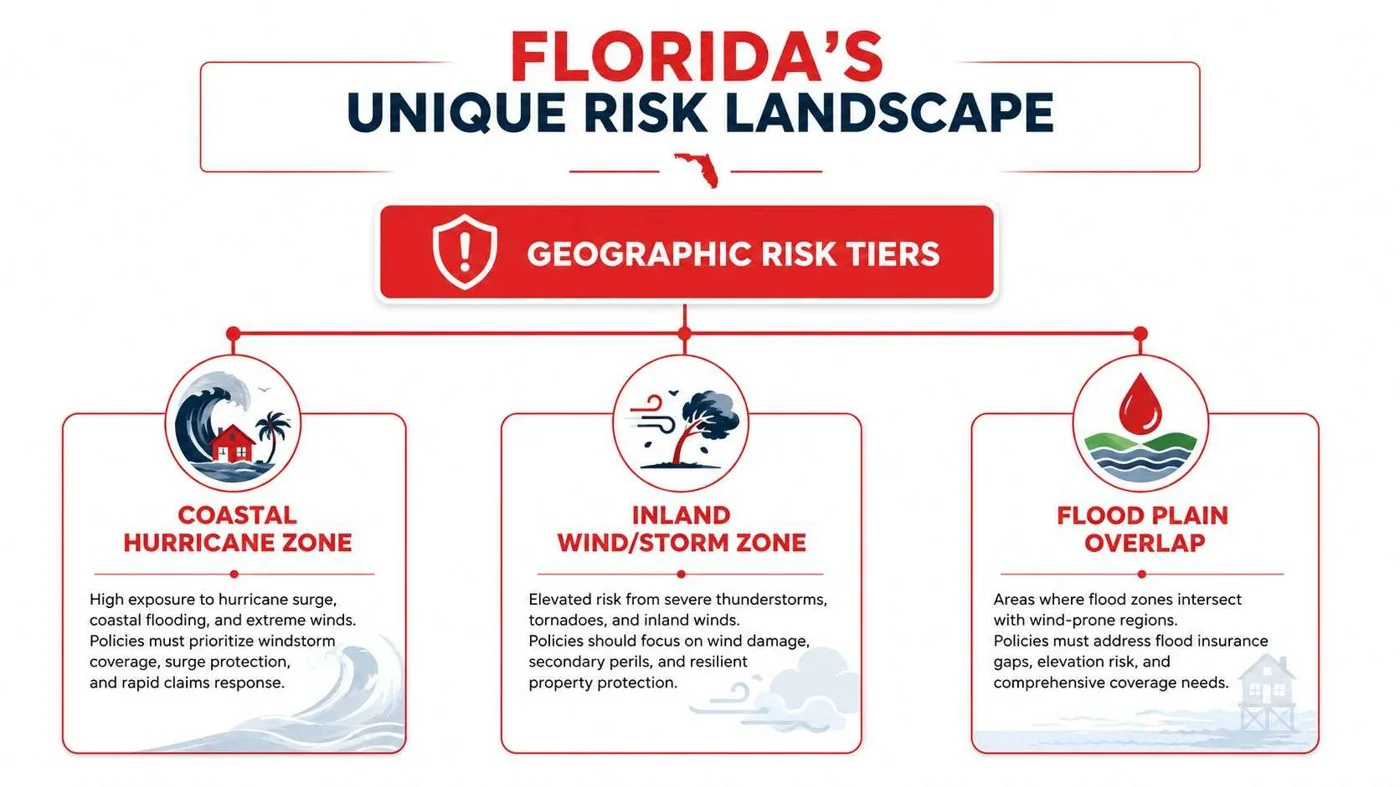
A Florida policy starts to make sense when you look at the state parcel by parcel, not as one uniform market. Coastal counties, inland communities, dense metro areas, and quieter rural areas all face different mixes of wind, water, and liability, so the same house style can lead to very different insurance questions depending on where it sits. A home near the Atlantic or Gulf coast is exposed to a different risk pattern than a similar home farther inland.
Geography changes what you protect
A condo in South Florida can call for a different conversation than a single-family home in the Panhandle. Location affects hurricane exposure, drainage, rebuilding access, and how a carrier weighs the area's loss history. That is why “Florida insurance” is really a set of coverage decisions, not one product with a fixed answer.
Separate wind, flood, and property damage in your mind. Wind can take off shingles, break windows, and push water into the home. Flood can enter from rising water and follow a different set of rules. The same storm can create both kinds of damage, which is why many Florida owners are surprised when one policy responds and another does not.
A coverage choice that fits one county can leave a gap in another.
Regional settlement patterns matter too
Florida's population is spread unevenly, so carriers often price risk differently from one region to the next. That unevenness matters to homeowners because underwriting, deductibles, and carrier appetite usually follow the risk pattern, not the zip code label alone.
A helpful way to sort the questions is by exposure type:
- Coastal Hurricane Zone: ask about roof strength, wind limits, and water intrusion.
- Inland Wind and Storm Zone: focus on trees, storm debris, and local drainage.
- Flood Plain Overlap: ask how the property handles water that enters from outside the structure.
Florida drivers also have to understand how auto rules fit into the bigger picture. A storm can lead to a crash, a glass claim, or injuries, and the policy limits you choose shape what happens next. For a plain-English explanation of Florida no-fault rules, see insights from Haddad & Associates P.A.. If you are checking Florida minimum car insurance requirements, do that before you assume a basic policy will cover more than it really does.
The best question is simple. What is this property exposed to here? Once you answer that, the rest of the coverage conversation becomes clearer, and you are less likely to buy protection for the wrong problem.
Core Coverages Every Florida Home and Driver Should Carry
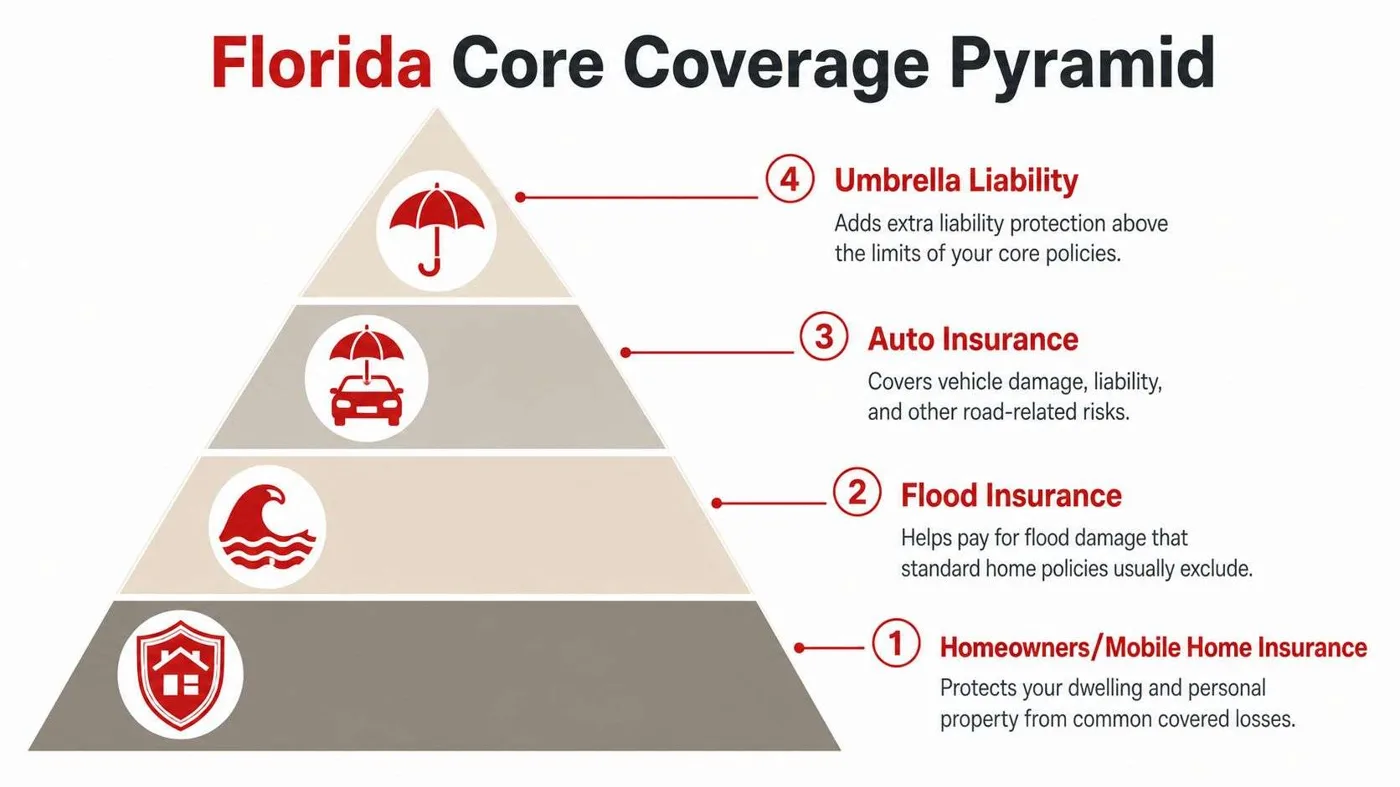
The cleanest way to build coverage is from the ground up. Start with the property itself, then protect the car, then add flood, then decide whether a larger liability layer belongs on top. That stack helps because Florida losses rarely stay in one category.
Start with the property you live in
For a house, a standard homeowners policy is the core layer, because the lender usually wants the structure protected. For a mobile home, the policy needs to fit the way the home is built and used, since the risk profile isn't the same as a conventional house. For a condo, the association's master policy and the unit owner's policy have to fit together so you know which walls, fixtures, and interior items are yours to insure.
Older Florida homes deserve a slower review. Roof age, updates, and local exposure can change how a carrier views the property, so a quote should never be read like a one-line price. It needs to be checked against the actual building and the way the home is used.
Then protect the driver
Auto coverage matters in Florida even when the weather is the thing you're worried about. A storm can create road hazards, traffic crashes, or debris damage, and the car still needs its own policy response. If you only compare home premiums and ignore the vehicle, you can miss part of the risk picture that affects the whole household.
Flood is separate, not optional thinking
Flood insurance sits on top of the homeowners policy, not inside it. That distinction causes a lot of confusion, especially after heavy rain or storm surge. A policy review should ask where water comes from, whether the property sits in a vulnerable area, and how water would enter the building.
Umbrella adds another layer of protection
An umbrella liability policy is the top layer. It doesn't replace the others, it extends liability protection when a serious claim goes beyond the base policy. That can matter for households with higher exposure, more drivers, teen drivers, rental use, or business activity tied to the property.
A simple pairing table helps keep the conversation clear:
| Coverage Type | Who It Protects | Pairs With |
|---|---|---|
| Homeowners or Mobile Home Insurance | The structure and personal property | Flood, umbrella |
| Auto Insurance | The vehicle and driver liability | Homeowners, umbrella |
| Flood Insurance | Water damage from outside flooding | Homeowners |
| Umbrella Liability | Higher-level liability exposure | Home, auto, business policies |
If you're sorting out flood specifics for a Florida home, the practical overview from Florida flood insurance for homeowners can help frame the conversation around water exposure and policy layering.
Independent Florida Agents vs Direct-to-Consumer Carriers
Florida buyers often focus on price first, then discover too late that service structure matters just as much. An independent Florida agency can compare options from multiple admitted carriers, which means the advisor is looking for a fit across more than one company's product. A direct-to-consumer model usually gives you one company's menu, one quoting path, and one way of handling the relationship.
Why the structure changes the experience
This matters most after a claim. When a roof is damaged or a windstorm drives water into the interior, somebody has to help interpret the policy, gather the documents, and push for a fair review. With an independent Florida advisor, you're working with someone whose job is to match the policy to the risk and stay involved when the claim gets complicated.
Practical rule: The best policy isn't only the cheapest quote, it's the one you can actually use when the loss happens.
A licensed Florida advisor also brings local context. That includes knowing how coastal exposure differs from inland exposure, how condo master policies can create confusion, and why flood questions deserve a separate conversation. If you want a plain-language definition of the independent model, the overview from what is an independent insurance agency is a useful companion read.
What to look for in the relationship
Ask who will help you after the sale, who explains the deductible language, and who follows up if the carrier requests more documents. Those are not small details. They decide whether you feel guided or left alone.
A good insurance relationship in Florida should feel like this:
- Carrier access: more than one option when the market changes.
- Local knowledge: an advisor who understands Florida property and weather realities.
- Claims support: help interpreting letters, deadlines, and next steps.
- Policy fit: coverage that matches the property, not just the premium.
Florida buyers don't need more noise. They need a structure that keeps the decision tied to the actual risk, especially when a storm pushes a claim into stressful territory.
How to Bundle Florida Home, Auto, Flood, and Business Coverage
Bundling works best when you treat it like a planning exercise, not a discount hunt. A homeowner who already has auto insurance can ask whether the home and car are lined up under one review, then add flood if the property exposure calls for it. A business owner can do the same thing by looking at property, liability, umbrella, and employee coverage together instead of buying each piece in isolation.
Build the bundle in the right order
Start with the property or operation that has the biggest exposure. A family home usually comes first, then the vehicles tied to daily life, then flood if the area or structure needs it. For a Florida business, the logic is similar, but the list broadens to a business owners policy, general liability, commercial umbrella, and, where needed, workers coverage.
That order matters because a flood policy doesn't replace homeowners coverage, and a business umbrella doesn't replace general liability. Each layer solves a different problem. When you separate them early, you can see where the overlaps are and where the gaps live.
Use a simple bundle checklist
Before you ask for quotes, write down the property type, who uses it, and what could go wrong. That's the fastest way to avoid a generic proposal that misses something important.
| Coverage Type | Who It Protects | Pairs With |
|---|---|---|
| Homeowners Insurance | House and personal belongings | Auto, flood, umbrella |
| Mobile Home Insurance | Mobile home structure and belongings | Flood, umbrella |
| Auto Insurance | Drivers and vehicles | Homeowners, umbrella |
| Flood Insurance | Water damage from outside flooding | Homeowners, condo policies |
| Business Owners Policy | Small business property and liability basics | Commercial umbrella, workers coverage |
| Commercial Umbrella | Higher-level business liability | General liability, BOP |
For a homeowner trying to understand water risk in plain English, the Florida-specific breakdown at Florida flood insurance requirements is a helpful prompt before a quote review. It keeps the discussion focused on how the property sits, not just on whether the premium feels comfortable.
A good bundle conversation should end with one clear question. If a windstorm, a car accident, and a water loss all happened in the same season, would the policies work together or fight each other? That's the question that exposes whether the package is complete.
Filing a Florida Insurance Claim Without Losing Ground
A Gainesville homeowner wakes up after a windstorm and finds shingles on the lawn, a ceiling stain in the hallway, and a branch lying across the fence. The first instinct is to start cleaning, but the better first move is to slow down just enough to preserve the claim. Insurance companies need proof of what happened, when it happened, and what got damaged, and that starts before any repair crew arrives.
Document first, then repair
Take photos and short videos before moving debris if it's safe to do so. Save receipts for temporary repairs, tarps, and emergency work, because mitigation is part of the claim record. If water is coming in, stop it as much as you can without creating more damage, then notify the carrier promptly.
Florida claims can become messy when multiple coverages might apply. A windstorm can damage the roof, then the resulting opening can let water inside. That's why the claim file should clearly separate what the storm damaged directly and what was damaged afterward.
Work the file, not just the phone call
When the adjuster responds, keep your notes organized. List the date, the property address, the specific rooms or structures affected, and any repair estimates or contractor observations you have. If the claim involves a home policy, the process overview at how to file a home insurance claim gives a Florida homeowner a useful framework for the paperwork side of the process.
Keep every message, photo, estimate, and receipt in one place. Claims go better when the story is consistent.
Florida's market conditions can also affect the claim path. A policyholder may be dealing with a last-resort carrier arrangement or a carrier change while the claim is still open, so the file needs to stay complete and easy to follow. The calmer and more organized the record is, the easier it is for the claim to move.
If you're ever unsure what to do next, focus on three things. Preserve the property, preserve the documents, and preserve the timeline. That sequence protects both the home and the claim.
How Schneider and Associates Supports Florida Clients
A Florida client usually wants two things at the same time. They want the policy to be right, and they want someone reachable when something goes wrong. That's where a local advisor matters, because home, auto, flood, and business coverage all change when the property, the family, or the company changes.
What a local Florida team brings
Schneider and Associates Insurance Agencies is a RamseyTrusted, family-owned, Florida-only independent agency serving Newberry, Micco, Gainesville, and Jonesville. The agency's personal lines include home, auto, flood, and mobile home coverage, and its commercial programs include restaurants, trucking, contractors, fitness, and veterinary practices, plus mobile home park, RV park, and campground coverage. It also offers employee benefits such as group health, dental, vision, and 401(k).
The day-to-day value is simple. A local advisor can help you revisit coverage when you buy a house, add a driver, move into a condo, or grow a business. A 24/7 client center and mobile app also make it easier to stay on top of policy documents and service requests without waiting for normal office hours.
The next step is a coverage review
If you live in Florida, the smartest move is to line up your real exposures with the policies you already have. That means reviewing the home, checking the auto, confirming whether flood belongs in the stack, and making sure business coverage fits what you do. A good conversation should leave you with fewer assumptions and more clarity.
Have questions about your coverage?
Our Newberry and Micco, FL team can walk through your policy and find the right coverage at the right price.
Get a Free Quote