FL Insurance: Your 2026 Guide to Florida Coverage

Image metadata: Title: Florida tropical beach header. Description: Tropical Florida shoreline with white sand, turquoise water, and palm tree under clear blue sky for a Florida insurance guide. Geo: Florida, USA.
You've probably had this moment already. You close on a home, sign a condo lease, buy a business in Florida, or move down from another state, and suddenly the insurance language stops sounding familiar. Wind mitigation. Separate flood policy. Named storm deductible. Citizens requirement. Sinkhole questions. It feels less like buying coverage and more like learning a new dialect.
That confusion is normal. Florida insurance is different because the risks are different, the rules are different, and the cost of getting it wrong is higher than commonly anticipated.
The shorthand FL insurance really means Florida-specific insurance, not a generic policy with your Florida address typed onto the declaration page. The state's exposure to wind, water, and ground movement changes how personal and business coverage should be built. A cheap policy that might be workable somewhere else can leave a Florida property owner badly exposed.
The pricing alone should get your attention. The Florida Office of Insurance Regulation reported that in 2025, the average cost of a standard homeowners insurance policy in Florida was $4,842, which is 147% higher than the national average of $2,012, making Florida-specific pricing and carrier selection critical for agencies serving only Florida markets, as noted in this Florida homeowners insurance market reference.
Welcome to Florida Your Insurance Is Different Here
A new Florida homeowner usually starts with one assumption that turns out to be wrong. They think one homeowners policy will handle everything. Then they learn flood is separate, wind deductibles can feel large when a storm hits, and two houses on the same road can be insured very differently.
That's not a sign the system is broken. It's a sign that Florida asks insurers and property owners to deal with layered risks, not one simple hazard. A roof claim, a storm surge loss, and a plumbing backup can all involve different policy language, different exclusions, and different deductibles.
Why Florida coverage has to be built on purpose
In practice, good Florida insurance works like a storm kit. One flashlight isn't enough. You need the right pieces, and each piece has a specific job.
For a homeowner, that often means looking beyond the declarations page and asking:
- What triggers the deductible: A hurricane deductible doesn't feel like a normal deductible. It can hit harder because it's tied to a major event, not a minor claim.
- What water is excluded: Many owners learn too late that rising water is treated differently from rain entering through storm-created openings.
- What the home would cost to rebuild: Market value and rebuild cost aren't the same thing in Florida.
Practical rule: If you can't explain where wind coverage ends and flood coverage begins, your insurance plan isn't finished yet.
Florida owners also need a realistic mindset. The lowest premium isn't automatically the best choice, and the highest limit isn't automatically the smartest choice. What works is matching coverage to the actual structure, location, loan requirements, and tolerance for out-of-pocket shock after a loss.
A family in Micco may worry about a different combination of issues than a condo owner in Gainesville or a shop owner in Newberry. The details matter. In Florida, the policy should fit the property, not the other way around.
Understanding Floridas Big Three Insurance Risks
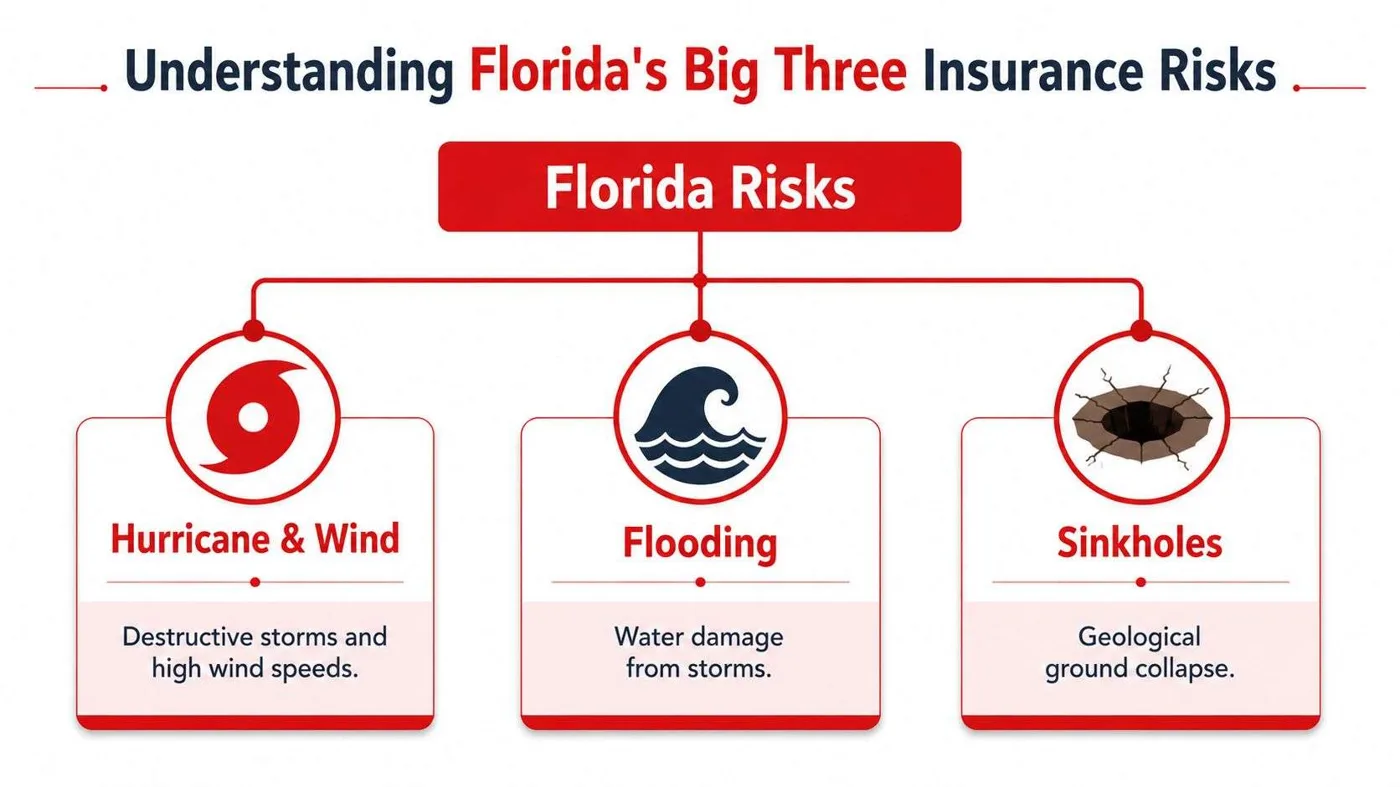
Image metadata: Title: Understanding Florida's Big Three Insurance Risks. Description: Infographic showing Florida risks branching into hurricane and wind, flooding, and sinkholes. Geo: Florida, USA.
Florida insurance prices and policy rules make more sense when you look at the three threats that shape them most. They are hurricanes, floods, and sinkholes. Each one damages property in a different way, and that difference matters when a claim is filed.
Hurricane damage is really two separate problems
A hurricane doesn't create one kind of loss. It creates wind loss and water loss, and those often follow separate insurance paths.
Wind damage usually involves the building envelope. Roof coverings peel back. Soffits fail. Windows and doors take pressure. Once wind opens the structure, rain can enter. That's why homeowners hear so much about roof age, opening protection, and mitigation features.
Water from outside the home is another story. If water rises from the ground, street, canal, or storm surge and enters the property, that's generally the flood conversation, not the standard home policy conversation.
Flood risk reaches far beyond the beach
Many Florida buyers still think flood insurance is mostly a coastal issue. It isn't. Water collects where drainage fails, where storms stall, where streets flood, and where development changes runoff patterns.
Florida's flood exposure is unusually high. According to Florida flood risk data, the state has an average composite flood risk score of 23 on a 0 to 100 scale, compared with the U.S. county-level average of 12. The same source identifies Lee County as the highest-risk area in the state with a composite score of 60. It also reports 32,000 flood claims from Florida with combined payouts of $2,431,483,568 across the dataset.
That same source states that nearly half of U.S. flood-related fatalities happen when people try to drive through flooded roadways. For Floridians, that's more than an insurance point. It's a safety rule.
Don't treat a flooded road like a shallow puddle. Drivers often can't see washouts, depth changes, or stalled traffic ahead.
Sinkholes are less common but harder to ignore
Sinkhole risk feels different because it's not seasonal and it's not always obvious at first. Owners usually notice doors sticking, cracks widening, or floors shifting before they understand what might be happening.
Insurance trade-offs here are practical. Some owners overreact and chase broad coverage they may not fully understand. Others ignore the issue entirely because they assume “that won't happen here.” The better approach is to read the policy language carefully and ask how ground movement is treated before there's a problem.
A quick way to think about these three risks is this:
| Risk | Typical concern | Common mistake |
|---|---|---|
| Hurricane and wind | Roof and building envelope damage | Assuming all storm water is covered the same way |
| Flooding | Rising water entering the structure | Thinking inland properties don't need flood coverage |
| Sinkholes | Structural movement and foundation distress | Waiting until damage appears to review the policy |
Your Essential Florida Personal Insurance Portfolio
Image metadata: Title: Florida suburban home insurance image. Description: Single-story Florida-style suburban home with driveway, manicured lawn, and landscaping representing residential insurance planning. Geo: Florida, USA.
A solid personal insurance portfolio in Florida usually includes more than one policy. For most households, the starting point is home or condo coverage, then auto, then flood if the property has any meaningful water exposure or lender requirement. Mobile homes need their own careful review because underwriting can be stricter and the structure details matter more.
Start with the home policy and read the deductible language
The most misunderstood part of Florida home insurance is often the deductible. Many people budget for a standard claim deductible and forget that hurricane deductibles operate differently. The practical effect is simple. When a named storm causes major damage, your share of the loss may be much larger than you expected.
Consider this: A regular deductible is a step. A hurricane deductible can feel like a staircase.
That's why the first review should cover:
- Dwelling amount: Is the home insured to a realistic rebuilding figure, not just a purchase price assumption?
- Deductible structure: Do you know which deductible applies to which event?
- Roof and opening protection: Mitigation features can affect both eligibility and pricing.
If you want a better sense of how rebuilding figures are approached, a replacement cost calculator for Florida properties is a useful starting point before you finalize limits.
Match the policy to the property type
A single-family home, condo unit, and mobile home don't need the exact same conversation.
For a home policy, the focus is usually structure, personal property, liability, and loss-of-use protection. For a condo policy, the key question is where the association's coverage stops and where your HO6 policy starts. That boundary matters most after a serious water or wind event.
For mobile homes, details become even more practical. Older units can raise more underwriting questions, tie-down and anchoring matter, and replacement assumptions need to be realistic. The right policy should reflect how the unit is built and used, not just its mailing address.
A Florida insurance review should start with the sentence, “Tell me about the building.” Not, “What premium are you trying to hit?”
Auto coverage in Florida needs more than a minimum mindset
Florida drivers often focus on price first, which is understandable. But personal auto insurance in this state should be built around what happens after a bad crash, not just what keeps the vehicle legal.
A household with home, condo, or mobile home coverage should also ask whether the auto limits make sense alongside the rest of the family's assets. Liability gaps have a way of showing up at the worst possible time.
What tends to work well is a layered approach:
- Protect the home properly first. The property policy is still the anchor.
- Add flood where the exposure justifies it. Don't assume the home policy handles rising water.
- Review auto liability with the same seriousness. A weak auto policy can undermine an otherwise solid plan.
People shopping online often buy pieces. Florida families need a portfolio.
Navigating Flood Insurance NFIP vs Private Options
A hard rain stalls over your neighborhood, the street fills up, and water starts pushing toward the front door. That is the moment many Florida owners learn a painful fact. Standard homeowners insurance does not pay for flood damage caused by rising water.
In this state, flood insurance is its own decision and, for many properties, a financial survival tool. The right choice depends on your building, your lender, your flood zone, and how much loss your budget could absorb without wrecking your savings.
What the NFIP does well
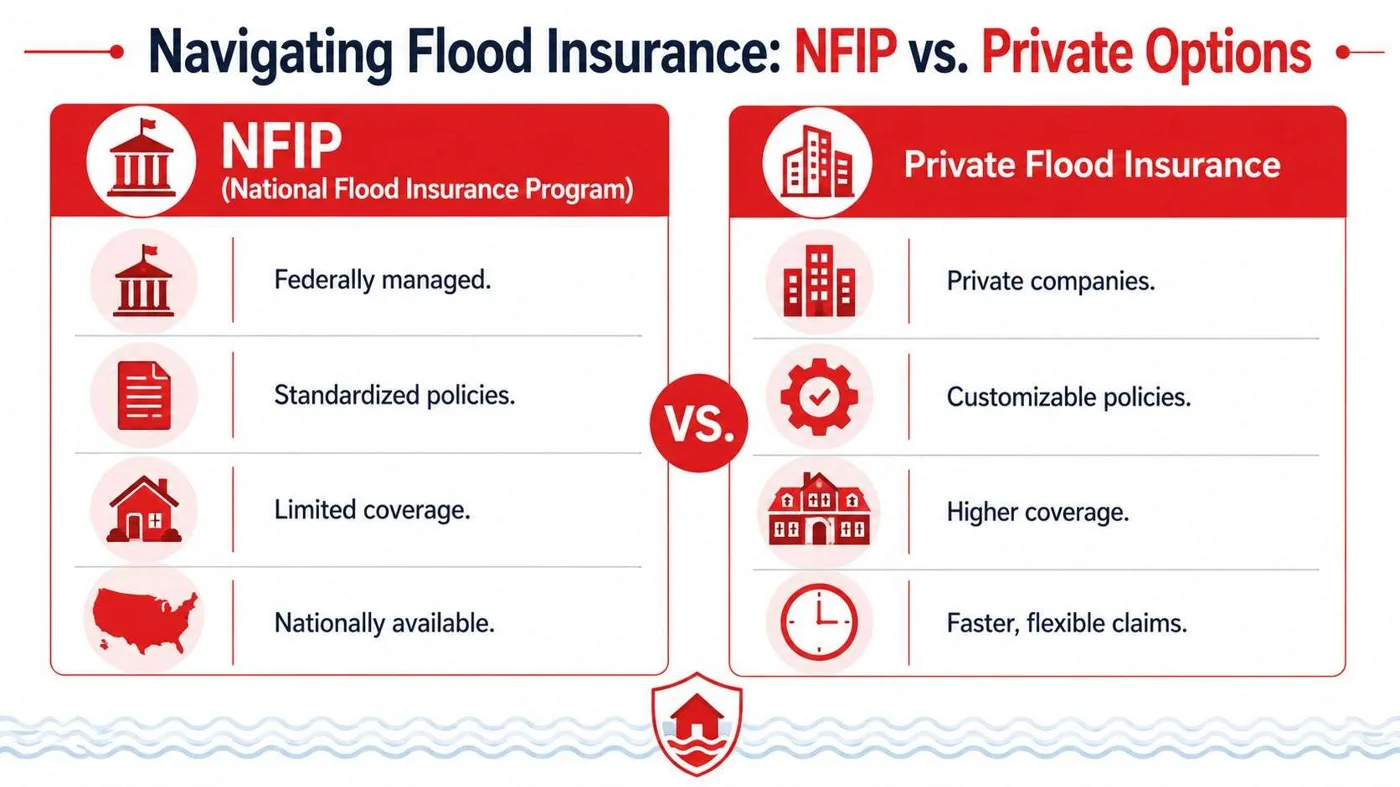
The National Flood Insurance Program is often the starting point because lenders recognize it and the policy form is standardized. That matters for buyers closing on a home in a Special Flood Hazard Area, or for owners who want a familiar structure without a lot of policy variation from one carrier to another.
For residential property, NFIP coverage is capped at $250,000 for the building and $100,000 for contents. Those limits can be enough for some homes, especially if the mortgage balance is modest and the contents exposure is limited. They can also leave a gap for higher-value homes, updated interiors, or households with expensive furnishings and equipment.
Where private flood can fit better
Private flood insurance usually enters the conversation when the NFIP limits are too low or the policy terms do not match the property well. In Florida, that is common with larger homes, homes with significant post-purchase renovations, and owners who want broader protection for contents or additional living expenses after a flood.
Private policies are not automatically better. They are more varied. That means a strong private option can be a very good fit, but the details matter more. Coverage triggers, waiting periods, deductibles, loss settlement, and exclusions should be read carefully before replacing or declining an NFIP policy.
For owners on the Treasure Coast, this guide to flood insurance for Indian River County homes and properties gives a more local view of what to review.
How to choose between them
Start with three practical questions.
| Question | NFIP may fit better when | Private may fit better when |
|---|---|---|
| How much building coverage do you need | The residential limit is enough | The home needs higher limits |
| How much contents coverage do you need | Basic contents protection is sufficient | You want more room for personal property losses |
| How much policy flexibility do you want | A standard policy structure works | The property needs more tailored terms |
There is also a Florida rule change that owners should watch closely. A regulatory shift is scheduled to take effect on January 1, 2027, under Florida Statute 627.715 and Citizens requirements. It is expected to require certain Personal Residential policyholders with wind coverage to carry separate flood insurance regardless of flood zone, with phased thresholds tied to dwelling value.
That matters because flood deductibles work like a shock absorber for your savings. A policy with the wrong limit or the wrong deductible can leave you paying far more out of pocket than you expected after a storm.
Bottom line: In Florida, flood coverage is often what stands between a water loss and a long financial recovery. Owners should compare NFIP and private options based on limits, terms, and how much risk they can realistically carry themselves.
Protecting Your Livelihood Commercial Insurance in FL
Florida businesses face the same weather reality as homeowners, but with extra pressure. A storm doesn't just damage a roof. It can shut down revenue, interrupt payroll, spoil inventory, damage tools, and create liability issues with customers or tenants.
A BOP is a base camp not the whole plan
For many small businesses, a Business Owner's Policy gives you the first layer of protection by combining core property and liability coverage. That can work well for offices, retail operations, and many service businesses. But in Florida, a BOP should be treated as the base camp, not the entire expedition.
A practical example is a business with customer foot traffic during heavy rain. One slip near an entrance can turn into a liability claim. A contractor storing tools in a yard has a different concern. A restaurant may be more focused on property damage plus the income hit that follows an extended closure.
That's why many owners compare broad package convenience with narrower standalone policies. If you want a cleaner explanation of that split, this guide on business owners policy vs general liability helps frame the decision.
Specialized businesses need specialized language
Some Florida operations need coverage that's much more specific than a general package. Mobile home parks are a clear example. Shared spaces, resident traffic, vendor access, signage, lighting, and common-area maintenance all create liability exposure that has to be handled deliberately.
In Florida, mobile home park insurance requires a minimum liability coverage of $1,000,000 per occurrence for common areas, and that threshold is explicitly enforced under the Florida Mobile Home Park Act, as noted in this Florida mobile home park insurance reference. For park owners and associations, that isn't a soft recommendation. It's a mechanical requirement.
Commercial insurance planning in Florida tends to work best when owners think in layers:
- Property protection: Buildings, contents, equipment, and storm-related physical damage.
- Liability protection: Customer injuries, third-party damage, and common-area exposure.
- Operational resilience: The ability to reopen after a shutdown, not just repair the structure.
A business that survives in Florida usually has operational discipline already. Its insurance should show the same discipline.
Attracting Talent with Florida Employee Benefits
Florida employers often treat benefits as a cost line until hiring gets harder or turnover starts disrupting operations. Then the conversation changes. Benefits become part of retention, stability, and credibility.
Benefits compete with uncertainty
Health coverage is a good example. A significant gap exists in Florida insurance content around the overlap between employer-sponsored benefits and individual ACA options. According to KFF's Florida uninsured profile, 44% of uninsured nonelderly Floridians are eligible for ACA Marketplace financial assistance, and nearly 1.3 million uninsured Floridians, about one-third of the total, are eligible for premium tax credits.
That matters because employees compare what an employer offers against what they believe they could get on their own. Small employers shouldn't ignore that comparison. They should answer it directly.
A group health plan can still win when it offers predictability, employer contribution, simpler payroll deduction, and a more stable year-round structure than workers expect from navigating coverage alone.
What works better than a bare minimum approach
The strongest Florida benefits packages usually don't rely on one headline item. They pair group health with dental, vision, and retirement planning so the employee sees a full support system rather than a single transactional offer.
That matters for everyday life, not just recruiting copy. Access to care includes behavioral health, and workers often need help understanding where to start. A practical local resource for that conversation is Find a Blue Cross psychiatrist Florida, especially for employees trying to understand mental health care through their insurance network.
A useful benefits strategy often looks like this:
- Group health as the anchor: Show employees why the employer plan may deliver steadier value than piecing things together individually.
- Dental and vision as visible wins: These benefits are easy for employees to understand and use.
- 401(k) access as a long-view tool: Retirement benefits make the job feel more permanent and more serious.
Employees don't judge benefits only by premium cost. They judge them by whether the package reduces confusion and supports real life.
In Florida, that's often the difference between an offer that gets accepted and one that gets passed over.
Why a Local Florida Agent Is Your Best Asset
Florida insurance punishes assumptions. The home policy isn't the flood policy. The cheapest deductible isn't always the safest choice. A business package can leave out the exposure that matters most. An employee benefit plan can look competitive on paper and still lose workers if it's built without local context.
Local advice beats generic advice
A local Florida agent understands that two properties in the same county can present very different underwriting questions. Roof age, flood exposure, building type, occupancy, common-area liability, and lender rules all change the recommendation.
That kind of advice is hard to replace with a call center script. Local work means knowing how a storm claim unfolds, how clients react when deductibles become real, and where policy language tends to surprise people.
The right relationship saves money and stress
Good insurance advice doesn't mean buying every possible endorsement. It means choosing the policies and limits that match the actual risk. Sometimes that means spending more. Sometimes it means not overinsuring a secondary concern while leaving a major one exposed.
The best outcome is simple. When something goes wrong, the client already knows what the policy is supposed to do.
If you own a home, condo, mobile home, vehicle, business, or employee benefit plan in Florida, local guidance isn't a luxury. It's part of the protection.
Have questions about your coverage?
Our Newberry and Micco, FL team can walk through your policy and find the right coverage at the right price.
Get a Free Quote