FL Insurance: Ultimate Guide 2026

Alt text: Florida homeowner reviewing insurance papers outside a home
Title: Florida Insurance Guide for Homeowners and Business Owners
Description: Header image for a Florida insurance survival guide covering home, auto, flood, business insurance, employee benefits, and claims strategy.
Geo-tag: Newberry, Florida
You're probably dealing with one of two situations right now. You just bought a home or started a business in Florida, and suddenly everybody is throwing around terms like flood zone, wind mitigation, deductible, named storm, and replacement cost. Or you've already had coverage for years, but your renewal made you realize you don't fully trust what you're paying for.
That's normal. Florida insurance is not a simple market, and generic advice usually fails here. If you live or work in Florida, you need coverage built around Florida risks, Florida rules, and Florida claims realities.
Understanding Your Florida Insurance Needs
Florida insurance starts with one hard truth. Coverage that might be “good enough” in another state often leaves dangerous gaps here.
A new homeowner in Gainesville, Newberry, Micco, Jonesville, or any other Florida community usually focuses on the mortgage payment first. Then the insurance quote arrives, and the questions pile up fast. What's covered by the home policy? What isn't? Why is flood separate? Why does the deductible work differently for storms? Why does your business need more than a basic liability policy?
The Florida mindset you need
In Florida, insurance isn't paperwork. It's asset protection.
That means you should review your risks in this order:
- Property risk. Can wind, water, or structural issues damage what you own?
- Liability risk. Could someone hold you responsible for injury or property damage?
- Income risk. If your home becomes unlivable or your business pauses, what pays the bills?
- Compliance risk. Are you meeting Florida lending and business insurance requirements?
If you skip one of those four, you're not insured well. You're just insured partially.
Practical rule: Buy coverage based on your worst realistic Florida loss, not your best-case budget.
What most people get wrong
The biggest mistake is assuming one policy handles everything. It doesn't.
A homeowners policy usually isn't a flood policy. A personal auto policy doesn't replace a real commercial auto policy if your vehicles support business operations. A cheap liability limit can disappear quickly when a serious claim hits.
That's why smart buyers take a broader view. If you want a solid starting point for cost-conscious planning, this guide on fiscally responsible insurance planning in Florida is worth reading.
Florida's Big Three Insurance Risks
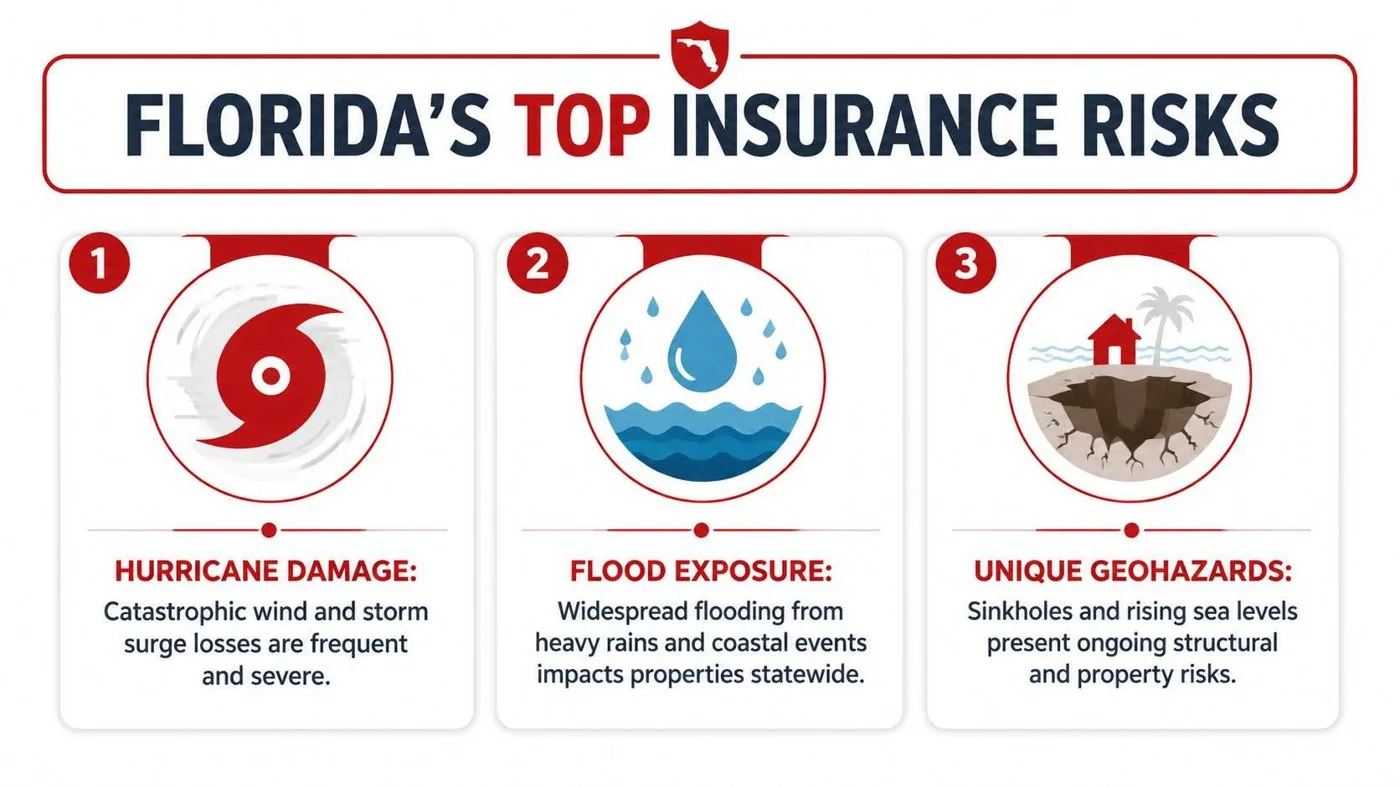
Florida's market makes sense once you understand the risks driving it. Most coverage problems come from three threats that hit property owners again and again: hurricanes, flooding, and ground-related structural issues such as sinkholes.
The mistake is treating them like the same problem. They aren't. Each one triggers different policy language, different exclusions, and different claim handling.
Hurricanes hit more than roofs
Upon hearing “hurricane risk,” one often thinks shingles. That's too narrow.
Hurricane losses in Florida can involve roof damage, broken openings, wind-driven rain, fallen trees, debris impact, detached structures, and temporary loss of use. The policy details matter because not every form handles every part of that chain the same way.
For homeowners, the key question isn't just “Do I have insurance?” It's “How does my policy respond to wind loss, and what deductible applies?” For a plain-language breakdown, read whether homeowners insurance covers hurricane damage in Florida.
Flooding is its own problem
Flood is where Florida owners make the most expensive assumption. Water coming from rising ground water, storm surge, or heavy rainfall generally requires flood coverage, not just standard homeowners insurance.
Florida carries heavy exposure here. Florida's average composite flood risk score is 23 on a 0 to 100 scale, which is 11 points higher than the U.S. county-level average of 12. FEMA's National Flood Insurance Program has recorded 32,000 claims from Florida with payouts totaling over $2.4 billion, according to Florida flood risk data.
That tells you two things. Flood isn't a fringe issue, and waiting until a storm is near is the wrong way to think about it.
Flood coverage should be treated like roof coverage in Florida. If your property can be damaged by water moving across the ground, it belongs in the core plan.
Sinkholes and geohazards are different from storm damage
Florida also deals with structural risk that has nothing to do with a named storm. Ground movement, soil conditions, and sinkhole-related concerns can create cracking, settlement, and major repair disputes.
That matters because people often assume “property damage is property damage.” It isn't. A claim involving foundation movement or suspected sinkhole activity can be evaluated very differently from a wind claim or a flood claim.
Here's the practical takeaway:
| Risk | Standard home policy may respond | Often needs separate attention |
|---|---|---|
| Hurricane wind | Often yes, subject to policy terms and deductibles | Review wind deductibles and exclusions |
| Flooding | Often no | Flood insurance |
| Sinkhole-related loss | Depends heavily on policy language | Review endorsements and structural coverage details |
If you own property in Florida, treat these as three separate insurance planning decisions.
Protecting Your Home and Auto in Florida
A Florida homeowner can do everything right, close on the house, insure the car, and still find out after a storm or major accident that the policy stack has holes. That happens all the time here. Florida is not a place for one-policy thinking. You need home, auto, flood, and liability protection that fit together and match local risk.
Homeowners coverage and the gaps that matter
Your homeowners policy is the base layer. It usually covers the house, detached structures, personal belongings, personal liability, and extra living costs after a covered loss. The problem is not what the policy promises on page one. The problem is what gets limited, excluded, or capped in the fine print.
Start with the rebuilding number. Market value and replacement cost are not the same thing in Florida. Labor costs, code upgrades, debris removal, and roofing rules can push repair costs far beyond what an owner expects.
Then review the pressure points that create bad surprises during claims:
- Dwelling coverage. Make sure the limit reflects what it would cost to rebuild the home now, under current local construction conditions.
- Liability limits. Raise them if you have savings, a pool, pets, frequent guests, or a higher-profile household risk.
- Loss of use. Check how much the policy pays if you cannot live in the home after a covered loss.
- Storm deductibles. Know the hurricane or wind deductible before storm season, not after damage happens.
- Policy exclusions and sublimits. Look closely at roof-related limits, water damage language, screened enclosures, and high-value personal property categories.
Do not buy based on premium alone. In Florida, cheap coverage often means you kept the risk and just did not realize it.
Flood insurance belongs in the plan from day one
Flood insurance should be part of the first conversation, not an afterthought after closing. A standard home policy usually does not cover flood damage caused by rising water, storm surge, or water moving across the ground.
Some Florida properties with federally backed mortgages must carry flood insurance if they sit in designated high-risk flood zones. Even if your lender does not require it, do not assume you are safe. Heavy rain, poor drainage, and neighborhood runoff cause losses far outside the highest-risk mapped areas.
The right question is simple. If water enters the home from outside and across the ground, what policy pays? If you do not know the answer, fix that now.
Auto insurance in Florida needs stronger limits than the minimum
A legal minimum policy is not a protection plan. It is a compliance document.
Florida drivers face expensive repairs, distracted drivers, uninsured drivers, weather-related crashes, and injury claims that can grow fast. If you own a home, have wages to protect, or carry real savings, low liability limits are a direct threat to your balance sheet.
Review these parts of the policy carefully:
- Bodily injury liability
- Property damage liability
- Uninsured or underinsured motorist coverage
- Collision and non-collision deductibles
- Rental reimbursement and roadside options, if losing the car would disrupt work or family logistics
Your ZIP code, driving history, vehicle type, and claim patterns matter more than what a neighbor pays. Premiums can move in very different directions from one Florida community to the next, especially in places with severe weather exposure or frequent claims.
Judge auto coverage by the claim outcome, not the monthly bill.
Mobile homes and umbrella protection
Manufactured and mobile homes need policy language built for that type of property. Setup, age, tie-downs, location, and storm exposure all affect how the risk should be insured. A generic property policy can leave major gaps.
Umbrella coverage is the piece many Florida households skip and later wish they had. If you have a teen driver, a pool, a boat, a dog, rental property, or assets worth protecting, add an umbrella. It gives you extra liability protection above the home and auto policies, and in Florida that extra layer is often the difference between an inconvenience and a financial mess.
Shielding Your Florida Business from Risk
Most Florida business owners start with revenue, payroll, and customer flow. Insurance gets pushed aside until a landlord asks for a certificate, a client wants proof of liability coverage, or a vehicle claim exposes a gap. That's backwards.
You should build business insurance around how the business operates. Where do people walk? Who uses vehicles? What equipment can stop revenue if it's damaged? Which contract requirements can block jobs if you're underinsured?
The core commercial policies
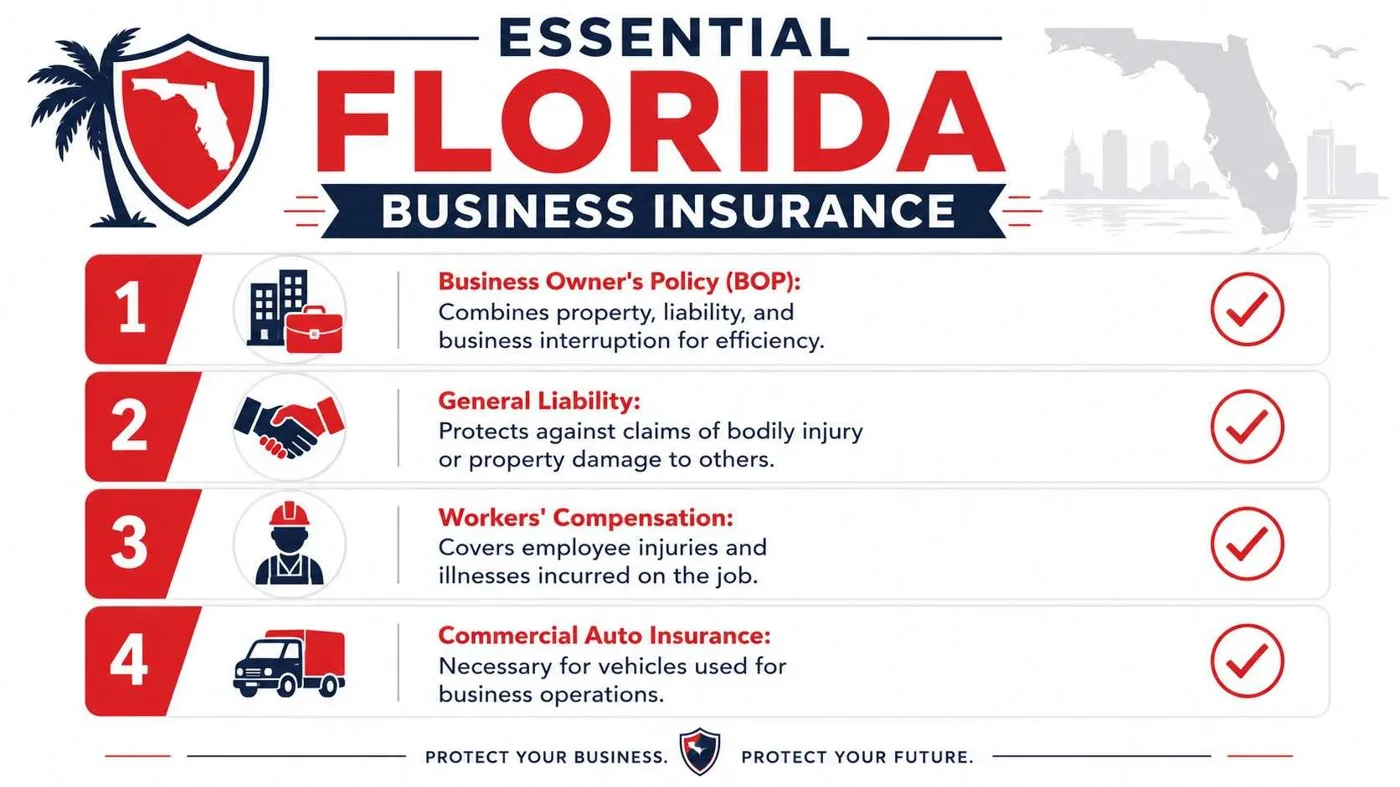
A Business Owner's Policy can be a strong starting point for many Florida businesses because it bundles major protections in a cleaner package. It often works well for businesses that need property and liability coverage together.
Beyond that, many companies also need focused protection for the way they operate:
- General liability for third-party bodily injury and property damage claims
- Commercial property for buildings, contents, tools, furniture, and equipment
- Business interruption support when a covered loss disrupts operations
- Commercial umbrella when the base liability limits feel too thin for the actual exposure
A restaurant, contractor, fitness business, veterinary practice, and mobile home park won't share the same risk profile. They shouldn't share the same insurance design either.
Commercial auto is not optional when the rules say it applies
Florida business owners often miss this because they assume personal vehicle insurance covers occasional business use. Sometimes it doesn't, and state requirements can make the issue much more urgent.
In Florida, construction businesses must carry Commercial Auto Insurance starting with just one employee, including owners, while non-construction businesses need it at four or more employees, based on Florida business insurance requirements.
That's not a technicality. It's a compliance and risk management issue.
A simple way to audit your business exposure
Use this quick review:
| Business question | Why it matters |
|---|---|
| Do customers or vendors visit your location? | Liability claims can start with one slip, trip, or property damage incident |
| Do you depend on equipment or stock? | Property loss can shut down revenue |
| Do employees drive for work? | Vehicle exposure changes your insurance needs fast |
| Would a large lawsuit threaten the company? | You may need higher liability limits or umbrella coverage |
If a single accident could force you to use business cash to cover the gap, your insurance structure is too thin.
Attracting Talent with Employee Benefits
Insurance for Florida employers isn't just about protecting buildings and vehicles. It's also about building a workplace people want to join and stay with.
A weak benefits package makes hiring harder. It also makes retention more expensive, because replacing people is disruptive even when the spreadsheets don't show the full cost.
Benefits shape how employees judge your business
Employees don't see benefits as a bonus anymore. They see them as part of compensation.
That means employers should think in terms of value, not just cost. A package that includes health-related coverage and retirement support tells candidates you're running a serious operation. It also gives current employees fewer reasons to look elsewhere.
The basics most Florida employers consider include:
- Group health coverage for medical protection and plan stability
- Dental benefits for routine and preventive care
- Vision benefits for everyday access needs
- 401(k) plans to support long-term financial planning
Cheap benefits can cost more than they save
A bare-bones plan may look efficient on paper, but it can hurt recruitment. Florida employers compete for dependable people in every region and every industry. If your offer feels thin, strong candidates often keep moving.
That doesn't mean you need the richest package in town. It means the package has to feel credible, usable, and aligned with your workforce.
A practical place to start is reviewing employee benefits options for Florida employers and then narrowing choices based on workforce size, hiring goals, and budget discipline.
Employees notice when benefits are built thoughtfully. They also notice when an employer picked the cheapest option and called it a strategy.
Smart Strategies to Lower Premiums and Handle Claims
A Florida claim rarely shows up on a calm day. It usually hits after a storm, a pipe break, a theft, or a crash, when you are already juggling repairs, contractors, and missed work. That is why premium strategy and claims strategy belong together. If your policy is cheap for the wrong reasons, you find out at the worst possible time.
Lower premiums by fixing the rating issues you can control
Start with the parts of your risk profile an underwriter can reward.
Document roof age, plumbing and electrical updates, opening protection, alarm systems, and any steps that reduce water or wind damage. If the carrier does not have that information, you do not get credit for it. Florida pricing is heavily tied to property condition and storm exposure, so stale application details can cost you every renewal.
Bundling can help, but only if the coverage stays strong and the carrier fits the risk. A small discount is not worth taking a weaker policy form, a higher hurricane deductible, or poor claims handling. Compare the total package, not just the premium.
Pick deductibles on purpose. A higher deductible can cut premium, but it only works if you can comfortably pay that amount after a loss. In Florida, that question matters even more for wind and hurricane claims, where deductibles can be much larger than owners expect.
If flood insurance may affect your budget or closing decision, confirm that early. As noted earlier, some properties will face flood insurance requirements based on location and loan terms. Do not wait until underwriting or closing to find that out.
Handle a claim in the right order
Bad claims usually get worse because the first few decisions were sloppy.
Follow this order:
- Protect people first. Leave unsafe conditions alone and get everyone out if there is fire, structural damage, live wires, or contaminated water.
- Document before cleanup. Take clear photos and video of every damaged area, damaged contents, and the source of the loss if you can do it safely.
- Stop additional damage. Tarp the roof, shut off water, board openings, or move property out of harm's way. Keep receipts for anything you buy.
- Report the loss quickly. Late reporting creates avoidable disputes about when damage happened and how severe it was.
- Track everything. Save emails, adjuster notes, contractor estimates, invoices, hotel bills, and a written timeline of what happened.
Short version. Act fast, but do not act blindly.
Know how your policy will value the loss
A lot of Florida claim disputes come down to one question: how will the policy pay?
Some property is settled at replacement cost. Some is settled at actual cash value first, with depreciation held back until repairs are finished. If you do not know which method applies, you cannot budget correctly for the gap between the damage and the first check. Review understanding ACV and replacement cost before you have a live claim on your hands.
The smartest move is simple. Review your deductibles, valuation method, exclusions, and post-loss duties before storm season and before renewal. In Florida, that review saves money two ways. It cuts waste in the premium, and it cuts mistakes when a claim hits.
Why a Local Independent Agent Matters in Florida
Florida buyers have choices. You can buy from a single-company representative, buy direct, or work with an independent agent. In a simple market, that choice might not matter much. In Florida, it matters a lot.
A single-company setup can only offer what that company writes. Direct buying puts most of the burden on you to interpret policy language and compare coverage details accurately. An independent agent gives you something more useful in a market like this: options and context.
Local knowledge changes better decisions
Florida risks aren't theoretical. Flood zone questions, storm deductibles, property type issues, business vehicle exposure, and claims preparedness all need local judgment.
That's especially true when statewide headlines hide local differences. A broad market trend may say one thing while your ZIP code, property type, or business class says something else. Buyers in places like Micco and Newberry already know that renewal reality can feel very different from the headlines.
Florida-only service has value
There's real value in working with an agency that stays focused on Florida. Schneider & Associates Insurance Agencies operates only in Florida, with offices at 7960 U.S. 1, Ste 2, Micco, Florida 32976 and 285 NW 138th Terrace, Suite 100, Newberry, FL 32669, as shown on their Florida agency location listing.
That narrow geographic focus isn't a limitation. It's the point. Florida demands specialized attention.
If you want to reach them, the agency's primary phone number is (352) 333-3775, with customer service at csr@saiains.com and commercial inquiries at commercial@saiains.com, listed on their Newberry agency contact page.
The right local advisor helps you avoid underinsuring the big stuff, overpaying for the wrong stuff, and finding out too late that your policy didn't fit your real Florida exposure.
Have questions about your coverage?
Our Newberry and Micco, FL team can walk through your policy and find the right coverage at the right price.
Get a Free Quote