Your FL Insurance Guide: Home, Auto, and Business

Title: Florida Insurance Guide for New Residents
Description: Practical guidance on Florida home, auto, business, and mobile home insurance, with special attention to flood risk, disclosure gaps, and local coverage decisions.
Geo-tag: Gainesville, Florida
You've probably had this moment already. You found a place you like in Florida, got a quote on insurance, and the number made you stop and reread the page.
That reaction is normal. Florida insurance is different from what many people knew in other states, and the surprise usually isn't just the premium. It's the fine print around wind, flood, deductibles, lender requirements, and what a seller may never have told you about the property.
In this guide, FL means Florida, and in insurance, that matters a lot. A Florida policy isn't just a routine purchase. It's a risk decision tied to storms, water, construction details, local underwriting, and state-specific rules that can affect what you pay and what gets covered when something goes wrong.
What FL Really Means for Your Insurance Bill
Florida has a way of making insurance personal fast. A new resident often starts with one simple question, “What do I need?” The better question is, “What risk am I taking on that I can't see yet?”
One of the least discussed issues is flood history. Florida is one of 21 states with no legal requirement for a seller to disclose whether a property is in a flood zone, has flooded before, or requires flood insurance, according to this Florida flood disclosure discussion. That means a buyer can get deep into a transaction before learning the extent of water exposure.
What buyers should verify before they shop insurance
Start outside the seller conversation. Don't assume the listing, the disclosure packet, or casual neighborhood comments tell the full story.
- Check flood exposure independently: Look at official flood mapping, prior claims context if available, and lender requirements before you bind a policy.
- Ask how water losses are treated: Standard home insurance and flood insurance are separate issues in Florida. If you need practical help with Florida water damage insurance, it helps to review how different types of water damage may be handled before you assume a loss would be covered.
- Review the whole budget, not just the home premium: Wind, flood, and deductibles can change the actual cost of owning the property.
Practical rule: If a Florida home sits near water, in a low area, or in a neighborhood with visible drainage challenges, verify the flood story yourself before you compare premiums.
A lot of new residents make the same mistake. They shop price first and property risk second. In Florida, that order usually backfires because the property itself drives the insurance outcome.
Why planning matters more in Florida
The best approach is to evaluate the house and the policy together. If you only compare premiums, you can miss the part that matters most: whether the property is even a good long-term insurance fit.
That's why a planning mindset helps. A coverage review tied to ownership costs, deductibles, and long-term affordability is far more useful than treating insurance as a last-minute closing item. A good place to think through that bigger picture is fiscally responsible insurance planning in Florida.
Floridas Key Risks and How They Shape Insurance
Florida's insurance market is built around physical risk. The two biggest forces are wind and flood. If you understand those, a lot of Florida underwriting starts to make sense.
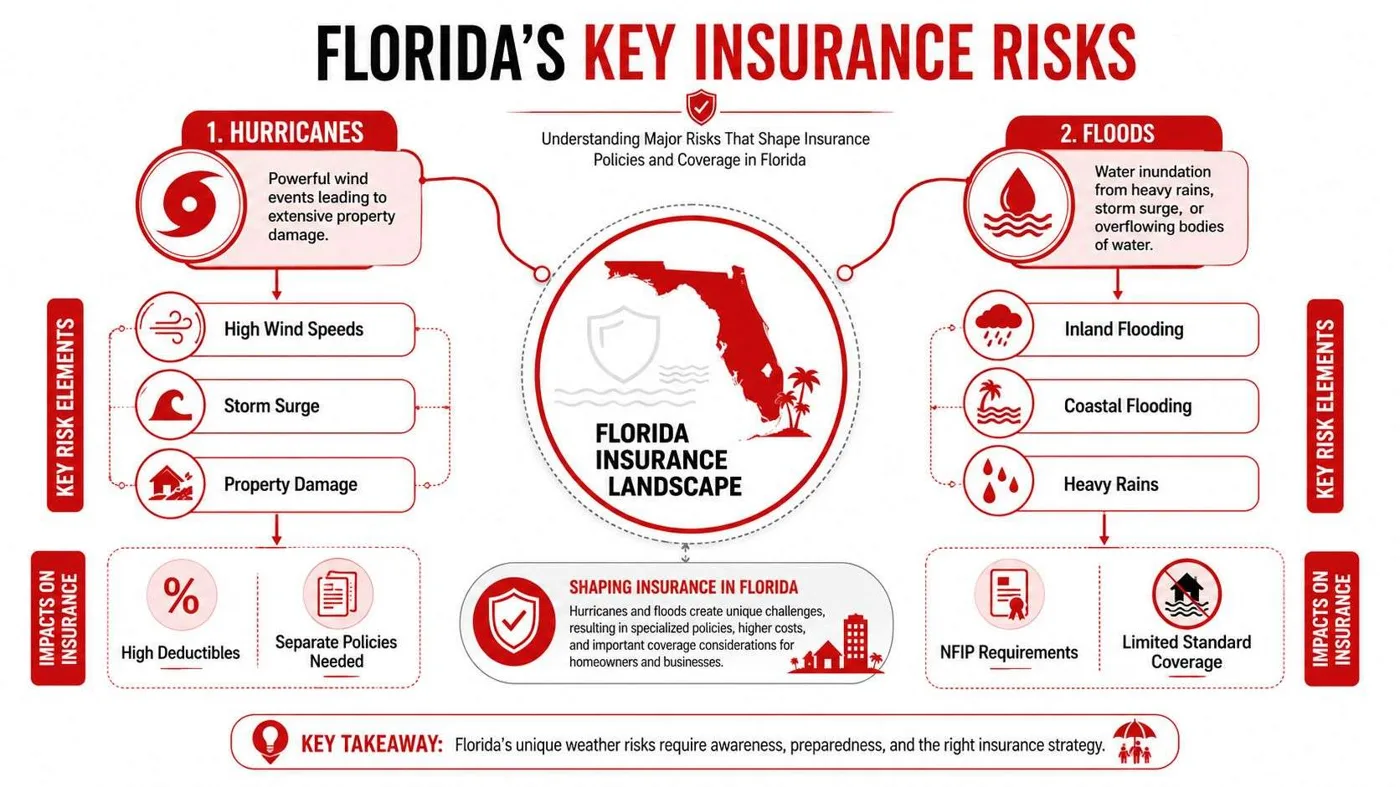
Wind is a pricing driver, not a side detail
Florida's residential property insurance market saw a 28% increase in average base rates between 2022 and 2023, and in high-risk coastal counties, windstorm coverage accounted for over 60% of the average premium, according to Florida property insurance market data. That tells you something important. Wind isn't just one line item inside the policy. It often drives the policy.
For homeowners, that affects underwriting, roof questions, opening protection, and how carriers view older structures. For business owners, it influences building coverage decisions, contingency planning, and whether standard policy structure is enough.
Flood risk is broader than many buyers think
Flood isn't only a beachfront problem. Florida's average composite flood risk score is 23 on a 0 to 100 scale, which is 11 points above the U.S. county-level average of 12. The same analysis shows 32,000 recorded NFIP claims and combined payouts exceeding $2.43 billion, with 61 of the state's 68 counties having at least one claim, according to Florida flood risk data.
That pattern matters because it shows flood exposure isn't rare or isolated. It's widespread, but uneven. Some neighborhoods face much heavier risk than others, and broad assumptions about a city or ZIP code won't protect you.
Flood losses in Florida often show up where buyers least expect them. Near rivers, low-lying inland areas, and neighborhoods with poor drainage, not just along the coast.
What Special Flood Hazard Area means in real life
FEMA defines the Special Flood Hazard Area as a place with a 1% annual chance or greater of flooding, which equals a 26% probability over a 30-year mortgage in FEMA flood map guidance. If a federally backed loan is involved, that designation can trigger mandatory flood insurance.
Here's where many residents get caught off guard:
| Issue | What it means for you |
|---|---|
| Flood zone designation | It can affect lender requirements and ongoing insurance cost. |
| Localized risk | Two homes in the same city can have very different underwriting outcomes. |
| Mapping and valuation | Buyers, lenders, and insurers all look at flood exposure differently. |
Citizens customers need to pay special attention. Florida flood insurance mandate timing for Citizens policyholders has rolled out in phases. Homes valued over $500,000 were required to carry flood insurance by January 2025. The threshold drops to $400,000 in January 2026. By January 1, 2027, all Citizens-insured homes will be included regardless of value.
Securing Your Florida Home
For most households, home insurance is where Florida hits hardest. Florida is the most expensive U.S. state for home insurance, with an average annual rate of $6,060 for $300,000 in dwelling coverage and a $1,000 deductible, according to Insurify's Florida homeowners and flood cost data.
That number gets attention, but the bigger issue is what sits behind it. In Florida, you're not just buying a policy. You're buying a structure of protections, exclusions, separate deductibles, and sometimes separate policies.
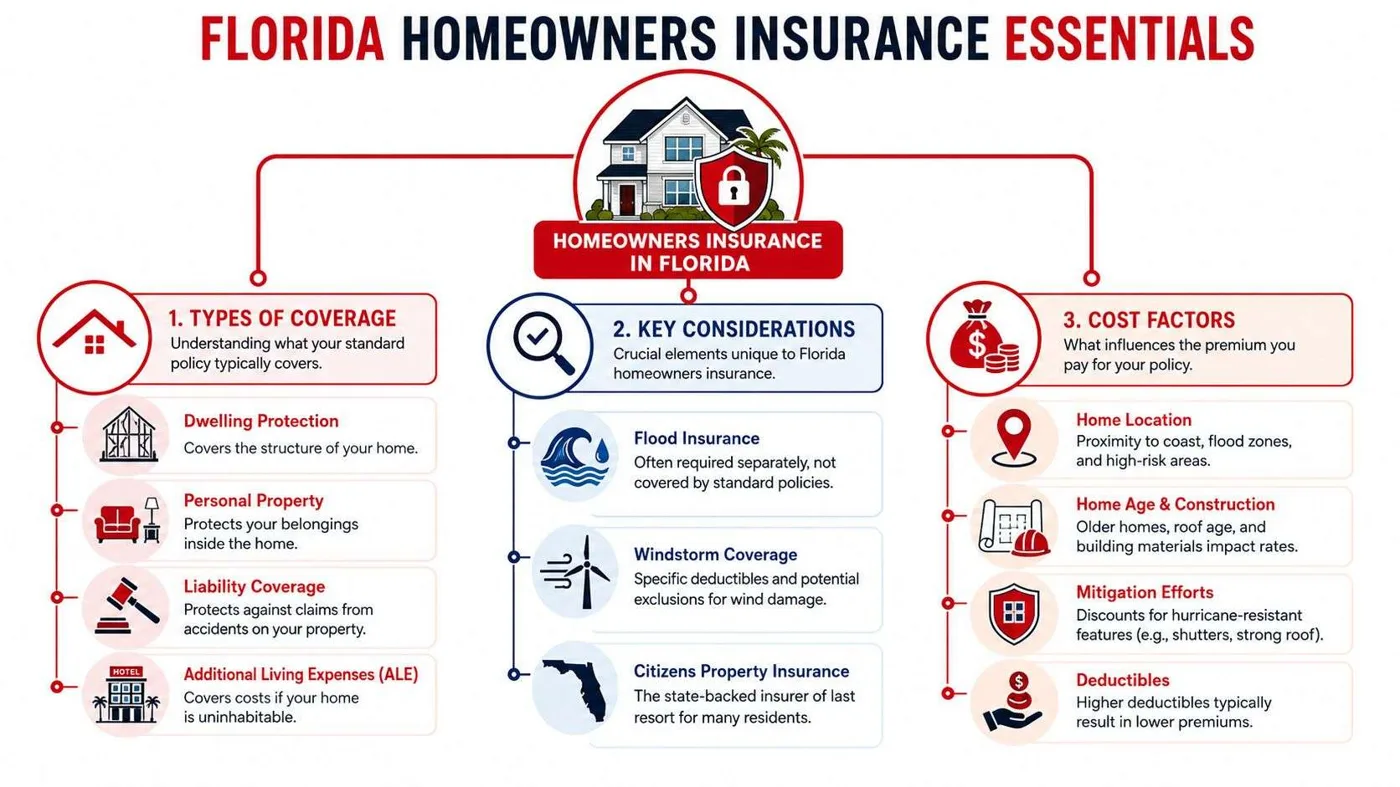
Read the quote in layers
A cheap-looking quote can be expensive once you understand what it leaves exposed. Start with the basics, then drill down.
- Dwelling and personal property
Make sure the structure limit makes sense for the home you own, not just for a target premium. Then look at personal property and loss-of-use terms so you know how the policy responds after a serious loss.
- Wind and hurricane deductible
Many Florida buyers focus on the annual premium and ignore the deductible structure. That's a mistake. If a wind claim happens, your out-of-pocket responsibility may look very different from what you expected.
- Flood treatment
Standard homeowners coverage doesn't do the same job as flood insurance. If the property has any realistic water exposure, ask directly what is and isn't handled under the home policy.
What usually helps and what usually doesn't
Some cost-saving moves work well in Florida. Others only create false confidence.
- Helpful: A current roof, strong opening protection, and documented mitigation features can improve insurability.
- Helpful: Choosing a deductible you can absorb can lower premium pressure while keeping the policy useful.
- Less helpful: Shopping only by price without reviewing endorsements, exclusions, and deductibles.
- Less helpful: Assuming a prior owner's insurance situation will translate to your own.
Field advice: In Florida, the best home quote isn't the lowest number. It's the one you still understand and can still afford after a storm claim.
Questions worth asking before you bind coverage
Use a short checklist when you review a homeowners quote:
| Question | Why it matters |
|---|---|
| How is wind covered? | Wind drives many Florida losses and often changes deductible exposure. |
| Is flood separate? | It usually is, and that affects total ownership cost. |
| What property details affect underwriting? | Roof age, construction, and location can shape both price and eligibility. |
| What discounts require documentation? | Mitigation savings often depend on current proof. |
If you're buying in Florida for the first time, don't rush the home quote at the end of the transaction. It needs the same attention as the inspection report and the loan terms.
Navigating Florida Roads with the Right Auto Insurance
Florida auto insurance confuses a lot of new residents because the legal minimums can make a driver feel protected when they're still carrying major financial risk.
Florida requires $10,000 in Personal Injury Protection and $10,000 in Property Damage Liability, but the state does not require bodily injury liability coverage unless a driver has a DUI conviction or certain traffic violations, according to Florida minimum auto insurance requirements.
What that means in practice
PIP is tied to Florida's no-fault structure. PDL addresses damage you cause to someone else's property. The gap is bodily injury liability. If you injure someone and don't carry that protection, your exposure can get very real very fast.
That's why state minimums shouldn't be treated as a finished plan. They're a legal starting point, not a strong protection strategy.
A better way to build the policy
Instead of asking, “What's the cheapest policy that gets my tag?” ask three questions:
- What could I afford to pay myself after an accident?
- Would I have enough liability protection if another person is injured?
- Does my vehicle value justify collision protection and coverage for non-collision incidents?
Those questions usually lead to a better policy than a minimum-limits quote.
If you own assets, drive regularly, or transport family members often, bodily injury liability deserves serious attention even when Florida law doesn't force it.
After an accident, value loss can matter too
A repaired vehicle can still lose market value after a crash. If you're sorting through post-accident options, a diminished value claim Florida calculator can help you understand that issue before you settle too quickly.
For drivers who are still learning the basics, it also helps to review Florida minimum car insurance requirements explained clearly. The key is knowing where the legal minimum ends and your real risk begins.
Protecting Your Florida Business and Employees
Florida business insurance isn't just about the building, the trucks, or the liability certificate. In this state, owners have to protect the operation from physical loss while also thinking about how benefits affect hiring and retention.
A storm can interrupt revenue. A gap in employee benefits can weaken recruiting. Those are separate issues, but in Florida they often need one plan.
Property protection has to match Florida conditions
For a small or mid-sized business, the usual starting point is commercial property coverage, general liability, and often a business owners policy if the operation fits that structure. The details matter more in Florida because a standard policy review has to account for wind vulnerability, possible flood exposure, equipment location, and how quickly the business could recover after damage.
Owners who lease space should still review insurance carefully. Landlords insure the building. Tenants insure their own business property, liability, and loss-of-income exposures. That misunderstanding causes plenty of trouble after a storm.
Benefits matter more in a state with healthcare gaps
As of 2024, Florida has not implemented the ACA's Medicaid expansion for low-income adults. As a result, nearly half of uninsured nonelderly Floridians rely on Marketplace premium tax credits, according to Florida Medicaid and coverage gap analysis.
That changes the conversation for employers. Health coverage isn't just a nice extra. In many Florida workplaces, it becomes part of whether an employee feels secure enough to stay.
Here are the practical takeaways for business owners:
- Group health can be a retention tool: Employees who don't have affordable alternatives often place real value on employer coverage.
- Dental and vision still matter: They may not carry the same weight as medical coverage, but they improve the overall offer.
- Retirement benefits support stability: A 401(k) can help a smaller employer compete for long-term talent, especially when paired with health benefits.
Build the insurance plan around people and continuity
A strong Florida business insurance strategy answers two questions at once. How do you keep operating after physical damage, and how do you keep good employees from leaving for a more stable benefits package?
Those decisions work better together than separately. If you're evaluating benefit options, this overview of employee benefits strategies for Florida employers is a practical starting point.
Specialized Coverage for Florida Lifestyles
Mobile and manufactured housing is a real part of life in Florida, and it comes with underwriting issues that many general discussions skip.
Think about a resident in Micco or Newberry who owns a mobile home in a larger community. The buyer sees an affordable housing path. The insurer sees age of unit, anchoring, wind exposure, updates, and whether the home meets current expectations for wind resistance.
Where mobile home coverage gets more technical
The challenge usually isn't one single rule. It's the combination of property condition, community requirements, and wind scrutiny.
For park operators and similar property owners, the compliance side gets even more specific. As of 2025, Florida's mobile home park insurance market requires $1,000,000 per occurrence in minimum liability coverage for parks with 10 or more units, and insurers must verify that each unit has windstorm coverage meeting the Florida Building Code's current wind-resistance standards, according to Florida mobile home park insurance requirements.
What owners and managers should do early
A smoother placement usually starts before the quote request.
- Document the unit clearly: Updates to roof, tie-downs, skirting, and openings should be easy to show.
- Verify community requirements: Park rules, lender expectations, and insurance conditions need to match.
- Ask about wind eligibility first: In Florida mobile home coverage, wind questions can decide the rest of the conversation.
Older mobile homes can still be insurable, but the path is easier when the owner has current documentation and understands the wind requirements before shopping.
For park managers, consistency matters. If one unit creates a compliance problem, it can complicate the insurance conversation for the broader property.
Partnering with a Local Agent for Your Florida Journey
Florida insurance punishes assumptions. Buyers assume a seller would have mentioned prior flooding. Drivers assume state minimum auto coverage is enough. Business owners assume the landlord's policy covers more than it does. Mobile home owners assume age alone makes coverage impossible or, just as risky, assume any quote they get must be acceptable.
That's why local guidance matters. The state's insurance issues are too specific for broad, generic advice to carry the full load.
What a Florida-focused review should catch
A good local review doesn't just pull a premium. It looks for hidden friction points before they become expensive surprises.
| Review area | Why local insight helps |
|---|---|
| Property history questions | Florida buyers often need to verify risk beyond seller disclosures. |
| Wind and flood structure | Separate deductibles and separate policies can reshape affordability. |
| Auto liability gaps | State minimums may leave families underprotected. |
| Business continuity | Physical risk and employee benefit strategy often need to be coordinated. |
| Mobile home compliance | Wind standards and community rules can affect eligibility. |
Why this matters most at claim time
Anyone can feel comfortable with a policy on a quiet day. The actual test comes after water, wind, a road accident, or a business interruption.
At that point, the value of local expertise is simple. You want someone who understands Florida claims realities, Florida underwriting habits, and the difference between a policy that looked fine at purchase and one that fits the risk.
A local Florida agent also helps residents adjust before renewal problems happen. That can mean reviewing property changes, checking whether a new lender requirement will affect flood coverage, or tightening liability limits before an accident exposes a weak spot.
Have questions about your coverage?
Our Newberry and Micco, FL team can walk through your policy and find the right coverage at the right price.
Get a Free Quote