Schneider & Associates: Your FL Insurance Partner

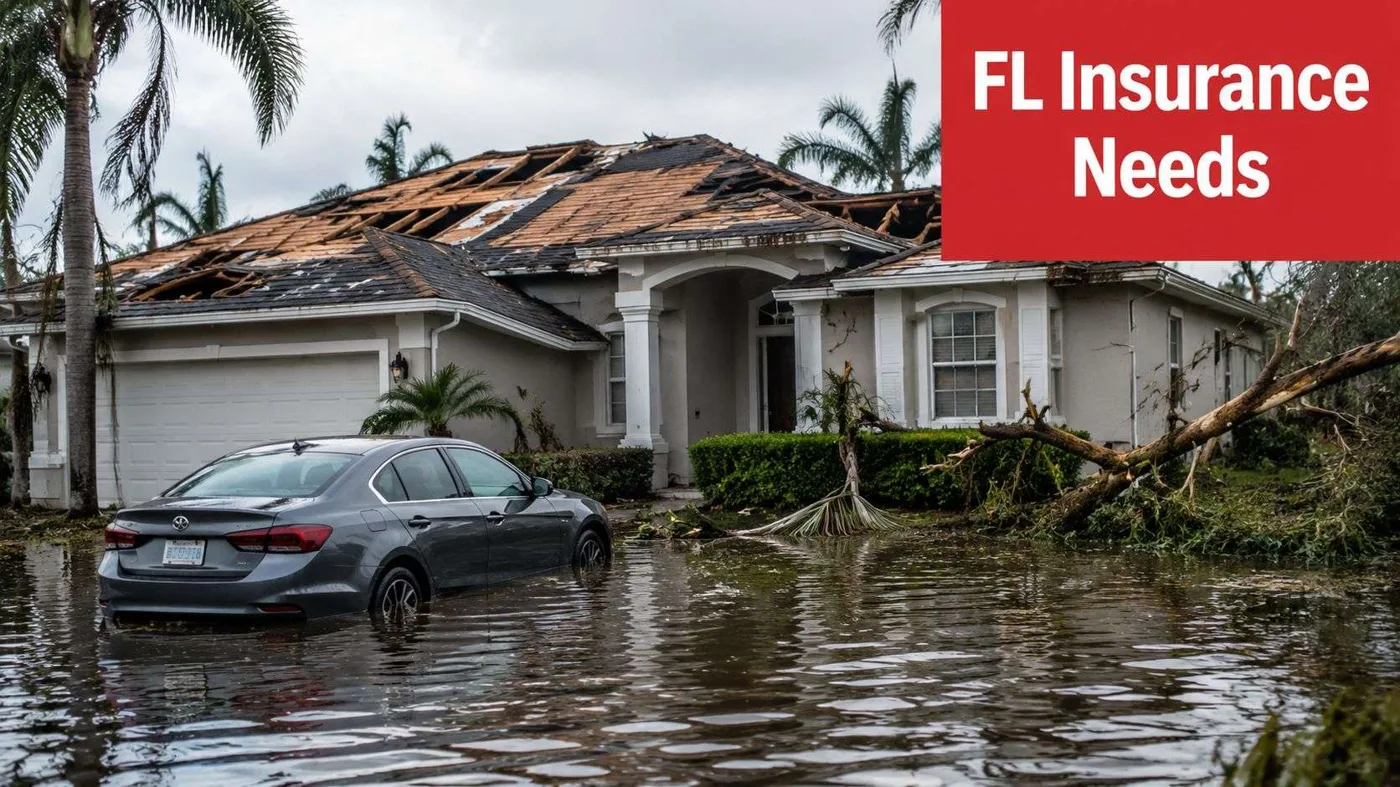
Image metadata: Title: Florida storm damage and flood loss scene. Description: A Florida home with major roof damage surrounded by floodwater, with a vehicle partly submerged after a severe storm. Geo-tag: Micco, Florida.
You wake up to the sound of dripping water, the kind that tells you the problem isn't small. Part of the roof has peeled back after a hard Florida storm. Water has pushed under the doors. Your car is sitting in standing water outside, and your phone is full of neighborhood messages asking the same question: “What does insurance cover?”
That's a very Florida moment.
People often buy insurance thinking one policy handles everything. Then a storm hits, and they learn that wind, flood, vehicle damage, condo walls-in coverage, mobile home protection, and business interruption don't all fit neatly inside one package. In Florida, small wording differences can decide whether a loss is covered, partially covered, or excluded.
The confusion starts earlier than is often thought. Sometimes it starts before a buyer even closes on a home. Sometimes it starts with auto insurance, where the state minimum sounds protective but leaves a serious gap after a bad crash. And for business owners, the misunderstanding usually shows up when they assume property coverage automatically means every kind of water damage or shutdown is insured.
This guide is built for people living real Florida life. Homeowners in rainy neighborhoods. Condo owners who aren't sure where the association policy stops. Drivers trying to make sense of no-fault rules. Mobile home owners balancing affordability and storm risk. Small business owners who need coverage that works when weather interrupts operations.
Introduction to FL Insurance Needs
Florida insurance doesn't work well when you treat it like a generic checklist. A homeowner in Gainesville may worry about wind-driven rain and roof condition. A condo owner in Micco may need to sort out what belongs to the unit policy and what belongs to the association. A driver in Newberry may carry state minimum coverage and still be exposed after one serious accident.
That's why FL insurance decisions need to match the property, the vehicle, and the way you live.
A simple example helps. Think of insurance like building a storm kit. If you only pack a flashlight, you're not ready for flooding. If you only buy flood insurance, you're not protected from every wind loss. If you only carry minimum auto coverage, you may still face out-of-pocket bills after a crash. Florida coverage works best when each piece fills a different gap.
Why one policy usually isn't enough
Most Florida households need to think in layers:
- Home or condo coverage: protects the structure you insure, your belongings, liability exposure, and temporary living costs after a covered loss.
- Auto coverage: handles vehicle damage, injuries, and the risk that another driver doesn't carry enough insurance.
- Flood coverage: usually sits outside standard home and many business policies.
- Specialized policies: mobile home, business, umbrella, or endorsements for property-specific risks.
People get tripped up when they assume “water damage” is one thing. It isn't. Water from a burst pipe, water entering from storm openings, and rising floodwater can trigger very different policy responses.
Practical rule: Don't ask, “Am I insured?” Ask, “Which policy responds to this exact kind of loss?”
Florida risk changes the buying process
Florida's weather creates fast-moving claim situations. A loss can involve the roof, interior, detached structures, a vehicle, and loss of use all at once. The right time to understand that isn't after the storm. It's before renewal, before closing on a home, and before hurricane season starts.
Good insurance planning in Florida is less about buying the cheapest option and more about avoiding blind spots. That becomes even more important when buyers don't always get clear property risk information up front.
Florida Insurance Risk and Disclosure Gaps
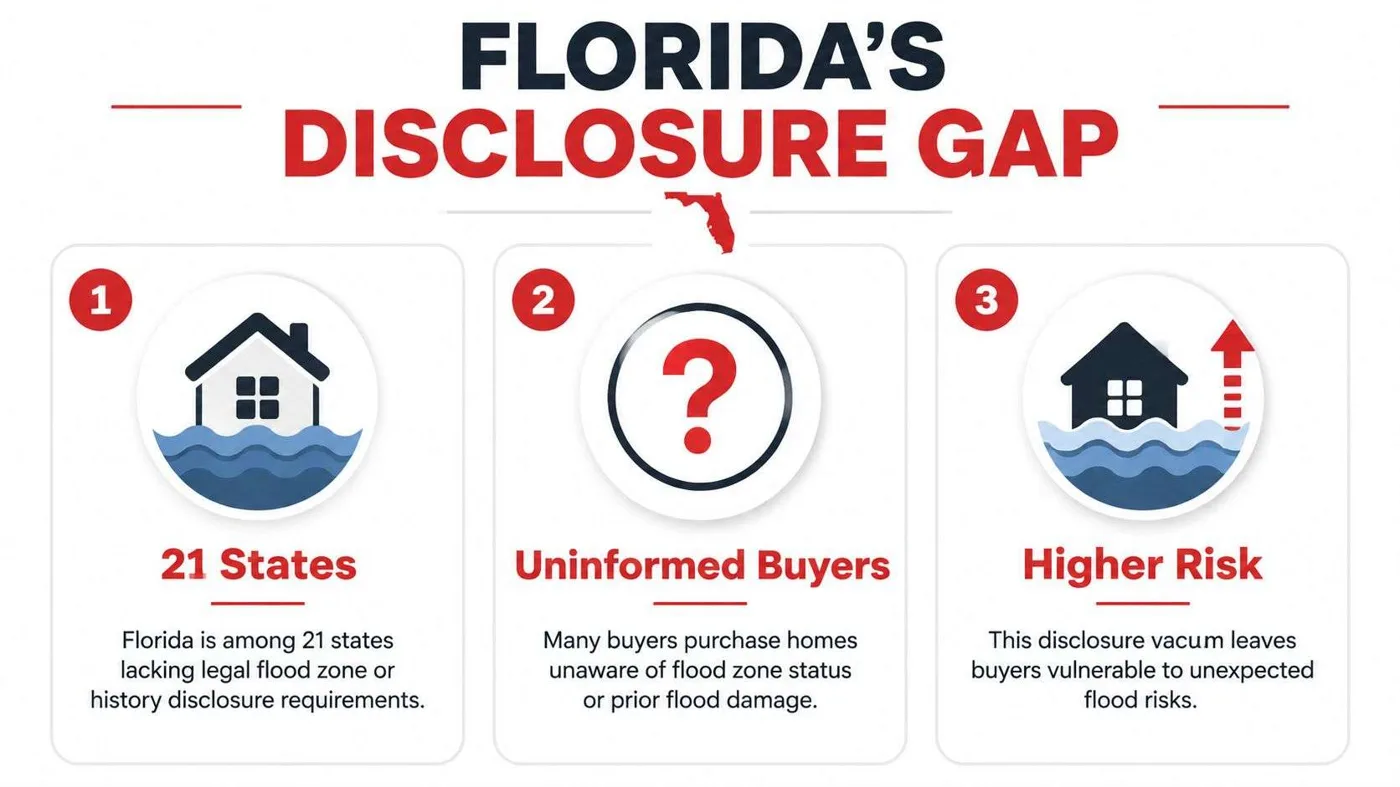
A buyer closes on a Florida home in June, sees no flood claim requirement from the lender, and assumes the property is a fairly ordinary insurance risk. Then heavy rain or storm surge exposes a gap no one explained clearly during the sale. The standard home policy may respond one way to wind-driven damage and a separate flood policy may be needed for rising water. That surprise often starts before the first premium is paid. It starts with incomplete property risk disclosure.
Florida creates a blind spot that national insurance guides often miss. The issue is not only flood exposure itself. The issue is how flood questions, auto protection choices, and business property decisions all depend on buyers and owners getting accurate risk information early enough to act on it.
Why buyers and owners get caught off guard
Many Florida buyers expect real estate disclosure to work like a full inspection checklist. In practice, flood history and water exposure are not always presented in a way that gives a family or business owner a clear picture before closing.
That matters because insurance decisions are built on the facts a buyer knows.
If those facts are incomplete, people often make three costly assumptions. They assume no lender requirement means low flood risk. They assume a prior water problem would have been obvious during the sale. They assume one property policy handles every kind of storm-related water loss. In Florida, each of those assumptions can fail.
The same pattern shows up outside home purchases. A condo buyer may focus on the association's master policy and miss what the unit owner still needs to insure. A driver may carry the minimum auto coverage and never ask how uninsured motorist coverage protects the household if another driver has too little insurance. A small business owner may insure the building contents but skip the flood review because the lease did not force the conversation.
That is the disclosure gap in plain English. People are asked to choose coverage before they have the full risk story.
What the disclosure gap means for insurance planning
Insurance works like a chain. If one link is missing, the rest of the protection can look stronger on paper than it feels after a loss.
In Florida, the weak link is often the handoff between property information and coverage selection. A buyer may know the roof age, square footage, and deductible, but still miss prior water intrusion, drainage issues, nearby flood exposure, or how the policy treats different causes of loss. Those missing details affect more than flood insurance. They can shape rebuilding expectations, temporary living costs, business interruption planning, and the amount of liability or umbrella coverage a household decides to carry.
Condo owners face a similar version of the problem. The building may be insured by the association, but the unit owner still needs to know where the association's responsibility stops and personal responsibility begins. A local example appears in this Florida condo insurance coverage guide for Micco unit owners, which shows how easily responsibility can split between the master policy and the owner's own policy.
Questions a careful Florida buyer should ask before purchase
A good review works like checking the weather, the roof, and the evacuation route before storm season. You are looking for gaps that do not show up on a simple quote screen.
| Item to check | Why it matters |
|---|---|
| Flood zone and map details | Shows whether separate flood coverage may be required or strongly recommended |
| Prior water intrusion or drainage issues | Helps uncover problems that may not appear in listing language |
| Elevation and site grading | Can affect flood exposure, mitigation steps, and pricing |
| Current insurance setup on the property | Reveals whether the prior owner relied on separate flood protection or endorsements |
| Condo or association documents, if applicable | Clarifies which part of the property the owner must insure personally |
| Business use of the property | Helps identify whether a home-based or commercial exposure needs different coverage |
One practical rule helps here. Do not ask only, “Is this property insured?” Ask, “What facts about this property could change which policy responds, what it pays for, and what stays uninsured?”
That question is how Florida families avoid buying a home, condo, vehicle, or business policy that looks adequate until the first serious claim.
Homeowners and Condo Insurance Coverage
Homeowners and condo owners often use the same phrase, “my home insurance,” but the policies work differently. A house policy usually insures the dwelling itself. A condo policy usually insures the parts of the unit that belong to the owner, along with contents, liability, and related coverage.
That distinction matters because two people in the same building can have very different responsibilities after a loss.
How home and condo coverage split responsibility
A standard homeowners policy is often easier to picture. It typically wraps several protections together: the home structure, personal property, personal liability, and extra living expenses after a covered claim.
A condo policy works more like insuring the inside of a shell. The association may insure common areas and parts of the building envelope, while the unit owner may need protection for interior finishes, belongings, liability, and temporary housing. If you want a Florida-specific example of how unit coverage can be structured, this condo insurance in Micco guide is a useful reference point.
Think of it this way. A homeowners policy often protects the house from the outside in. A condo policy often protects the unit from the inside out.
What Florida owners should inspect closely
Florida owners should read beyond the declarations page and focus on the moving parts.
- Dwelling or building coverage: For homeowners, this is the core structure limit. For condo owners, the question is what interior elements are your responsibility under the association documents.
- Personal property: This covers belongings, but the value needs to match what you own, not a guess you made years ago.
- Liability coverage: If someone gets hurt on your property or you accidentally cause damage to others, this part may respond.
- Loss of use: If a covered claim makes the property unlivable, this may help with temporary living costs.
Perils, exclusions, and the Florida trap
Policy wording can feel abstract until you put it into plain language. Some protections are broader, some are narrower, and every policy still contains exclusions. That's why people get caught by flood assumptions.
An easy analogy is an umbrella. If the fabric covers many risks but has a hole labeled “flood,” water still gets through that hole no matter how wide the rest of the umbrella is.
Florida owners should also ask how the policy handles wind-related issues, whether special deductibles apply during hurricane events, and how mold-related damage is treated when moisture follows a covered loss. Those details are where many post-storm disputes begin.
A policy can be strong overall and still leave one expensive Florida exposure uncovered.
A quick annual review helps. Check roof updates, renovations, older plumbing, association responsibilities, and changes in personal property. Coverage should follow the property you have now, not the version you insured years ago.
Auto Insurance and Uninsured Motorist Protection
A Florida driver can do everything right, stop at a red light, carry the state minimum, and still end up with bills that the policy does not fully cover. That surprise usually starts with a disclosure gap. The policy meets the legal requirement, but the driver was never really shown how small that requirement is once injuries enter the picture.
Auto coverage in Florida works best when you separate two questions. First, what does the state require? Second, what protects your household if the other driver has little insurance or none at all?
Why Florida's minimum can create a false sense of security
Florida drivers often hear that the state is a no-fault system and assume their own policy will take care of the injury side of a crash. It does address the first layer through PIP and property damage requirements, but that first layer is limited. A bad wreck can burn through it fast.
If you want the baseline in plain English, this guide to Florida minimum car insurance requirements shows what the law requires. That legal floor is a starting point, not a full injury plan.
A simple way to picture it is a sandbag line before a storm. It may hold back shallow water. It does not protect the whole house if the surge rises higher.
What Uninsured Motorist coverage actually does
Uninsured Motorist coverage, or UM, helps pay for injury-related losses when the at-fault driver does not have enough insurance to cover the harm they caused. In Florida, that matters more than many drivers realize because the state minimum rules do not automatically give you strong bodily injury protection from the other person's policy.
This is one of Florida's quieter insurance disclosure problems. National articles often explain UM as an optional add-on, but Florida households need to view it in the context of local realities. Flood leaves gaps in property protection. UM leaves gaps in auto injury protection. Business policies can leave income or liability gaps if they are not designed for how the company operates in practice. The pattern is the same. The coverage form looks fine at a glance, but the costly hole appears after the claim.
Where UM changes the outcome
The clearest test is a real-life scenario. A driver in Tampa is hit on I-275 by someone who carries little coverage. The car damage is only part of the problem. The larger cost may be surgery, rehab, missed work, or long-term pain.
Without UM, the household may be left trying to cover expenses that go far beyond the policy's first layer.
With UM, the policy can step in where the at-fault driver's insurance falls short.
Here is the difference in practical terms:
| Situation | What coverage gap often appears |
|---|---|
| Minor crash with short-term injuries | PIP may handle some immediate costs, but follow-up expenses still need review |
| Serious crash caused by a driver with little or no insurance | Injury costs and lost income can outgrow the basic protection quickly |
| Policy includes meaningful UM limits | The policy can help pay injury-related losses the other driver cannot cover |
What Florida drivers should review now
Vehicle deductibles get a lot of attention because they are easy to compare. Injury exposure deserves equal or greater attention. Replacing a bumper is frustrating. Replacing months of income is much harder.
A strong policy review should look at:
- UM limits
- Bodily injury coverage choices
- Who regularly drives the vehicle
- Teen drivers or other household members
- Commute length and highway driving
- Whether your current limits fit your savings, income, and risk tolerance
The goal is simple. Make sure your auto policy matches the financial reality of a serious Florida accident, not just the minimum needed to register a car.
Business and Mobile Home Insurance Options
Business insurance and mobile home insurance can sound unrelated, but in Florida they share a common challenge. Both have to deal with property exposure, liability exposure, and weather-related disruptions that don't fit neatly into one-size-fits-all forms.
The right solution depends on what you own, how you use it, and what would happen if operations stop.
How a business policy differs from a mobile home policy
A Business Owners Policy, often called a BOP, typically combines core business property and liability protection into one package. It may fit a small office, retail operation, or service business that needs a straightforward structure. Depending on the business, owners may also need add-ons for equipment, professional exposure, or income loss after a covered event.
A mobile home policy is built around a different set of concerns. The home itself, attached structures, personal property, liability, and storm-specific vulnerabilities all need attention. Mobile homes often require closer review of physical details that affect how the risk is insured.
Here's a side-by-side view:
| Coverage type | Best fit | Common focus |
|---|---|---|
| Business Owners Policy | Small to midsized Florida businesses | Building or tenant improvements, contents, liability, interruption of operations |
| Mobile home policy | Owners of Florida mobile homes | Structure, personal property, liability, storm-related protections, attached features |
Coverage gaps owners often miss
For businesses, the most common problem is assuming property insurance means every shutdown is covered. It doesn't. The trigger usually depends on the cause of loss and the policy wording. If weather interrupts operations, owners need to know whether the event was covered and whether income-related protection applies.
For mobile home owners, the issue is often the opposite. They may focus on price first and miss important structural details that affect claims. Tie-downs, attached rooms, skirting, and site-specific exposure can all shape how well the policy matches the home.
A few smart review questions help:
- For businesses: What property is essential to daily operations, and what happens if it's unusable after a covered loss?
- For mobile homes: Does the policy reflect the actual setup of the home and any attached structures?
- For both: Which weather-related events are covered, and which require separate protection or endorsements?
The strongest approach is practical, not generic. Business owners should map coverage to operations. Mobile home owners should map coverage to the actual structure and site conditions. In Florida, that kind of specificity matters more than broad promises.
Essential Flood Insurance Steps
A Florida family closes on a home a few blocks inland, sees no lender flood requirement, and assumes the hard part is over. Then a heavy rain event pushes water across the lot, into the structure, and into a claim conversation they were never prepared to have. That gap between what owners assume and what the policy says is one of Florida's biggest insurance disclosure problems.
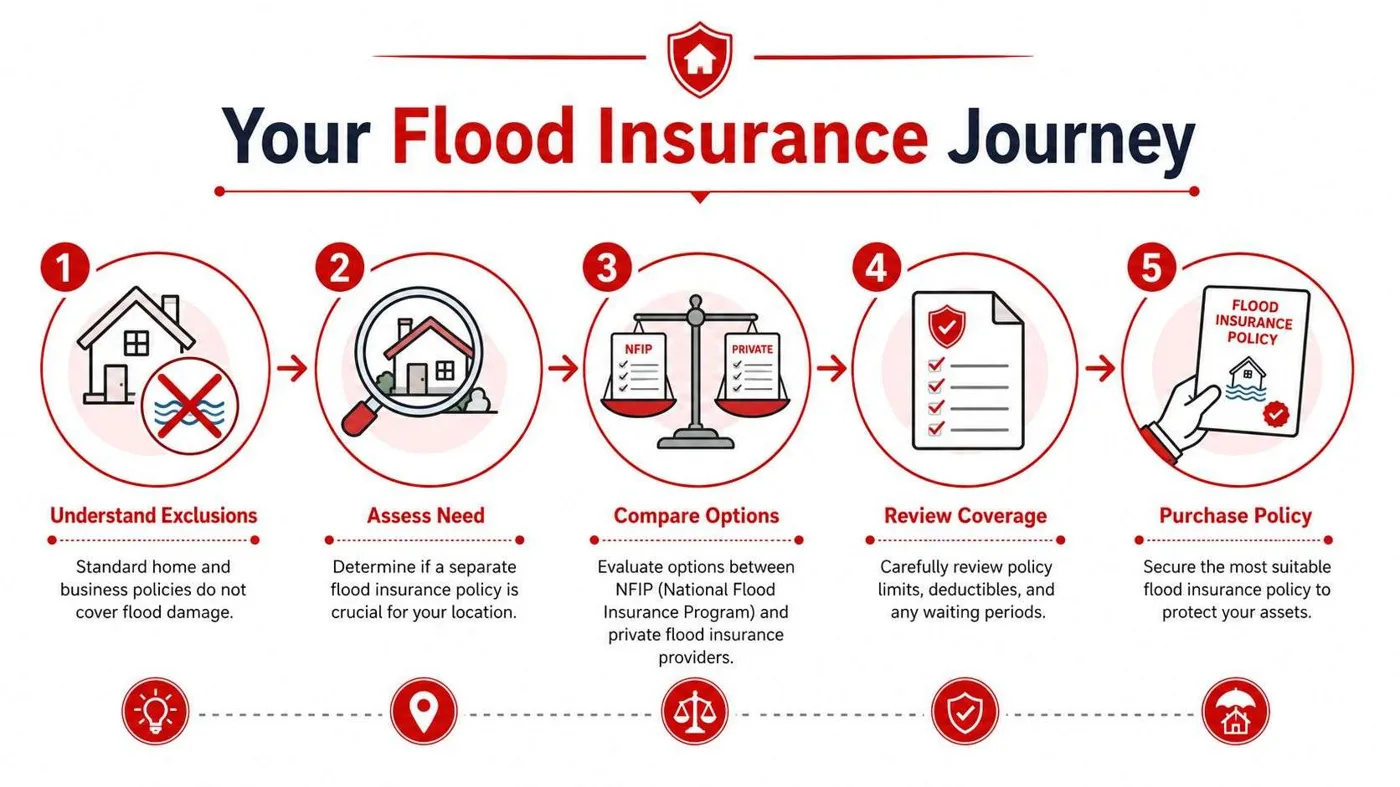
Flood insurance starts with one plain fact. Standard homeowners coverage, condo unit coverage, and many commercial property policies usually do not cover flood damage caused by rising water. If that exclusion is not discussed early, people compare premiums before they understand the risk they are pricing.
That matters in Florida because flood exposure is not limited to one coastline, one flood zone, or one property type. As noted earlier, statewide flood risk and past claim activity show a pattern many national guides gloss over. Flood can affect a primary home, a condo unit, a seasonal property, a storefront, or a mobile home park lot in different ways. The common thread is disclosure. Owners are often told whether flood insurance is required, but not whether it is wise.
Start with the loss scenario
A better first question is not “What does flood insurance cost?” Ask this instead. “If water rises from outside the building and enters the property, what policy would respond?”
That question clears up confusion fast. It separates flood from plumbing leaks, roof leaks, and other water losses that may be handled under different rules. It also helps Florida drivers, homeowners, and business owners see a pattern across coverages. Just as uninsured motorist coverage fills a gap after a crash with an underinsured driver, flood insurance fills a gap left open by standard property policies.
Flood zones matter, but they are only one part of the picture. Lower-risk map areas can still flood. Elevation, drainage, nearby water flow, lot grading, building design, and past local loss patterns can all affect the actual exposure. In Florida, relying only on a lender's requirement works like judging hurricane risk by whether the sky is clear this morning. It is too narrow for the decision you are making.
A practical buying checklist
Use a step-by-step review before storm season and before a closing, renewal, or property purchase.
- Confirm the flood exclusion in your current policy. Read the policy or ask your agent to point to the exact wording. Do not rely on assumptions or a summary from memory.
- Identify how the property sits. Flood zone, elevation details, prior water intrusion, and the building's location on the lot all help shape the conversation.
- Review which flood policy options fit the property type. A single-family home, condo unit, rental property, mobile home, and commercial location may each need a different setup. Local examples in this guide to flood insurance for Indian River County show the kind of details that often change the recommendation.
- Check limits, deductibles, and waiting periods carefully. Coverage amounts can look adequate at a glance and still leave a large out-of-pocket gap after a loss.
- Match the policy to how the property is used. Owner-occupied, seasonal, tenant-occupied, and business use can change what should be reviewed.
One more point causes trouble in Florida. A lender's flood rule is not the same thing as a personal risk review. The bank is protecting its loan. You are protecting your property, your cash flow, and your recovery after a loss.
What Florida owners often misunderstand
Many Florida owners wait until a storm is already on the radar. That approach creates rushed decisions, fewer choices, and more confusion about waiting periods and effective dates.
Another common mistake is treating flood insurance as a home-only issue. Condo owners may assume the association's policy solves everything. Business owners may assume property insurance automatically includes flood-related shutdowns. Mobile home owners may focus on the structure and miss how site conditions affect exposure. These are different versions of the same Florida disclosure gap. The risk is present, but the explanation often stops too soon.
The better approach is calm and specific. Review the exclusion. Review the property. Review the policy structure. In Florida, that sequence helps people make smarter decisions before the water rises, not after.
Choosing Local Agents and Claims Best Practices
A summer storm hits overnight. By morning, a Florida family is sorting out roof damage, water inside the house, and a soaked car in the driveway. A condo owner down the street is asking whether the association policy or unit policy responds. A small business owner is facing a different question. Property damage is only part of the problem if operations stop for days.
That is why the agent relationship matters.
In Florida, claims often spill across policy lines. Flood may be excluded under one policy and handled through another. Auto damage may raise separate questions from uninsured motorist protection after a storm-related crash. A business claim can involve the building, equipment, income loss, and cleanup responsibilities at the same time. National advice often treats these as separate topics. Florida residents usually experience them as one stressful event.
What a strong Florida agent relationship looks like
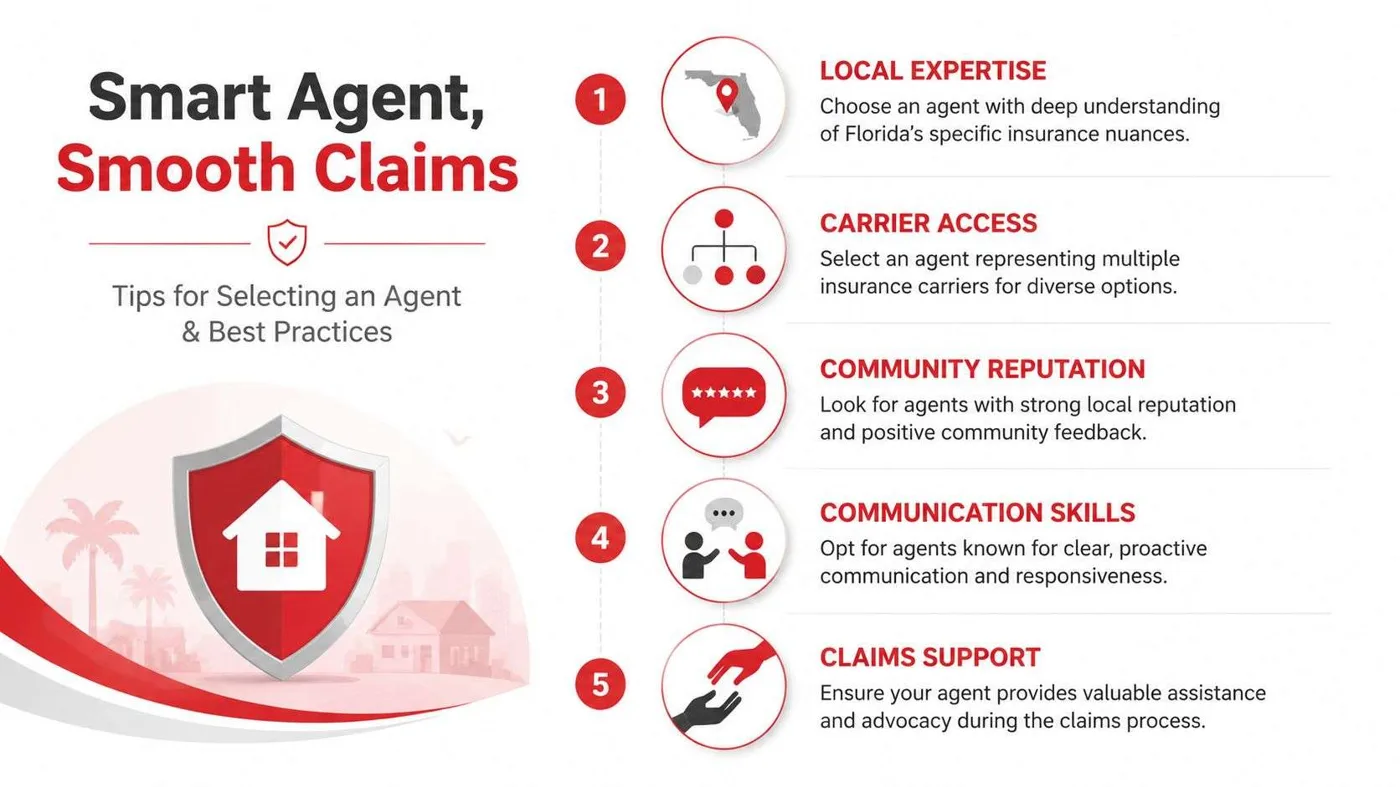
A good local agent does more than deliver a price. The job is closer to a translator and planner combined. You need someone who can explain where the policy stops, where another policy starts, and where a disclosure gap could leave you paying out of pocket.
That matters in Florida because the hidden gaps are rarely obvious on a quote summary. A homeowner may see water damage listed and assume flood is included. A driver may carry auto liability and still miss how uninsured motorist coverage protects household finances after a serious crash. A business owner may insure the building and contents but miss how a shutdown affects income. A local agent should slow that down and explain it clearly.
Schneider and Associates Insurance Agencies serves Florida clients from offices in Micco and Newberry. That Florida-only focus can help when the conversation needs to be about local property conditions, storm patterns, road risks, and how different coverages fit together.
When you evaluate an agency, listen for practical teaching, not sales language. Good questions include:
- How do you explain exclusions in plain language?
- Do you review how the property, vehicle, or business is used?
- Can you show where flood, auto UM, and business income issues create separate decisions?
- What records should I keep now so a future claim is easier to document?
- Who helps me after a loss, and what does that support look like?
A clear answer today can prevent a confused claim tomorrow.
What to do right after a loss
The first hours after a loss shape the claim. Stress makes memory unreliable, so build the file with evidence as early as you can. Photos and video work like a timestamped notebook. They capture details you may forget once cleanup starts.
Use a simple process:
- Protect people first. Address safety hazards and emergency repairs that prevent further damage.
- Document the scene early. Photograph affected rooms, vehicles, equipment, exterior damage, and standing water before conditions change.
- Make a written timeline. Note when the damage happened, when you found it, and what steps you took.
- Save damaged property when possible. Do not throw items away until you understand whether inspection is needed.
- Track every conversation. Write down names, dates, claim numbers, and what each person said.
- Keep receipts. Temporary repairs, cleanup costs, lodging, and replacement purchases may all matter.
Florida claims can become confusing when people assume one policy will handle every part of the loss. That is a common disclosure gap. The house claim, flood claim, auto claim, and business interruption claim may each follow different rules, deadlines, and documentation steps. Sorting those buckets early helps reduce delay and frustration.
Digital account access can also help during a claim, especially if you need declarations pages, contact information, or copies of submitted documents while power or phone service is disrupted. The tool matters less than the outcome. You need fast access to your policy information when conditions are chaotic.
Next Steps to Get Quotes from Schneider and Associates
A Florida family can have a solid homeowners policy, decent auto limits, and even business coverage, then still discover a gap only after a storm, a flood loss, or a crash with an uninsured driver. That is why the quote process matters. It is your chance to line up the pieces before a claim tests them.
Schneider and Associates Insurance Agencies writes policies only in Florida, with offices in Micco at 7960 U.S. 1, Ste 2, Micco, FL 32976 and Newberry at 285 NW 138th Terrace, Suite 100, Newberry, FL 32669. A Florida-only agency focus can help when your questions are local and specific, such as how flood exposure affects a home quote, how UM fits into your auto choices, or how a business policy may leave out water damage unless you address it directly.
Bring the right facts to the first conversation. A quote works like a set of building plans. If key measurements are missing, the finished protection can miss the mark too.
- Home or condo quotes: property address, year built, roof and system updates, occupancy details, and current declarations pages
- Auto quotes: driver information, vehicle details, current liability limits, and questions about uninsured motorist coverage
- Business quotes: what the business does, where it operates, property details, payroll or staff information if requested, and liability concerns
- Mobile home quotes: home age, setup details, attached structures, occupancy, and current insurance information
- Flood quotes: property location, flood zone information if you have it, and elevation documents if available
Ask direct Florida-specific questions during the quote review. For example, if your home policy excludes flood, ask what fills that gap. If your auto policy has low UM limits, ask how a serious injury claim would be handled if the other driver has little or no insurance. If you own a business, ask which losses fall under property coverage, which require separate flood protection, and how downtime would be treated after a storm.
Small disclosure details matter here. Prior roof issues, an older mobile home, a teen driver, a commercial vehicle, home-based business activity, or past water losses can all affect what a carrier offers and how a future claim is handled. Bringing those details up early usually leads to a more accurate quote and fewer surprises later.
The Micco office hours are Monday through Thursday from 9 AM to 5 PM and Friday from 9 AM to 3 PM. That helps if you need to plan a call around work, school pickup, or storm prep.
If you want Florida-focused help sorting through home, auto, flood, business, condo, or mobile home coverage, connect with Schneider and Associates Insurance Agencies. Their team serves Florida communities with local guidance, multiple carrier options, and practical help choosing coverage that fits how you live and work.
Have questions about your coverage?
Our Newberry and Micco, FL team can walk through your policy and find the right coverage at the right price.
Get a Free Quote