High-Value Home Insurance Newberry FL: Expert Guide

You can own a beautiful Newberry home, keep it in excellent shape, and still be exposed in all the wrong places. That's the trap with high-value property in Florida, the policy can look fine on paper, then fall short when a storm tears into the roof, wind-driven rain gets inside, or the rebuild cost runs past what a standard carrier was willing to insure in the first place. The fix is not buying “more home insurance,” it's buying the right structure, with the right deductibles, limits, and endorsements.
Why Standard Policies Fall Short for Newberry Luxury Homes
A Newberry homeowner can do everything right, custom build the house, choose premium finishes, keep up with maintenance, then discover after a severe storm that the policy ceiling was never designed for that kind of property. The claim adjuster doesn't care what the home sold for last year. The insurer cares what it costs to rebuild today, and in Florida that gap can be brutal.
Replacement cost is the real threshold
High-value home insurance is generally triggered by replacement cost, not market value. Specialty carriers often set the threshold around $750,000 to $1.5 million in dwelling reconstruction cost, with some programs starting at $1 million+ w3ins. That's the number that matters because rebuilding includes labor, materials, code upgrades, and the kind of craftsmanship a standard policy assumes away.
Practical rule: If your home would cost much more to rebuild than a comparable house would sell for, price the insurance from the rebuild number, not the sale price.
That's where standard policies break down. A conventional form may look adequate on the declarations page, but it often wasn't built for custom architecture, specialty materials, or the higher liability and contents exposure that come with a high-net-worth household. For Newberry properties, the gap gets wider when the roof, finishes, or property layout don't resemble an ordinary tract home.
Why the policy form matters more than the label
Luxury coverage is a different underwriting mindset. It usually allows broader limits, better treatment of valuable personal property, and endorsements that standard carriers either don't offer or price awkwardly. That doesn't mean every high-value policy is perfect. It means the homeowner should stop asking, “What's the cheapest premium?” and start asking, “What happens after a total loss?”
The difference is especially important in Florida because insurers written in the state must include wind damage coverage, and mortgage lenders usually require homeowners coverage even when the law doesn't Insurance.com. If the dwelling limit, roof assumptions, or deductible structure are wrong, you've technically got coverage and still don't have enough protection.
Essential Coverages for High-Value Florida Properties
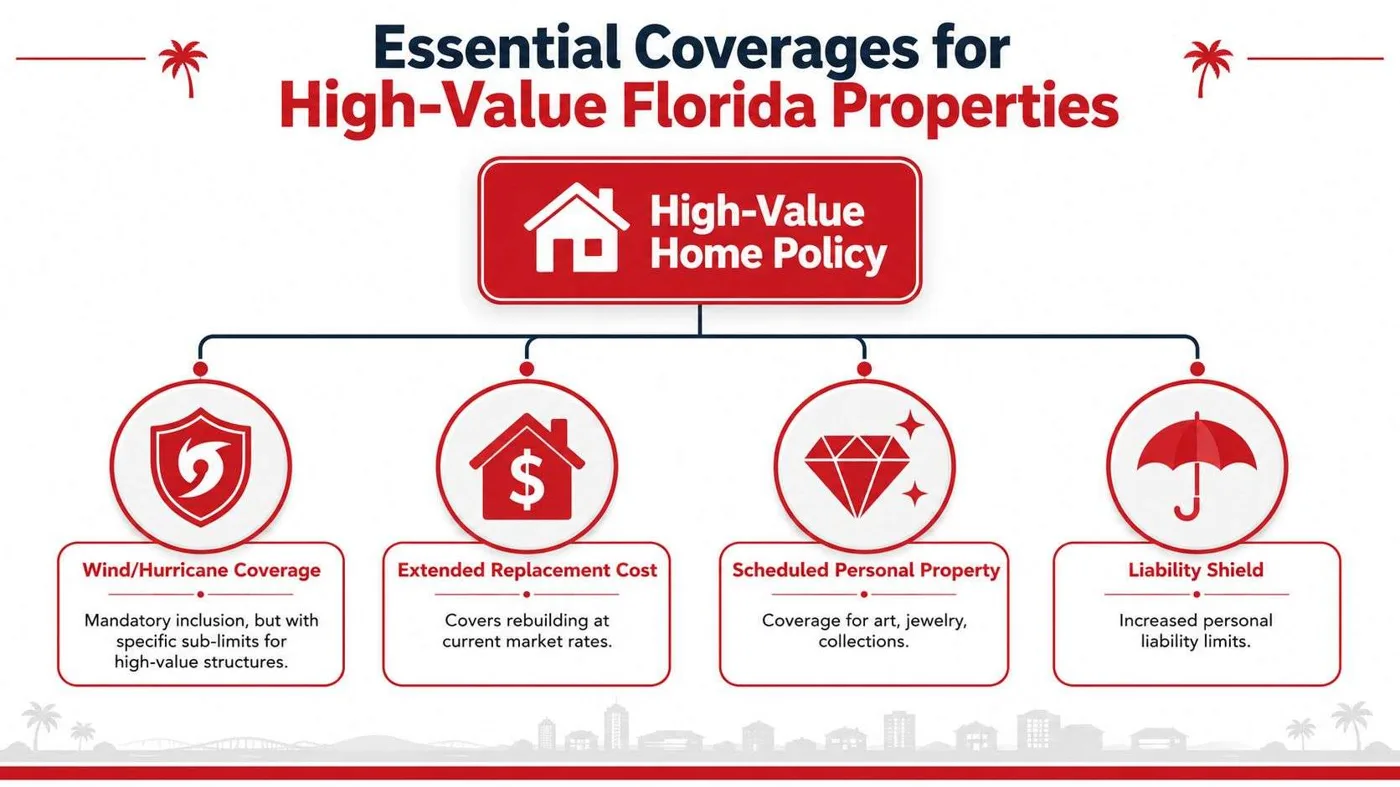
A storm can rip shingles off a Newberry roof, push water into the structure, and leave a luxury homeowner arguing with an adjuster over what the policy covers. That problem usually starts long before the claim. The issue is a weak coverage setup, a deductible that shifts more cost to the homeowner than expected, or a rebuild limit that follows market value instead of true replacement cost.
A high-value Florida policy has to do more than cover walls and a roof. It needs to protect the home after wind, after water, after a code-driven rebuild, and after a liability claim that goes far beyond what a standard homeowners form was built to handle. If you only check the dwelling limit, you are missing the parts that usually hurt wealthy owners the most.
The coverages that actually matter
The first line of defense is wind and hurricane coverage. Florida policies include wind damage coverage, but the question is how the deductible is structured and whether hurricane exposure sits in a separate bucket Insurance.com. A homeowner can have a roof loss covered on paper and still face a large out-of-pocket bill if the wind deductible is different from the all-peril deductible.
The second line is flood insurance, which a standard homeowners policy does not include. For a Newberry property, that distinction matters because surface water and storm surge are not the same claim as a wind loss. A clean policy review should separate the two instead of treating them as one vague storm problem. If you are reviewing roof damage after a hurricane, the Guide for roof damage claims is a practical reference for documenting damage before repairs begin.
Scheduled personal property belongs on nearly every high-value file. Jewelry, art, collectibles, and other special items need their own treatment instead of being buried inside a generic contents limit. Standard policies usually miss on this point, and the shortfall shows up fast after a loss.
Liability and rebuild gaps are where the pain shows up
High-value policies also need higher liability limits. A guest injury, a pool accident, or a contractor claim can run well past what a basic policy is designed to absorb. You also want guaranteed replacement cost or an equally strong rebuild feature, because a policy can look large and still come up short when labor, materials, and code upgrades push the rebuild higher than expected HomeInsuranceU.
That is not luxury fluff. It is what keeps a family from absorbing the full hit when the house has to be rebuilt to current standards after a severe loss. It also protects owners who assume their limit is tied to market value, when the number that matters is the cost to rebuild the home correctly.
A custom policy starts with clean documentation. Keep an updated inventory of valuables, a current roof record, and a realistic rebuild estimate, then compare those figures against the dwelling limit and endorsements. If the file is weak, the quote will be weak too.
Schneider and Associates Insurance Agencies' high-net-worth insurance page is the right place to start when you want a Florida-focused advisor to review those coverage gaps instead of guessing at endorsements.
What Drives High-Value Home Insurance Pricing in Florida
Florida pricing is expensive because the risk is real, the repair environment is tight, and insurers have to price for severe weather exposure every single year. For high-value homes in Newberry, the premium is driven less by a single “rate” and more by the combination of rebuild value, roof condition, wind exposure, and the way the carrier structures deductibles and endorsements. If you want a better quote, you need to improve the file, not just ask for a discount.
The numbers tell you how hard Florida prices the risk
Insurance.com estimated the average U.S. homeowners premium at $2,543 per year for $300,000 in dwelling coverage, while Florida averaged $7,136 per year for the same coverage level, about 2.8 times the national average Insurance.com. At $400,000 in dwelling coverage, Florida's average rose to $9,283 per year Insurance.com. That's the key point, costs scale quickly as the insured value rises.
| Florida Home Insurance Premium Comparison by Coverage Level | Florida Average Premium | U.S. Average Premium | Cost Multiplier |
|---|---|---|---|
| $300,000 dwelling coverage | $7,136 | $2,543 | About 2.8x |
| $400,000 dwelling coverage | $9,283 | Not stated in verified data | Not stated in verified data |
Underwriting details can move the quote
For a Newberry property, the carrier will care about the roof replacement date, available permits, and major repair records because those details help evaluate the condition of the home Schneider insurance guide. That documentation matters more than homeowners think. A clean roof file can make the risk look far more stable than a house with unclear updates and missing records.
The Florida surplus-lines market also shows how specialty coverage has expanded. The Florida Surplus Lines Service Office reported that surplus-lines HO-3 policy counts increased 22% from 2024 to 2025, while total premium increased only 5% over the same period, which drove an approximately 14% decline in average premium per policy FSLSO. In plain English, more property owners moved into specialty placements, not because homes got safer, but because the standard market got tighter and owners needed broader options.
If your home has custom construction, higher rebuild cost, or complex contents exposure, stop comparing it to an average Florida house. That's the wrong benchmark.
Understanding Wind and Flood Coverage Structures
A luxury home in Newberry can look fully insured and still be exposed on the two claims that matter most, wind and flood. Owners see “storm damage” as one event. Carriers do not. They split the risk into separate triggers, separate deductibles, and sometimes separate policies, which is how expensive homes end up short on recovery money after a major storm.
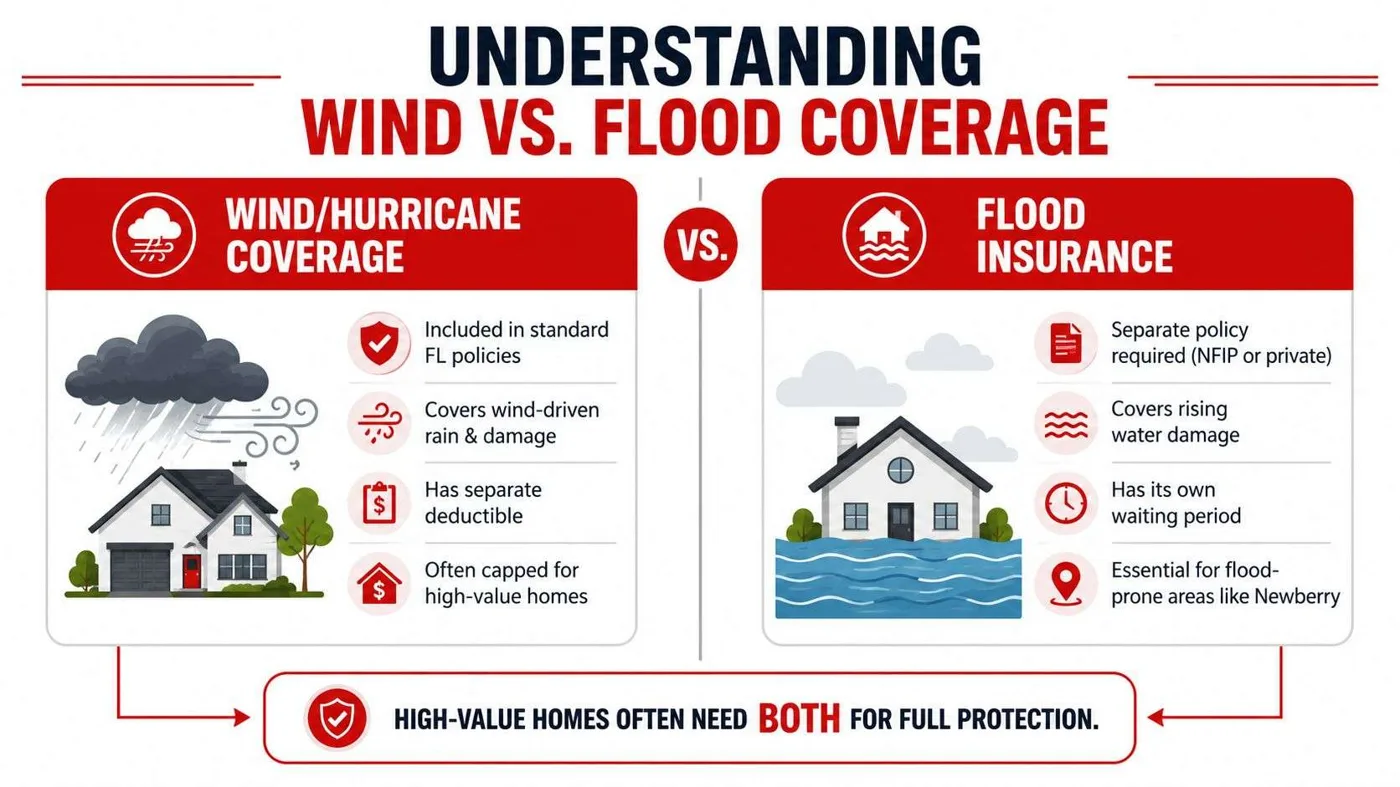
Wind is inside the policy, flood usually is not
Florida homeowners policies include wind damage, but the deductible structure can still be punishing. A Newberry homeowner needs to ask one simple question before binding coverage, does hurricane wind fall under the standard homeowners form, or does it trigger a separate wind or hurricane deductible? That distinction matters more than the premium number. A policy with an attractive price can still force a large out-of-pocket hit when the roof fails.
Flood is a separate problem. Standard homeowners insurance does not cover it, so the flood policy has to stand on its own and be reviewed on its own terms. For a high-value home, the rebuild amount and contents limit need to match the property, or the policy can stay active and still leave a major funding gap after water enters the house.
Compare the exposure, not the marketing
A clean policy review starts with the structure of the loss, not the sales language.
- Is hurricane wind covered under the homeowners policy or handled separately? If it is separate, the deductible needs to be clear.
- Does the flood policy reflect rebuild cost? If the limit is based on a weaker number, the home may be underinsured.
- Are contents settled at replacement cost or a lower method? That changes the recovery on furniture, electronics, and specialty items.
- What waiting periods and exclusions apply? Those terms can block payment or slow a claim when time matters most.
That is the trap with high-value homes. The policy can exist, the declarations page can look fine, and the actual exposure can still sit in the deductible, the valuation method, or an exclusion no one read closely enough. For a direct explanation of how storm claims are handled, review this Florida hurricane damage coverage guide before you bind anything. It keeps the focus on what the policy pays after the roof is gone and the interior is wet, which is the only part that counts.
How to Secure a Custom High-Value Policy in Newberry
A policy built for a high-value home starts with clean paperwork and hard facts. If you show up with vague answers about the roof, upgrades, or valuables, you will get a vague quote back. Underwriters price risk from the file in front of them, and a complete file gives them fewer reasons to pad the terms or miss a gap.
Start with the file, not the quote
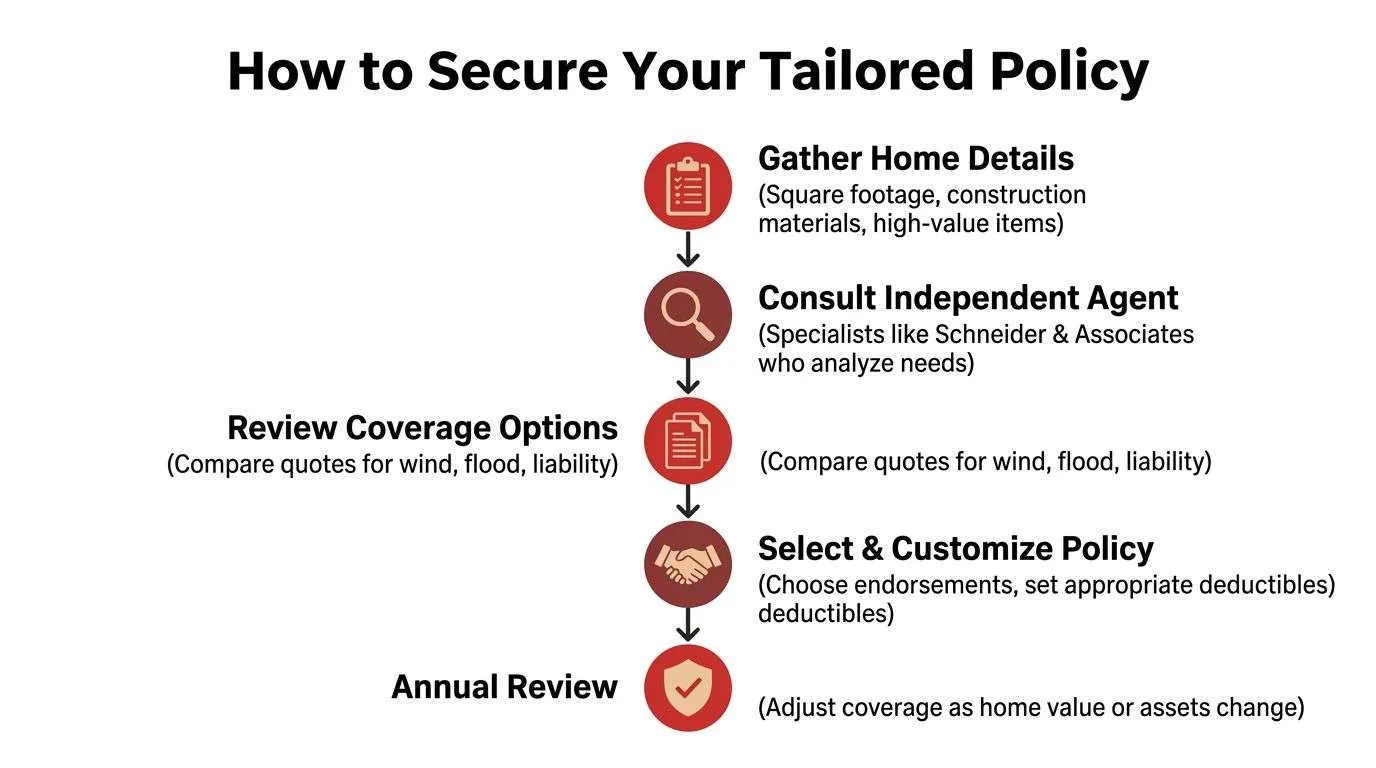
Build the file first. Pull the roof replacement date, permits, major repair records, renovation history, and any appraisal or valuation documents you already have. Those are the documents carriers use to judge the home, and missing records invite cautious assumptions. For a high-value property, that caution usually shows up as tighter terms, weaker assumptions, or a price that looks cheap until the claim gets measured against the paperwork. For a broader reference on how carriers look at Newberry homeowners coverage, review Schneider insurance guide.
Then read the policy structure with a skeptical eye. A low premium with a heavy wind deductible, weak contents treatment, or thin liability protection is not a bargain. It is a deferred problem, and storms in Florida collect those problems fast.
Work through the policy in layers
Start with the rebuild figure. Use replacement cost, not market value, because the sales price of a home does not pay contractors after a loss.
Then separate the storm exposures. Wind and flood are different coverages with different triggers, deductibles, and limits, and one carrier form does not fix the other. That distinction matters in Newberry because a homeowner can buy a policy that looks complete and still discover the worst loss sits outside the part they studied.
Check the contents and liability terms with equal pressure. Jewelry, art, and high-end furnishings need to be listed correctly, and personal liability has to reflect a household that owns more, hosts more, and has more to lose. Read the exclusions in writing too. If the policy language narrows coverage, that is the version that counts.
Review the policy every year. Renovations, roof work, new purchases, and ownership changes can make last year's limits stale quickly. A clean annual review catches the gap before a claim forces the issue.
An independent Florida agent helps here because the advisor can compare multiple carrier options and specialty placements instead of forcing the home into one narrow box. That matters when the rebuild value, construction details, or location push the risk outside standard appetites. Schneider and Associates Insurance Agencies works with Florida homeowners on those comparisons and keeps the discussion centered on the property, the coverage terms, and what the policy will pay after a loss.
A quick pricing check helps before you request quotes. Use this replacement cost calculator to sanity-check the rebuild number, then bring that figure into the underwriting conversation.
A good quote is the one that survives a claim. Anything else is just a price.
Your High-Value Home Insurance Evaluation Checklist
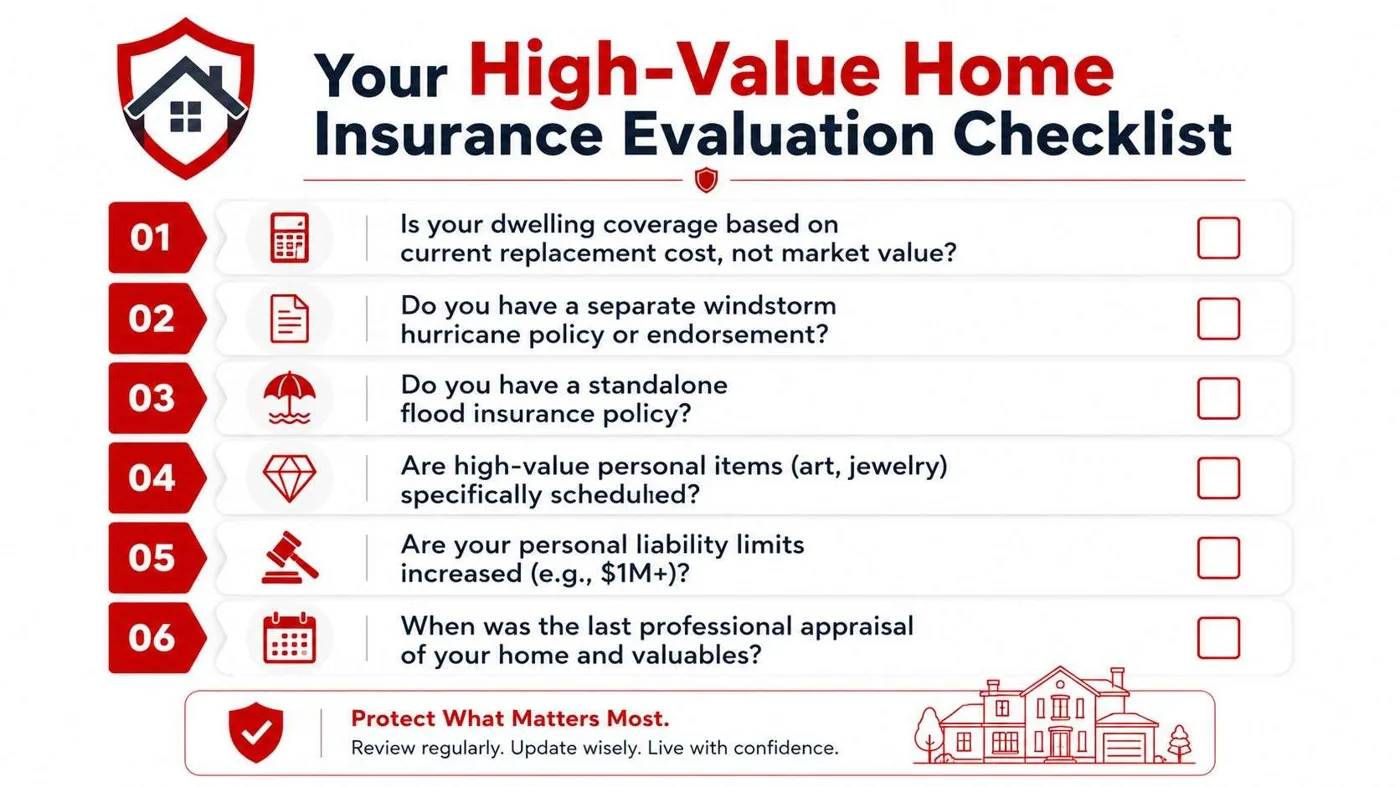
A serious coverage review doesn't take long, but it has to be ruthless. If your policy hasn't been checked against the actual rebuild exposure, the wind structure, and the contents inside the house, you're guessing. Guessing is not a strategy in Florida.
Use this checklist before you renew
- Dwelling limit: Is it based on current replacement cost, not market value?
- Wind structure: Do you know whether hurricane wind has a separate deductible or a separate coverage trigger?
- Flood policy: Do you have a standalone flood policy, and does the limit fit the home?
- Valuables: Are jewelry, art, and collectibles specifically scheduled?
- Liability: Are your personal liability limits high enough for a high-net-worth household?
- Documentation: Do you have your roof date, permits, and repair records ready for underwriting?
- Review schedule: Have you set an annual policy review after renovations or asset changes?
For homeowners who want a practical pricing lens, this replacement cost calculator is a smart starting point before you ask for quotes. It keeps the conversation anchored to the number carriers underwrite against.
If you're in Newberry and your home is custom, upgraded, or worth protecting correctly, get a Florida-only review before the next renewal date. Schneider and Associates Insurance Agencies can help you compare replacement cost, wind deductibles, flood gaps, and valuables coverage so you're not discovering weaknesses after the storm. Visit Schneider and Associates Insurance Agencies and ask for a high-value home insurance review built around your property, not around an average house.
Have questions about your coverage?
Our Newberry and Micco, FL team can walk through your policy and find the right coverage at the right price.
Get a Free Quote