Choosing a Home Insurance Agency in Newberry: A 2026 Guide


Title: Choosing a Home Insurance Agency in Newberry: A 2026 Guide
Description: Practical Florida guidance for choosing a home insurance agency in Newberry, understanding policy gaps, managing wind and flood risk, and improving claim readiness.
Geo: Newberry, Florida, United States
You've probably felt it already. You close on a home, or your renewal hits the inbox, and suddenly every insurance decision feels expensive, technical, and slightly urgent.
That reaction is justified in Florida. Home insurance in Newberry follows the same pressure homeowners see across the state. For $250,000 in dwelling coverage, average annual premiums reach $10,380, or $865 per month, which is 199% higher than the national average, according to Florida homeowners insurance cost data from MoneyGeek. The reason isn't mysterious. Florida homes sit in the path of hurricanes, tropical storms, and water-related loss exposure that raise both claim severity and repair costs.
Most homeowners don't need more marketing language. They need straight answers about what a Florida policy covers, what it excludes, what affects the quote, and what to do before a storm ever shows up. They also need to understand one issue many generic guides skip entirely: in Florida, claim results often come down to procedure, documentation, and timing, not just whether you bought a policy.
Navigating the Newberry Home Insurance Market
A new homeowner in Newberry closes on the house, calls for coverage, and gets three very different quotes for what looks like the same policy. One carrier asks about the roof permit. Another wants a four-point inspection. A third offers a lower premium, but the wind deductible is far higher than the homeowner expected. That is how Florida home insurance usually starts.
In Newberry, price matters, but procedure matters just as much. A policy that looks acceptable on the declarations page can still create trouble later if the application was based on bad roof information, missing update dates, or a deductible the owner did not fully understand. I see that issue more often than buyers expect.
Why Newberry homeowners get conflicting answers
Carriers do not evaluate Florida homes the same way. One company may be comfortable with an older roof that has documentation and remaining life. Another may decline the same home until inspections are updated. A house with solid wind mitigation features can price far better than a similar house without proof of those features on file.
That is why the first question should be about underwriting facts, not just premium.
Roof age, electrical and plumbing updates, prior water losses, construction type, and inspection records all affect whether the quote is accurate and whether it holds up through binding. Local conditions matter too. Newberry homeowners may not face every coastal issue, but they still need to account for wind exposure, drainage concerns, and how the property sits on the lot.
The Florida detail many buyers miss
Claim success starts before the storm.
Florida gives policyholders a limited window to report a hurricane or windstorm claim. If notice is late, you create an avoidable fight over cause, timing, and condition. New homeowners should set up a Hurricane Claim Folder now, not after a loss. Keep dated roof photos, exterior photos, inspection reports, receipts for updates, the full policy, endorsements, and a copy of any mitigation documents in one place, both digital and printed if possible.
That file helps at two points. It helps you buy the right policy because the home data is organized. It also helps support the claim if you need to show pre-loss condition and prove when damage was discovered.
What usually works in this market
Homeowners usually make better decisions when they handle the process in this order:
- Confirm the property facts first: roof age, permit history, update dates, square footage, construction type, and storm-mitigation features
- Read the deductible line closely: hurricane deductibles and all-peril deductibles can change your out-of-pocket cost far more than people expect
- Check for exclusions and limitations: water damage language, screen enclosure treatment, ordinance or law coverage, and loss settlement terms deserve a close review
- Organize claim documentation early: photos, inspections, receipts, policy forms, and carrier contact information should be easy to access before storm season
A good agency does more than produce numbers. It helps you choose a policy that can be serviced properly, documented properly, and defended properly if a claim happens. In Florida, that is the difference between having insurance and being prepared to use it.
Understanding Your Florida Homeowners Policy
Florida homeowners often carry policies for years without really knowing how the parts fit together. That becomes a problem during a claim, when terms that sounded familiar at purchase suddenly control what gets paid and what doesn't.
What the main policy sections do
Start with the core structure.
Dwelling coverage protects the house itself. This is the section tied to the structure, attached components, and the rebuild side of the risk.
Personal property coverage applies to belongings inside the home, subject to policy terms and category limits.
Liability coverage helps when someone alleges injury or property damage for which you're legally responsible.
Loss of use addresses extra living expenses when a covered loss makes the home temporarily unlivable.
Those are the buckets most homeowners recognize. The misunderstanding usually starts with how causes of loss are treated.
HO-3 and HO-5 in plain language
Think of an HO-3 policy like a shopping list of covered events for some parts of the policy, paired with broader treatment for the dwelling subject to exclusions. An HO-5 policy generally works more like a shorter exclusion list, giving broader protection across more categories of property.
That doesn't mean one is automatically right and the other is automatically wrong. It means you're trading premium, breadth, and sometimes eligibility.
| Feature | HO-3 (Special Form) | HO-5 (Comprehensive Form) |
|---|---|---|
| Coverage approach | Broader for dwelling, more limited treatment for some personal property | Broader protection across dwelling and personal property |
| Typical fit | Common choice for many owner-occupied homes | Often considered by homeowners seeking wider coverage |
| Claims friction | More room for dispute over whether a personal property loss fits a covered peril | Fewer named-peril limitations on contents, subject to exclusions |
| Cost trade-off | Usually positioned as the more budget-conscious structure | Usually costs more in exchange for broader protection |
| Underwriting reality | More widely available | May be more selective depending on home details |
A homeowner who wants to keep premium pressure down may lean toward HO-3 if the terms are well understood and the exclusions are acceptable. A homeowner with higher-value contents or less appetite for gray-area claims may prefer the broader format if the home qualifies.
Broad coverage doesn't remove the need to read exclusions. In Florida, homeowners get into trouble when they assume “comprehensive” means “everything.”
A practical review should also include these questions:
- How is water damage treated: Different kinds of water loss are handled differently, and flood is separate.
- What deductible applies to wind or hurricane loss: This can differ from your all-other-perils deductible.
- Are special limits too low for your property: Jewelry, electronics, collections, and business property at home may need closer review.
- Does the policy reflect the actual home condition: If the application understates roof age or updates, claim friction becomes more likely.
If you understand those decisions before binding coverage, you're in a much better position than the average homeowner who only looks at the total premium.
Covering Florida's Unique Risks Wind Flood and More
A July storm rolls through Newberry, shingles lift, rain pushes under the roof edge, and water shows up on the ceiling the next morning. That is the point where coverage details stop being academic. In Florida, claim results often turn on what caused the damage, which deductible applies, and how quickly the loss is documented and reported.
Flood is a separate decision
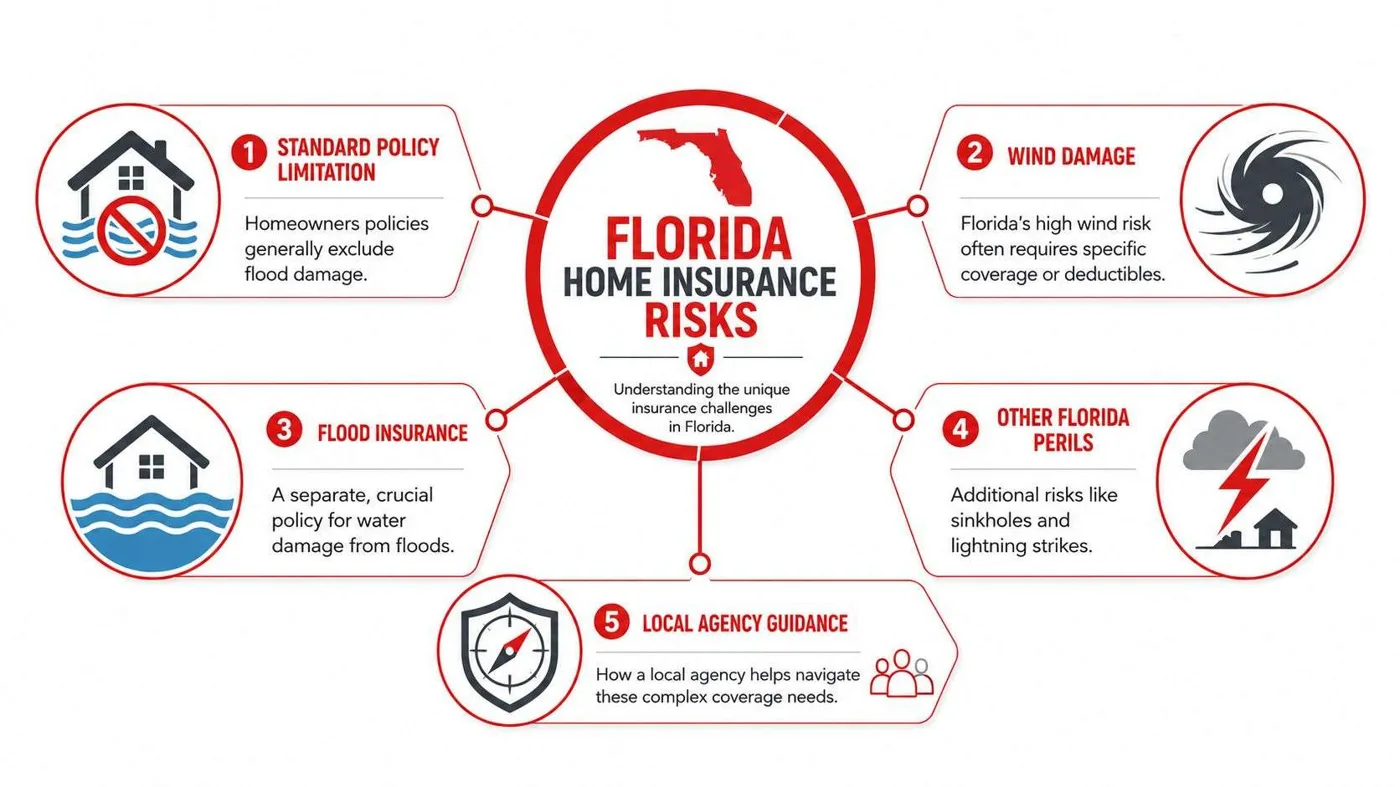
Standard homeowners insurance does not cover flood loss from rising water that enters from outside. That catches a lot of Florida buyers because they hear "water damage" and assume one rule applies to every water claim. It does not. A sudden pipe break inside the house is handled one way. Water that rises across the yard and enters the home is handled under flood insurance, not the homeowners policy.
Around Newberry, flood exposure is not limited to homes that look obviously risky at first glance. Low spots, drainage patterns, nearby creeks, and lots that hold water after heavy rain all deserve a closer look. Lender requirements matter, but they are not a full risk analysis.
Before you decide against flood coverage, review these points:
- Flood zone information needs to match the actual property. Pricing and carrier options depend on correct mapping and home details.
- Elevation and construction records can affect underwriting. Missing documents can limit options or raise cost.
- Past water movement on the lot matters. Ask about standing water, grading problems, and prior drainage work before you rely on assumptions.
Wind and hurricane losses are won or lost in the file
Florida homeowners usually ask whether hurricane damage is covered. The better question is how the claim will be documented from day one. A policy may cover the event and still become a difficult claim if the roof condition was poorly documented before the storm, temporary repairs were not recorded, or the carrier was notified too late.
For a closer explanation of common storm coverage issues, review whether homeowners insurance covers hurricane damage in Florida.
I tell Newberry homeowners to build a hurricane claim folder before storm season, not after. Keep it in cloud storage and on your phone. Include dated photos of each roof slope, screens, windows, doors, exterior walls, detached structures, and major interior rooms. Save your policy declarations page, roof invoice, mitigation documents, inspection reports, and a current home inventory. After a storm, add new photos before cleanup, receipts for emergency supplies, notes of every call, and copies of any repair estimates.
That file matters because Florida claim procedures are strict. Homeowners generally have a 1-year deadline to give notice of a new claim, reopened claim, or supplemental claim after the date of loss. Waiting to "see if it gets worse" is one of the costliest mistakes I see.
Ask these questions before you bind coverage:
- What deductible applies to a hurricane loss? Florida policies often use a separate hurricane deductible that can be much higher than the all-other-perils deductible.
- How fast should damage be reported? Prompt notice protects your position and reduces arguments about whether later damage came from the storm or from delay.
- What temporary repairs should be made right away? Stopping further damage is part of the homeowner's job, but those steps need photos and receipts.
- Which structures and exterior items are treated differently? Screen enclosures, fences, sheds, and water intrusion tied to openings can be handled under different terms.
If you want a practical look at how storm damage shows up on roofs and exterior components, HIBCO ROOF LLC storm services is a useful contractor-side reference.
The homeowners who do best after a storm usually are not the ones with the cheapest policy. They are the ones who understood the flood gap, knew their hurricane deductible, and had a clean claim file ready when the adjuster asked for proof.
Why a Local Independent Agency Matters in Newberry
A homeowner in Newberry can have a solid house, a recent roof update, and no claim history, then still get very different answers from different carriers. The difference is usually not the house alone. It is how the risk is presented, which carriers are a fit, and whether the agent catches issues before the application goes in.

Local presence changes the conversation
A local office gives homeowners a place to have the hard discussion before a claim ever happens. Schneider and Associates Insurance Agencies has a physical office at 285 NW 138th Ter, Suite 100, Newberry, FL 32669. That matters in a market where small property details can change eligibility, deductibles, and claim expectations.
The useful part of a local conversation is specificity. A homeowner can ask about a roof that was repaired in stages, a detached structure used for tools or lawn equipment, a home that sits near a low drainage area, or a prior inspection note that may create underwriting trouble. Those are the details that affect whether a policy fits the property or just produces a low first quote.
An independent agency can check more than one carrier's guidelines for those details. A captive agent cannot. If you want the plain-language version of that difference, read how an independent insurance agency works.
Questions worth asking any agent
Price still matters. Process matters just as much in Florida.
Ask these questions before you bind coverage:
- How many Florida carriers fit this home as it sits today? You want to know whether the agent has options if one carrier declines the roof age, prior updates, or property features.
- What should be documented now, before there is any loss? A good agency should tell you what photos, inspection reports, permits, and update records to keep on hand.
- What should go into my hurricane claim folder? The right answer includes policy documents, contact numbers, dated home photos, receipts for updates, and a place to store repair invoices and notes after a storm.
- How do you help clients after a loss is reported? Some agencies only give out a claims number. Others help clients organize documents, review deductibles, and avoid preventable reporting mistakes.
- Which parts of this policy tend to create surprises at claim time? In Florida, that often includes wind deductibles, water damage limitations, and how detached structures or screened enclosures are treated.
That last question saves people trouble.
A Home Insurance Agency in Newberry should do more than sell a policy. It should help you set up the file, records, and expectations that make a Florida claim easier to prove if a storm hits.
One factual option in this market is Schneider and Associates Insurance Agencies, a Florida-only agency that works with multiple carriers and serves Newberry homeowners through its local office and remote support channels. That approach helps when a home does not fit a standard underwriting template.
Getting Your Accurate Quote with Schneider and Associates
A new homeowner calls after a summer storm and wants to know whether the policy they bought will really respond. The answer usually traces back to the quote application. If the roof age was guessed, the updates were undocumented, or prior coverage was reported loosely, the problem starts long before the claim.

What to gather before you ask for numbers
Accurate pricing in Florida depends on details that underwriters rate. Start with the facts a carrier will check anyway, so the quote you receive is closer to the policy you can keep.
Gather these first:
- Property basics: address, year built, square footage, construction type, and whether the home is owner-occupied, tenant-occupied, or seasonal.
- Roof information: installation year, covering type, roof shape, and any permit records for replacement or repair.
- House systems: electrical panel type, plumbing material, water heater age, and HVAC age and condition.
- Insurance history: current declarations page, prior carrier, lapse history, and recent claims.
- Mitigation paperwork: wind mitigation and four-point inspection reports, if you have them.
- Photos if the home has unusual features: screened enclosures, detached structures, older additions, or custom finishes.
Homeowners often lose accuracy. They know the roof was replaced "a while back" or that the electrical was "updated by the last owner." Carriers do not rate on rough memory. They rate on dates, forms, and permit-backed updates.
If you are ready to get numbers based on the home as it is today, start by contacting the Newberry insurance office with your property details organized.
Bring documents. Roof age, update dates, and inspection forms often decide eligibility, premium, and how much gets questioned later.
Build your hurricane claim folder now
The quote process is also the right time to set up your claim file. Florida gives homeowners less room for delay than many people realize. For hurricane and wind losses, late notice can create avoidable problems, and the 1-year notice deadline matters.
Set up a digital folder before storm season and keep it updated. Include:
Pre-loss photos and video
Photograph each elevation, the roofline from the ground, windows, doors, ceilings, flooring, kitchens, baths, and any high-value finishes.Policy records
Save the declarations page, endorsements, deductibles, agent contact information, and claim reporting instructions.Home update documents
Keep permits, invoices, inspection reports, and receipts for roof work, plumbing updates, electrical work, and opening protection.Post-storm evidence
After damage is discovered, add dated photos, a written timeline, weather screenshots, temporary repair receipts, and notes from every call or inspection.Maintenance records
Carriers look closely at wear, neglect, and long-term water intrusion. Routine upkeep records help separate storm damage from deferred maintenance. Exterior drainage is a common example. This guide on avoid costly gutter damage shows how small maintenance issues can turn into larger repair disputes.
A hurricane claim folder does two jobs. It helps the carrier price the home correctly on the front end, and it gives you a cleaner file if you ever have to prove what changed after a storm.
That is practical preparation in Florida.
Your Partner in Protection and Frequently Asked Questions
A lot of claim problems in Florida start long before the storm. The policy is in force, the roof looks fine from the ground, and the homeowner assumes they can sort out the paperwork later. Then damage shows up, records are scattered, and valuable time is gone.
Good insurance help is not just about placing coverage. It is about setting up the file so a claim can be reported cleanly, documented clearly, and supported with the right records if a carrier asks hard questions. In Newberry, that means keeping your policy documents current, updating photos after major work, saving receipts and permits, and knowing exactly how you would report a loss. Florida deadlines and documentation standards are not forgiving.
Routine upkeep matters for the same reason. If water has been getting in for months because drainage was ignored, that can complicate a storm claim fast. For a simple example of how maintenance issues turn into bigger repair and claim problems, review this guide on avoid costly gutter damage.
Wind mitigation is another area where paperwork changes the result. Discounts can be meaningful, but only if the inspection is current and the form matches the home's actual features. I tell homeowners to treat mitigation documents like claim documents. Keep the signed form, roof permits, product approvals when available, and any records showing updated opening protection or roof-to-wall connections.
FAQ
What does a local agency help with after the policy is issued?
Annual reviews, inspection questions, coverage changes after renovations, and claim preparation. The goal is to keep the policy and the house aligned so there are fewer surprises at renewal or after a loss.
What is the biggest mistake Florida homeowners make before a claim?
Waiting to organize records until after damage is found. A hurricane claim folder should already exist, with pre-loss photos, the declarations page, endorsements, mitigation documents, receipts for updates, and a simple contact sheet for reporting a claim.
How fast should I report storm damage?
Promptly. Florida claim handling gets harder when notice is delayed, and the 1-year notice deadline can become a serious issue if a homeowner assumes they have plenty of time.
Do bundling options always save money in Florida?
No. Sometimes the combined price is better. Sometimes the stronger choice is to place home and auto separately because underwriting results and coverage terms are not always strongest with the same carrier.
How often should I review my homeowners policy?
At every renewal, and any time the property changes. Roof replacement, remodels, occupancy changes, new structures, and major interior upgrades should all trigger a review.
Do I need flood insurance if my lender does not require it?
Lender rules and property risk are different questions. If water can rise onto the property or back up around the structure, flood coverage deserves a separate decision.
If you want a Florida-focused review of your current coverage or need a new quote for a Newberry home, Schneider and Associates Insurance Agencies can help you organize the property details, review your options, and match the policy to how the home is built and maintained.
Have questions about your coverage?
Our Newberry and Micco, FL team can walk through your policy and find the right coverage at the right price.
Get a Free Quote