Home Insurance Newberry FL: A Complete 2026 Guide

The renewal letter lands on the kitchen table, and the number is higher again. You're staring at home insurance Newberry FL coverage, wondering whether the problem is your roof, your deductible, your flood exposure, or just Florida being Florida. The honest answer is that it's usually all four, and the only way to make a smart decision is to treat them as one bill instead of four separate boxes.
What Newberry Homeowners Are Paying in 2026
A Newberry homeowner opens the renewal letter at the kitchen table and finds the core question is not the premium alone. The question is whether the policy still fits a house west of Gainesville, where values sit below coastal Florida but carriers still price in statewide storm risk. Start there before comparing a single quote.
Florida remains one of the most expensive homeowners insurance markets in the country. Insurify reports Florida's average annual premium reached $8,292 in 2025, with an 18% increase over 2024, and Florida ranked 1st for cost in that period, with a $8,458 projection for 2026 (Insurify Florida home insurance report). That state figure matters because Newberry pricing does not stand alone. It is pulled by Florida's reinsurance and claims environment.
Inland Alachua County looks different from the statewide average. One county report places Alachua at $1,877 for average single-family home property insurance, which shows how much lower inland pricing can sit than coastal Florida even while the state stays expensive overall. Newberry homeowners should use that as a reality check, not a guarantee.
Newberry's housing base reinforces the local picture. DataUSA reports that in 2024 the city's median property value was $288,100 and the homeownership rate was 93.4% (DataUSA Newberry profile). Separate Newberry ZIP-code data for 32669 estimates about 6,007 occupied homes, an average home insurance rate of $1,928 per year, and an average home price of $354,100 (DataUSA Newberry profile). That gap between market value and premium is why you should stop guessing and start comparing the structure of the policy.
Practical rule: benchmark against the local Newberry rate first, then compare it with Florida's statewide pressure. Do not assume the state average is what you should pay.
| Market | Average Annual Premium | Source Period |
|---|---|---|
| Newberry ZIP 32669 | $1,928 | Local ZIP estimate |
| Alachua County | $1,877 | County report |
| Florida | $8,292 | 2025 |
| Florida projection | $8,458 | 2026 projection |
For a plain-language look at how claims can start with water damage before they turn into a coverage fight, the Florida homeowners water damage guide is a useful companion read.
The Six Parts of a Florida Homeowners Policy
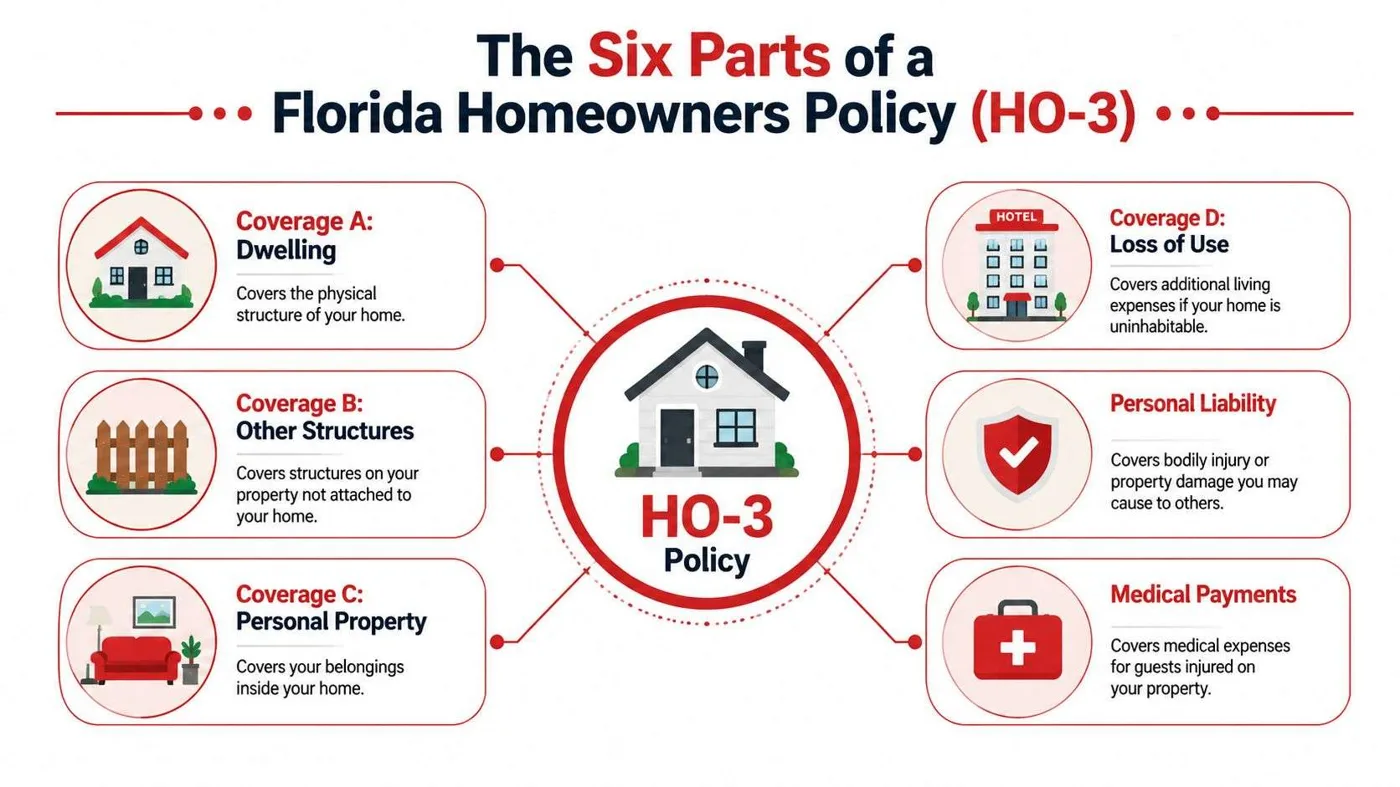
A Florida homeowners policy isn't one thing. It's a stack of coverages, and each line has a job. If you don't know what each part does, you can't tell whether a cheap quote is actually cheap or just stripped down.
Start with the dwelling line
Coverage A, Dwelling is the big one. It pays to repair or rebuild the house itself, and in Newberry that means the policy should be built around replacement cost, not the price you paid for the home. Market value can reflect land, location, and demand. Rebuild cost reflects labor, materials, and what it takes to put the structure back after a loss.
Then look at the rest of the policy
Coverage B protects other structures like a detached shed or fence. Coverage C is personal property, the furniture, clothes, and appliances inside. Coverage D handles loss of use, which matters if you have to live somewhere else after a covered loss. Coverage E is personal liability, and Coverage F pays certain medical expenses for injuries that happen on the property.
A roof claim shows why the distinction matters. If a policy is written on actual cash value for damaged items, age and wear reduce the payout. If the policy pays replacement cost, the settlement is tied to what it costs to replace the item today, subject to the policy terms. That difference can be huge on a kitchen or a roof, and it's one reason a lower premium can turn into a painful claim check.
Read the declarations page like a claim file
When you pull a dec page, don't skim the cover page and stop. Check the Coverage A limit, then see whether the rest of the policy is built from that number in a way that still matches the home's rebuild cost. In Florida, the right question isn't “What did the house sell for?” It's “What would it cost to rebuild this exact structure now?”
If Coverage A is too low, the policy is underbuilt before the storm ever hits.
For homeowners comparing policy structure, the key is simple. Coverage A should track rebuild cost, and the other lines should be sized with the same discipline. If the policy is cheap because it shortchanges the dwelling or personal property limits, it isn't a bargain. It's a future argument.
Hurricane Deductibles and Wind Coverage in Florida
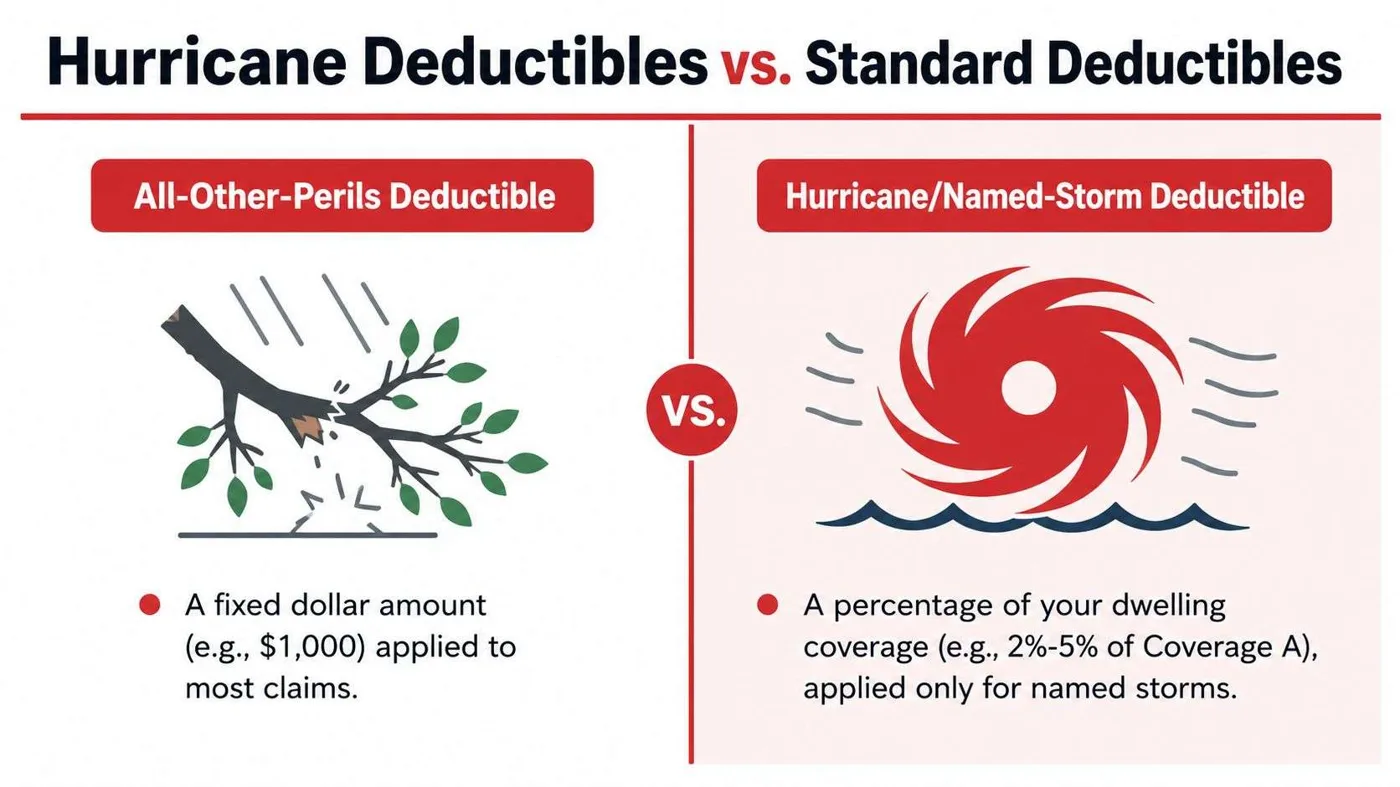
Newberry homeowners get burned when they shop the monthly premium and ignore the deductible language. The quote can look fine until a named storm hits, then the out-of-pocket number is much larger than the buyer expected.
Florida Statutes Section 627.7011 controls how hurricane deductibles and wind coverage options are offered on residential policies (Florida Statutes 627.7011). Read that before you bind anything. You need to know whether wind is included, excluded, or tied to a separate hurricane deductible structure. Schneider's Newberry guidance says the same thing, wind coverage and deductible design change what you pay after the storm (Newberry homeowners insurance guide).
Do the math before you sign
A standard all-other-perils deductible is usually a fixed dollar amount. A hurricane deductible is often a percentage of Coverage A. On a policy with $300,000 dwelling coverage, the numbers look like this:
- 2% hurricane deductible: $6,000
- 5% hurricane deductible: $15,000
- 10% hurricane deductible: $30,000
That is the number that matters at claim time. A lower premium can hide a much larger check you will have to write after a storm. If the roof is older or the carrier is tightening wind underwriting, the deductible matters more than a small monthly savings.
Ask the right question
Ask, “What do I owe if a named storm damages the house and the roof takes the first hit?” That question tells you whether the policy protects your family or just looks acceptable on paper.
A roof leak starts small and turns into a repair problem fast. The same warning applies to storm water inside a house, and professional water leak detection services are a reminder that hidden water damage does not stay hidden for long.
Flood Coverage for Inland Newberry Homes
Flood is the coverage gap that catches inland homeowners off guard. A standard Florida homeowners policy protects the dwelling package, liability, personal property, and related coverages, but it does not cover flood damage from the ground up. That matters in Newberry because heavy rain and drainage-driven losses don't care whether you're near the coast.
NFIP or private flood, the decision starts with the house
The practical choice is not “Do I live in a high-risk zone?” It's “What would happen if water entered the home from below grade or from surface runoff?” If the answer is costly, you need a flood policy. Florida guidance also says flood should be separated from standard homeowners coverage because water losses create a major coverage gap.
NFIP is the primary federal flood option, while private flood can sometimes offer different pricing or limits. The right fit depends on the property, the elevation, and how much building and contents protection you want. For inland Alachua County properties, that choice should be made with the same seriousness as wind coverage, not treated as an afterthought.
Use a simple decision tree
If the home has poor drainage, a history of heavy-rain claims, or sits on a lot that tends to hold water, flood belongs in the budget. If an elevation certificate exists, use it. If it doesn't, don't pretend the risk is zero just because the map isn't screaming at you.
If you want a Florida flood-zone reference point while you're reviewing the property, this resource on Florida flood zone AE guidance is worth checking while you compare options.
What to buy
For some Newberry homes, NFIP is the straightforward answer. For others, private flood may fit better. Some households should price both and compare the actual structure of the policy, not just the annual bill. The wrong answer is buying nothing because the house sits inland.
Bottom line: if water can get into the house from the ground, the homeowners policy will not save you.
What Really Drives Your Premium in Newberry
Carriers in Florida don't price your house by vibes. They price it off the parts of the building that change the odds and the size of a claim. In Newberry, that means roof age, roof shape and material, electrical age, plumbing age, HVAC age, prior water or wind losses, and whether there's a mortgage on the property.
The roof carries a lot of weight
A newer roof usually helps. A roof that looks older, has a less favorable shape, or lacks the features an underwriter wants can push the quote up or make the carrier more cautious. That's why a homeowner who wants a lower premium should start with the roof before worrying about cosmetic upgrades inside the house.
Wind mitigation credits matter too. Features like a hip roof, a secondary water barrier, hurricane straps, and opening protection can improve the way a policy is priced when the carrier accepts the inspection results. Those are not decorative details. They're claim-reduction features.
Don't ignore the plumbing and systems
A home with older electrical, plumbing, or HVAC components can draw a tougher underwriting review because those systems affect water-loss and fire-loss potential. Prior claims do the same thing. If the file shows repeated water damage or storm losses, carriers tighten up fast.
Bundling can help at the margin, but it doesn't fix a weak risk profile. The bigger levers are still the house itself and the deductible structure. I'd rather see a homeowner spend money on the right inspection and needed upgrades than chase a tiny premium reduction by trimming coverage.
The smart move: spend to reduce loss exposure, not just to shave the renewal.
For a realistic Newberry example, use the local ZIP context. With about 6,007 occupied homes, an average home price of $354,100, and an average home insurance rate of $1,928 per year in 32669, the pricing picture suggests that the policy can be very sensitive to house-specific details even inside the same neighborhood (DataUSA Newberry profile). That's why two homes on the same street can get very different quotes.
Getting Quotes Without Wasting Your Week
Losing time on quoting happens when calls start without preparation, letting the agent spend the first half hour collecting facts. Don't do that. Have the file ready before you start, and the conversation gets sharper immediately.
Gather the quote file first
You need the year the home was built, square footage, roof age and material, prior claim history, mortgage company, desired Coverage A based on rebuild cost, and the deductible structure you want to compare. If you have a current declarations page, keep it handy. If the roof has been inspected for wind mitigation, have that report ready too.
Then ask for side-by-side quotes that compare coverage, not just price. Two policies with the same premium can be wildly different if one has a low dwelling limit, a tighter water backup cap, or a harsher hurricane deductible. The quote that looks cheapest on the front end can be the most expensive at claim time.
Ask these coverage questions
- Replacement cost wording: Does the policy pay replacement cost on dwelling and contents, or are some items settled differently?
- Ordinance and law: How much help is there if building codes force added work after a loss?
- Water backup: Is there any coverage for backup or overflow, and what does it include?
- Wind structure: Is the deductible fixed, percentage-based, or tied to named-storm events?
I'd also keep an eye on whether the home has been re-inspected recently. A policy written off an old roof report can price differently once the carrier sees a newer inspection. Don't switch carriers blind and assume the old mitigation file still works.
The fastest way to stay organized is to build the quote packet once, then reuse it with every agent. That makes the comparison cleaner and keeps the discussion on coverage choices, which is where the money lives.
Citizens Property Insurance and the Last-Resort Question
Citizens Property Insurance Corporation exists for a reason, and Newberry homeowners should treat it as a fallback, not a starting point. If the private market will write the home on reasonable terms, that is the cleaner path. Citizens belongs on the table when the admitted market tightens or the roof, age, or loss history makes private offers impractical.
How Citizens fits
A Florida independent agent can quote private carriers and Citizens side by side, which gives you an actual comparison instead of a one-carrier answer. That matters because a homeowner can get stuck too early if the file is sent to one company before the house is fully evaluated. Citizens is the safety net.
If you want a plain-language overview of that role, the Citizens Property Insurance page explains where it fits in the market. The point is not to chase the lowest sticker. The point is to know when Citizens becomes the practical fallback for the property.
What to do after damage
Florida claim handling moves on deadlines, and homeowners should track them from day one. Insurers must acknowledge a claim within 14 days, pay or deny a claim within 30 days after a satisfactory Proof of Loss, and resolve the claim within 90 days regardless of Proof of Loss status (Newberry property claim attorney guide). The same guide says most non-hurricane lawsuits must be filed within five years from the date of loss, and policyholders are often required to submit a signed Proof of Loss within 60 days of the carrier's request.
Those deadlines control the file.
Build the first 48-hour file
After a loss, document everything before repairs begin. Take photos, shoot video, save contractor estimates, write down damaged items, and keep a log of every call and email. If the carrier drags its feet, a public adjuster or attorney can help push the claim, but they cannot recreate evidence that was never saved.
Claim rule: the homeowner who documents early usually has the cleaner file later.
Why a Local Florida Independent Agent Matters
A Florida-only independent agency earns its keep by doing the part most homeowners don't want to do. It compares admitted carriers, checks the wind structure, lines up flood with homeowners coverage, and keeps the conversation alive if the carrier starts asking questions later. That's different from calling one number and hoping the answer is good enough.
Make the process simple
Start with the quote packet, then ask for at least two carrier options plus a Citizens comparison. If the home is more than five years old, schedule a roof and wind mitigation inspection before you settle on the final structure. That one step can change how the policy is underwritten and what deductible design makes sense.
If you want a clearer explanation of how that independent model works, this guide on what an independent insurance agency does lays out the difference in plain terms.
Keep the claim path clean
When a storm hits, the same agent relationship matters because the file has to move fast. The earlier checklist, the deductible structure, and the claim documentation all connect. If you've done the prep work, you're not scrambling after the loss.
Schneider and Associates Insurance Agencies writes home insurance for Florida properties, including Newberry, and helps homeowners compare coverage, deductible structure, and flood decisions with a Florida-only lens. If you want a straight answer on your own house, visit Schneider and Associates Insurance Agencies and ask for a Newberry quote review today.
Have questions about your coverage?
Our Newberry and Micco, FL team can walk through your policy and find the right coverage at the right price.
Get a Free Quote