Homeowners Insurance Near Archer, FL: Your 2026 Guide


You open the renewal packet, scan the premium, and your first thought is usually some version of: how can an inland home near Archer cost this much to insure?
That reaction makes sense. Archer isn't on the coast, and it doesn't feel like Miami or the Keys. But Florida insurance doesn't price risk by feel. It prices for statewide storm exposure, construction details, roof condition, and how a carrier views your specific home at that moment.
That's why Homeowners Insurance Near Archer can feel confusing. One house gets a workable renewal. Another gets hit with stricter underwriting questions about roof age, shutters, electrical updates, or prior claims. The paperwork gets heavier even when the home itself hasn't changed much.
A local Florida homeowner needs a practical roadmap, not generic national advice. You need to know what coverages matter, where inland North Central Florida gets treated differently, and what proves useful when you're comparing policies.
Protecting Your Archer Home in Florida's Unique Market
The most common Archer scenario isn't a dramatic disaster story. It's a homeowner at the kitchen table trying to make sense of a renewal that suddenly asks harder questions than last year. Maybe the roof is older. Maybe the carrier wants an updated wind mitigation report. Maybe the premium isn't shocking by Florida standards, but it's still high enough to force a real decision.
That local context matters. Florida homeowners pay the highest average insurance rate in the United States, with a 2026 analysis showing that a policy with $300,000 in dwelling coverage costs $7,136 annually, while homeowners near Archer in inland North Central Florida may fall toward the lower end of Florida's range at about $1,825 to $2,915 annually, though still above most other states, according to Insurance.com's Florida homeowners insurance rate analysis.
Archer benefits from being inland. That helps. But inland doesn't mean low-risk in the way many people assume. Carriers still price for Florida wind exposure, litigation environment, repair costs, and the age and condition of the home itself.
Why Archer homeowners feel stuck
A lot of local owners end up between two bad options. They either keep a policy they don't fully understand, or they chase the lowest premium and miss the exclusions and deductible structure that matter when a claim happens.
Practical rule: If a renewal looks confusing, don't start by asking only whether it's expensive. Start by asking what changed in the coverage, deductible, and underwriting assumptions.
That shift in mindset makes the rest of the process easier.
What usually works better
For homes in and around Archer, the productive approach is usually straightforward:
- Review the dwelling amount carefully. It should reflect rebuilding cost, not what a buyer might pay for the property.
- Check roof and opening protection details. Inland homes still get evaluated heavily on wind-related features.
- Read the deductible page. A lower premium can hide a deductible structure that changes the whole deal.
- Confirm whether flood was addressed at all. Many owners assume they already handled it when they haven't.
Florida homeowners often need plain language more than they need more paper. Once you understand what the carrier is charging for and what the policy is built to do, the shopping process gets more manageable.
What Coverage Do You Actually Need in Archer
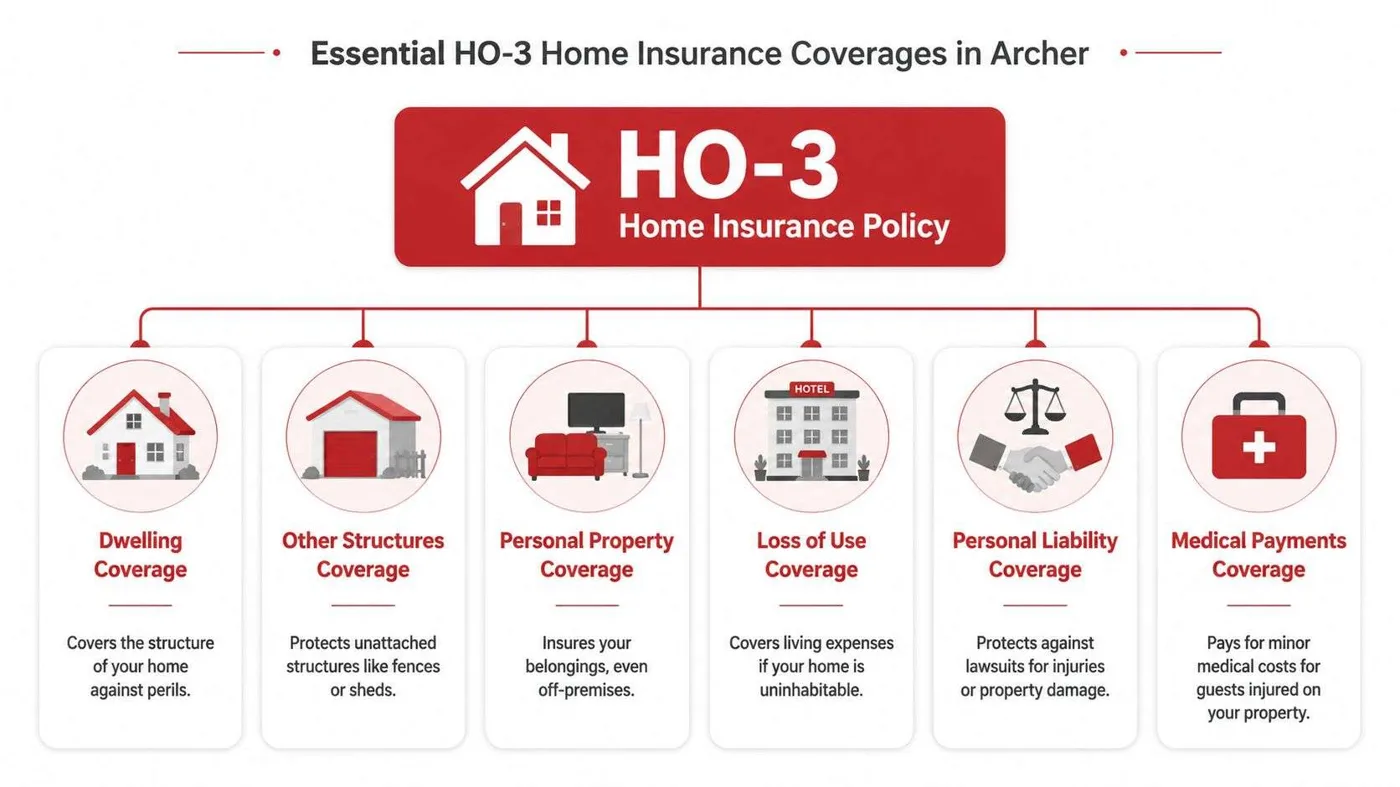
A standard Florida homeowners policy often gets discussed in abbreviations, but most homeowners don't need more jargon. They need to know what each part does in real life. If you're looking at Homeowners Insurance Near Archer, focus first on whether the policy protects your house the way you'd expect after a serious loss.
Start with rebuilding cost, not market value
The dwelling limit is the backbone of the policy. It should be tied to what it would cost to rebuild the structure in Alachua County with current labor and material conditions, not the tax assessment, not the original purchase price, and not an online estimate.
That difference matters because the insurance contract is built around reconstruction. Land value, school zones, and resale demand don't rebuild a wall, roof system, or kitchen after a covered loss.
A few core pieces deserve a separate review:
- Dwelling coverage: This is the amount available to repair or rebuild the home itself.
- Other structures: Think detached sheds, fencing, or a separate garage.
- Personal property: This is your furniture, clothing, electronics, and household items.
- Loss of use: If a covered claim makes the home unlivable, this section helps with temporary living expenses.
- Liability and medical payments: These address injury and property damage claims involving other people.
The coverage parts that deserve a hard look
Personal property is where many homeowners underestimate what they own. The easiest fix is a simple room-by-room inventory. Walk the house with your phone, open drawers and closets, and save the photos somewhere outside the home.
If part of your property is rented on a short-term basis, don't assume the base homeowners form handles that exposure cleanly. A separate review is smart, and this primer on securing short-term rental coverage is useful for understanding where standard homeowners coverage can fall short.
The best home inventory is the one you actually finish. It doesn't need to be fancy. It needs to exist before a claim.
Replacement cost versus actual cash value
This is one of the biggest trouble spots in Florida policies. The Florida Department of Financial Services warns consumers to understand the difference between Replacement Value and Actual Cost Value before binding coverage, as explained in the state's shopping guide for Florida insurance consumers.
Here is the practical version:
| Coverage basis | What it usually means for you |
|---|---|
| Replacement cost | Pays based on the cost to repair or replace with like kind and quality, subject to policy terms |
| Actual cash value | Factors in depreciation, which can reduce what you receive on a claim |
A roof, older flooring, or aging contents can create a painful surprise if you thought you had replacement cost and instead had actual cash value in part of the policy.
When reviewing a quote, ask these direct questions:
- Is the dwelling settled on replacement cost?
- Are contents also on replacement cost, or only actual cash value?
- Are roof losses handled differently because of roof age or endorsements?
Those answers matter more than a small premium difference.
Understanding Florida's Wind and Flood Coverage Rules
For Archer homeowners, the most expensive misunderstandings usually involve wind and water. People hear "inland" and assume those are mostly coastal problems. That's not how Florida underwriting works.
In North Central Florida, covering Alachua, Marion, and Levy counties, homeowners insurance premiums for $250,000 dwelling coverage range from $1,825 to $2,915 annually, and one reason some homes stay in that range is that wind mitigation features can improve the home's profile. The same Florida guide notes that installing impact-rated garage doors and hurricane shutters can help qualify for opening protection credits, as outlined in this North Central Florida homeowners insurance guide.
Wind still matters inland
A strong inland policy review starts with the wind mitigation inspection. The carrier wants evidence of how the home is built and how well openings and roof connections resist wind damage.
That review commonly centers on features like:
- Roof-to-wall attachment: How the roof structure connects to the walls
- Roof shape: Some roof designs are viewed more favorably than others
- Opening protection: Shutters, impact-rated doors, and protected openings
- Secondary water resistance: Extra protection beneath roof coverings in some homes
If you improve the house and never update the paperwork, the carrier may still rate the home on old information. That's one of the most common missed opportunities in Florida.
For roof-related loss questions, fallen limbs, and cleanup disputes after storms, homeowners often benefit from practical outside reading. This Richmond Tree Experts homeowners guide gives a solid consumer-level overview of what tends to matter when a tree damages a home.
Flood is a separate decision
Standard homeowners insurance doesn't cover flood damage from rising water. That's the rule that catches people every year.
An inland location near Archer may reduce storm surge concerns, but it doesn't remove rainfall, drainage, or localized water accumulation issues. Homeowners should check the property's flood zone and then make an intentional decision about flood insurance rather than assume the homeowners policy handles it.
Flood is not a wording detail. It's a separate coverage decision, and many homeowners don't realize that until after the loss.
If you're reviewing storm-related protection more broadly, this article on whether homeowners insurance covers hurricane damage in Florida helps clarify how wind and water can be treated differently under the policy.
Deductibles need close review
Florida policies often have more than one deductible structure. The standard all-peril deductible may apply to many losses, while hurricane-related losses can trigger a separate hurricane deductible. The important point isn't just the deductible amount. It's when that deductible applies and whether the homeowner understands the out-of-pocket exposure before a storm hits.
A good review usually includes these questions:
- Which deductible applies to non-hurricane wind events?
- What qualifies as a hurricane loss under the policy wording?
- Is there any separate handling for roof surfaces or water damage?
- Was flood quoted, declined, or never addressed?
Homeowners who slow down and answer those four questions usually make better choices than homeowners who shop by premium alone.
Getting and Comparing Home Insurance Quotes in Archer
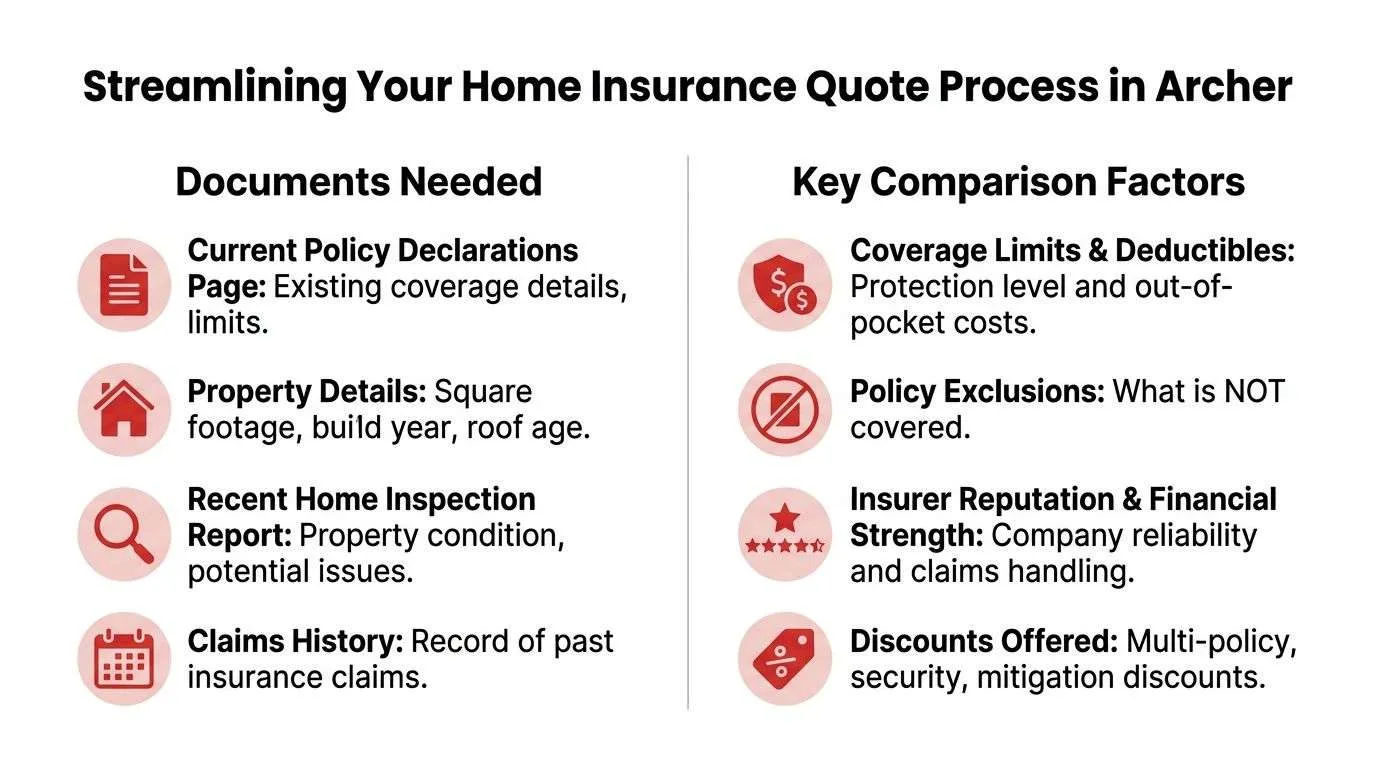
Quote shopping in Archer goes smoother when you treat it like a documentation exercise first and a price exercise second. In Florida, missing details often lead to weak quotes, delayed underwriting, or a premium that changes later.
County and location differences inside Florida are real. A Florida county-by-county report shows inland North Florida counties such as Sumter at $1,533 per year on average, while Monroe County reaches $7,162, and inland areas of North Central Florida, including communities near Archer, typically fall between $1,825 and $2,915 annually, according to this Florida property insurance county report. That spread is a reminder that you should compare your home against homes like yours, not against broad Florida headlines.
What to gather before you shop
The cleaner your file, the better your quote process usually goes.
Bring together:
- Current declarations page: This shows present limits, deductibles, endorsements, and forms.
- Roof information: Year installed, material type, and any upgrades or permits you can document.
- Inspection reports: Wind mitigation and 4-point reports are often essential for older Florida homes.
- System updates: Electrical, plumbing, HVAC, and water heater details help underwriting move faster.
- Claims history: Know what was filed and when, even if the damage seemed minor.
How the main quote channels differ
There are three common ways to shop, and each has trade-offs.
| Quote path | What it does well | Where it can fall short |
|---|---|---|
| Single-carrier agent | Good if that one carrier fits your home well | Fewer options if underwriting is tight |
| Direct purchase | Fast for simple situations | Harder to compare endorsements and exclusions |
| Independent agency | Multiple carrier options through one contact point | Still requires good documentation from you |
For many Florida homeowners, the independent route is the most efficient because carrier appetite changes. A home that one carrier dislikes because of roof age or prior updates may fit another carrier better if the documentation is complete.
If your main goal is lowering cost without stripping out important protection, this guide on how to lower homeowners insurance premiums in Florida is a useful companion to the quote process.
Compare quotes on an apples-to-apples basis
A cheaper quote isn't automatically a better quote. It may instead move the risk back onto you.
Use a short checklist:
- Match dwelling limits first. If one quote insures the house for less, the premium comparison isn't fair.
- Review deductibles line by line. Different deductible structures can change the whole value of the policy.
- Check valuation method. Replacement cost and actual cash value should never be assumed to mean the same thing.
- Look for exclusions and endorsements. Roof language, water limitations, and settlement terms matter.
- Confirm required documents. If a quote depends on inspection updates, know that before you bind.
A quote isn't finished when the premium looks good. It's finished when the documents, terms, and underwriting conditions all line up.
That approach takes longer than grabbing the lowest number. It also leads to fewer surprises.
Choosing the Right Insurer for Your Florida Home
Once you've narrowed the quote options, the next step is judging the insurer, not just the policy. In Florida, that's where many homeowners rush.
The main issue near Archer isn't usually whether a carrier has heard of inland Alachua County. It's whether that carrier's underwriting fits your home's age, roof condition, and documentation. Independent 2026 Florida guides note that carriers increasingly require proof of roof age, wind mitigation forms, and updated system records to avoid declinations, especially as wind, water, and roof-age-specific declinations have become more common, as discussed in this Florida home insurance underwriting guide.
Underwriting details matter more than most people expect
Two homes on the same road can receive very different treatment.
One owner has a documented roof replacement, current inspection forms, and clear records on electrical and HVAC updates. Another owner has done some work but can't prove the dates. The second file often gets more questions, fewer options, or stricter terms.
That doesn't mean the house is uninsurable. It means the paperwork is part of the risk profile.
A good carrier review should include:
- How clear the underwriting requirements are
- Whether the quote is subject to additional inspection
- How roof age is being treated
- Whether any settlement limitations apply to certain parts of the home
What to review before you bind
Price still matters. It just shouldn't be the only filter.
Read the quote packet like a buyer, not like someone skimming a bill:
- Look at exclusions carefully. Water, roof, and wear-related language deserves extra attention.
- Check endorsement pages. Significant coverage modifications are often located there.
- Ask what documents are still outstanding. A policy can look approved and still hinge on follow-up items.
- Verify billing and claim contact details. Small administrative errors become big frustrations after a loss.
The right insurer is the one that offers coverage you understand, on terms you can document, with underwriting that matches the home you actually own.
That standard usually produces a better long-term result than chasing the lowest premium on the page.
Partnering with a Local Expert for Peace of Mind
Archer homeowners don't need a lecture about how complicated Florida insurance has become. They already see it in renewals, inspection requests, and quote differences that don't always make obvious sense.
What helps is a disciplined process. Review the rebuilding amount carefully. Separate wind questions from flood questions. Gather roof and system documentation before shopping. Compare quotes by terms, not just by premium. Vet the insurer with the same care you use to vet the policy.
That process is easier when you're working with someone who understands the local housing mix in and around Archer, Newberry, Gainesville, and Jonesville. Inland North Central Florida has its own profile. Homes may avoid some coastal pricing pressure, but they still run into statewide underwriting standards, roof scrutiny, and storm-related coverage decisions that need close review.
If you want a plain-English explanation of how the independent model works, this overview of what an independent insurance agency does is a good place to start.
The true value of local guidance isn't hype. It's pattern recognition. A Florida-focused advisor can often spot the missing inspection, the weak deductible setup, or the coverage gap that doesn't stand out until claim time.
That kind of review doesn't guarantee the cheapest policy. It usually gives you something better. A policy that fits the house, the location, and the way Florida carriers are underwriting today.
Have questions about your coverage?
Our Newberry and Micco, FL team can walk through your policy and find the right coverage at the right price.
Get a Free Quote