Homeowners Insurance Near Tioga Guide for Local Homeowners

You pull into the driveway after a hard North Florida rain. The yard is soggy, the ceiling has a fresh stain, and one question hits fast: is this covered?
That moment is why so many homeowners start looking more closely at Homeowners Insurance Near Tioga. The confusing part isn't just price. It's knowing which water damage counts, which doesn't, when wind is covered, and why two homes in the same general area can get very different quotes.
Florida makes that harder than it should be. Policies here have to account for hurricane risk, heavy rainfall, older roofs, shifting ground conditions, and insurer pullbacks. Tioga doesn't face the same coastal storm surge exposure as shoreline communities, but inland location doesn't mean low risk. It means a different mix of risk, and that difference matters when you choose a policy.
Introduction to Homeowners Insurance Near Tioga
A lot of Tioga homeowners start in the same place. They know they need coverage for the house, but once they look at a quote, they see terms like dwelling, windstorm deductible, exclusions, endorsements, and loss of use. Then a storm rolls through, and those terms suddenly matter.
For Florida homes, insurance presents substantial financial implications. Florida homeowners face the highest national insurance costs, and inland North Florida counties near Tioga typically see annual premiums between $1,800 and $3,600 for $300,000 in dwelling coverage, versus the statewide average of $7,136. Tioga benefits from being inland, but inland doesn't mean simple. It means you may avoid some coastal pricing pressure while still dealing with rainfall, wind, roof-age issues, and policy exclusions that many people don't spot until claim time.
Why Tioga needs a local reading of a Florida policy
A Florida homeowners policy isn't just a generic contract with your address added on top. Insurers price and structure coverage based on the property itself. Roof age, construction type, updates, and the way water could reach the home all shape the final result.
That matters in Tioga because homeowners often assume their main concern is hurricane wind. Wind is important, but it isn't the only problem. A backed-up drainage area, water entering from the ground, or damage tied to excluded causes can become the bigger surprise.
Practical rule: If you can't explain in plain language how your policy treats wind, flood, and ground-related damage, you don't know your policy well enough yet.
A smart first step is to review a Florida-specific local guide on homeowners insurance in Newberry and then compare that guidance against your current declarations page. The goal isn't to memorize insurance wording. It's to know where your real exposure sits.
What most homeowners need to sort out first
The clearest way to reduce confusion is to break the subject into a few decisions:
- Choose the policy form: Start with the structure of the policy itself, because broad protection and narrow protection don't work the same way.
- Check excluded perils: Flood, sinkhole, and surface water questions deserve separate attention in Florida.
- Review deductibles: A premium can look manageable until you realize how much you'd have to pay first after a storm claim.
- Match coverage to the house: An older home and a newer code-compliant home won't be viewed the same way.
Homeowners Insurance Near Tioga works best when you treat it like a fitted plan, not an off-the-shelf product.
Understanding Homeowners Insurance Types
The biggest split in standard Florida home coverage is usually between HO-3 and HO-5. If those names sound technical, think of them like two trims of the same vehicle. Both are built for the same road. One comes with a more basic protection package, and the other includes broader built-in features.
Why policy form matters
Most homeowners don't file claims every year. That means the policy form can feel abstract until something goes wrong. But the form controls how hard it is to prove a loss is covered.
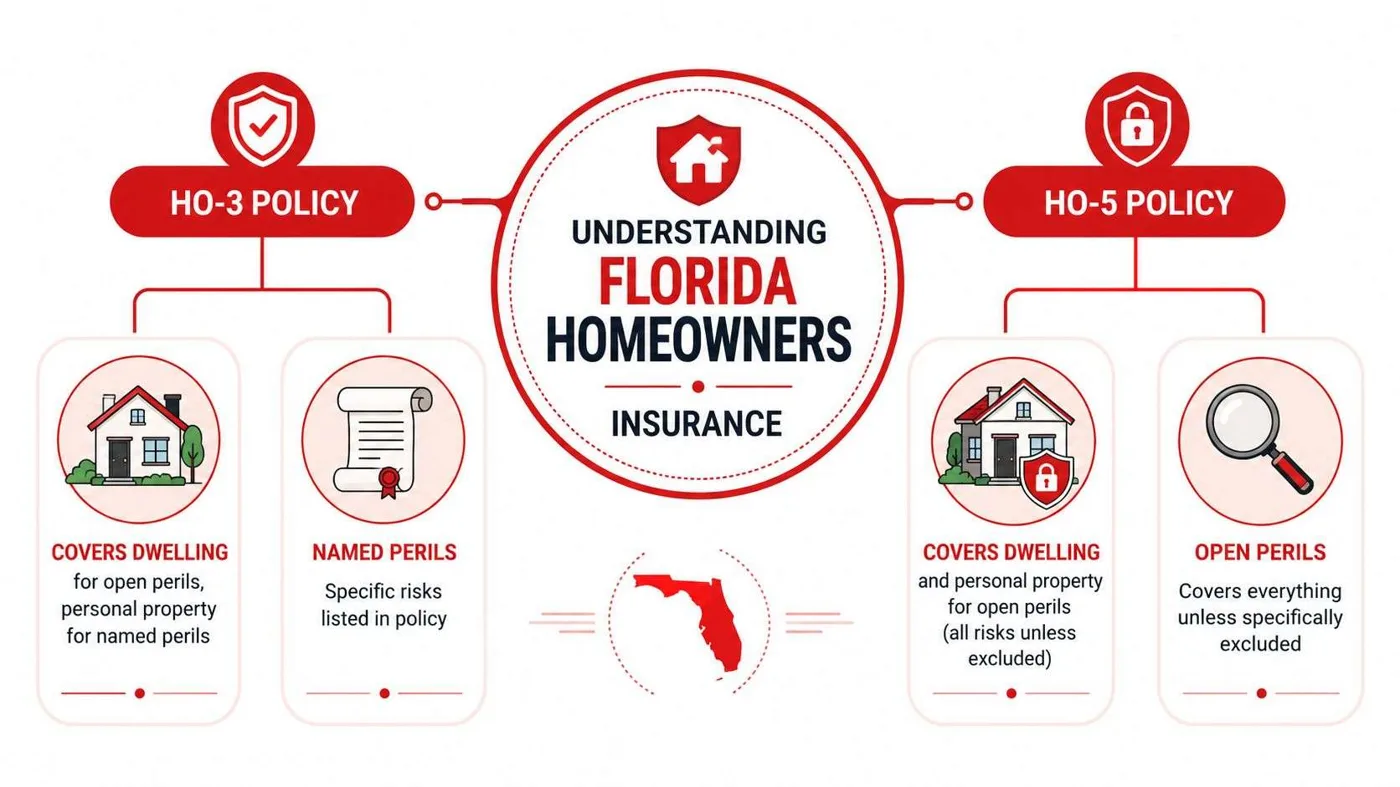
An HO-3 policy usually covers the dwelling on an open-perils basis, which means the house itself is covered unless the policy excludes the cause. Personal belongings are usually handled more narrowly under named perils, which means the policy lists the events that qualify.
An HO-5 policy is broader. It generally applies open-perils treatment to both the dwelling and personal property, subject to exclusions. That's why people often see it as the premium version of standard home coverage.
A simple way to think about HO-3 and HO-5
Here's the plain-language difference:
| Policy type | Dwelling coverage | Personal property coverage | Best fit |
|---|---|---|---|
| HO-3 | Usually open perils | Usually named perils | Many standard owner-occupied homes |
| HO-5 | Usually open perils | Usually open perils | Homes that qualify for broader protection |
If your home is newer, better updated, and easier for an insurer to underwrite, broader forms may be easier to access. If the property has more underwriting concerns, the policy may be narrower or require more conditions.
A few practical examples help:
- Older home with mixed updates: An HO-3 is often the more common fit because carriers may be more cautious about broad property coverage.
- Newer well-maintained home: An HO-5 may make more sense if you want broader treatment for belongings and fewer fights over whether a listed peril applies.
- Home with higher-value contents: Broader personal property treatment can matter if replacing belongings would be expensive and complicated.
A policy form doesn't replace endorsements or flood coverage. It just changes the base layer of how protection is built.
For Tioga homeowners, the lesson is simple. Start by asking not just "What is the premium?" but "How does this form respond when the cause of loss is disputed?"
Peril Specific Considerations for Tioga Homes
Tioga homeowners often hear the same shorthand: "You have homeowners insurance, so you're covered for storm damage." That's only partly true. In Florida, the cause of the damage matters as much as the damage itself.
What a standard Florida policy usually handles
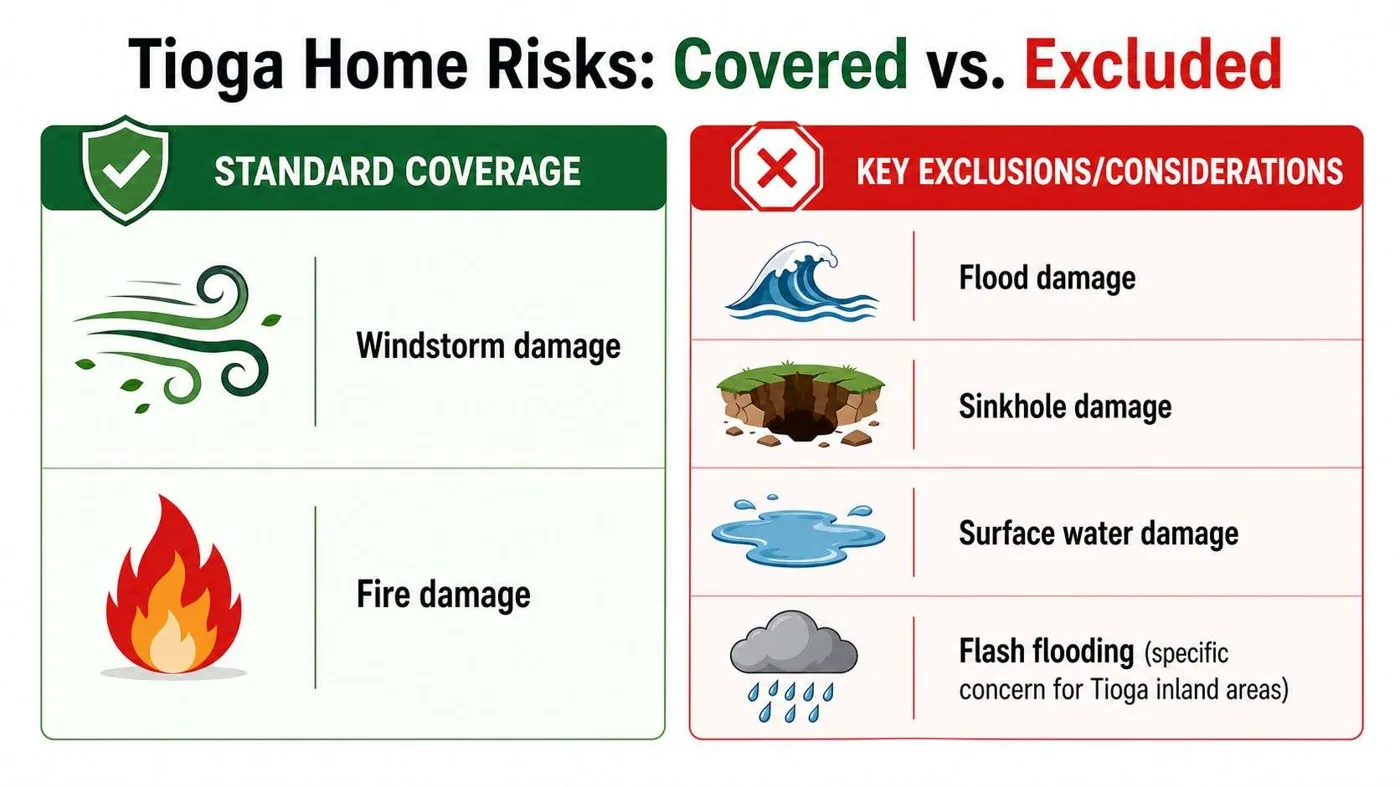
A standard homeowners policy in Florida commonly covers direct damage from events such as fire and windstorm, subject to the policy terms. That's the part many people already know.
Where confusion starts is water and ground movement. A policy can cover wind-driven roof damage but still exclude damage caused by flood or surface water entering from outside. It can respond to one kind of storm loss and reject another that looks almost identical to the homeowner.
That distinction isn't minor. A 2025 study found that 28% of Florida homeowners insurance claims were denied due to ‘non-covered cause' misunderstandings, often involving flood, sinkhole, or surface water damage excluded by default.
Where Tioga homeowners often get caught off guard
Tioga's inland setting changes the risk conversation. You may have less coastal surge exposure, but heavy rain, drainage issues, and localized flooding can still create expensive damage. Homeowners often use the word "flood" to mean any water damage. Insurers don't.
Here's a basic way to separate the common categories:
- Windstorm damage: Often part of the standard policy, subject to deductible and policy wording.
- Flood damage: Usually requires a separate flood policy.
- Sinkhole or earth movement damage: Often excluded unless additional coverage or a specific endorsement applies.
- Surface water intrusion: Often excluded under standard policy language.
If you notice stair-step cracks, sloping floors, sticking doors, or widening gaps around openings, it helps to understand whether the issue may involve settlement or ground movement before you assume insurance will step in. Homeowners trying to understand structural warning signs may find Firm Foundations' expert advice useful because it explains how settlement can show up in a home before the insurance question is even answered.
Water from above and water from the ground aren't treated the same way. That's one of the most expensive misunderstandings in Florida insurance.
For storm questions tied specifically to wind and hurricane-related concerns, it also helps to review a Florida-focused explanation of whether homeowners insurance covers hurricane damage. That kind of review gives you a better test for your own policy wording than relying on assumptions.
Common Endorsements and Deductible Choices
A standard policy gives you a base layer. Endorsements are the add-ons that close gaps, expand protection, or tailor the contract to the home you own. In Florida, those choices matter more than many homeowners realize.
Endorsements that fill real gaps
Some endorsements are about convenience. Others are about avoiding a painful surprise. For Tioga homes, these are the ones people most often need to review closely:
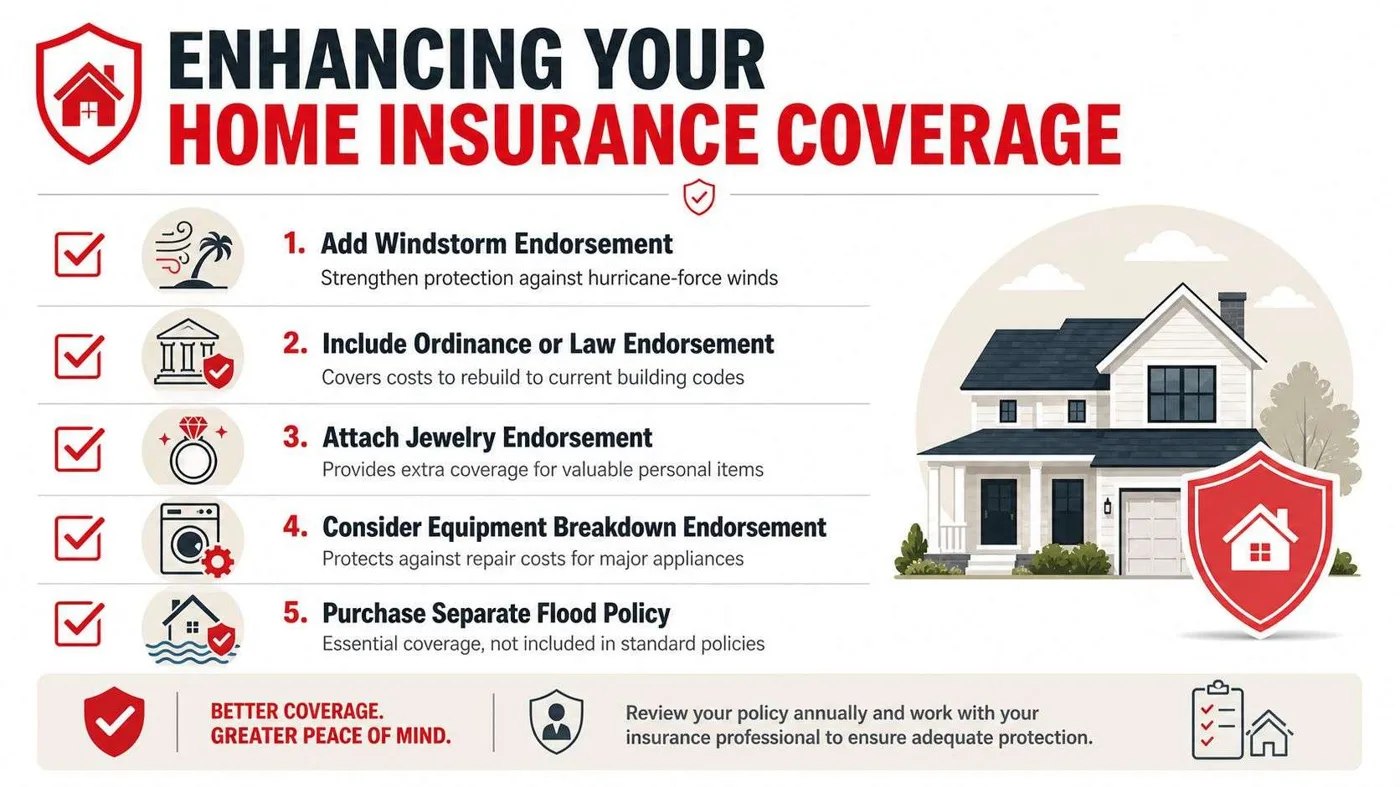
- Separate flood protection: Standard homeowners insurance usually doesn't include flood. If runoff or rising water is part of your concern, this isn't optional.
- Sinkhole or ground-related coverage: Florida homeowners should check whether the policy excludes these losses or offers a way to buy back protection.
- Ordinance or law coverage: If part of the house must be rebuilt to current code after a covered loss, this can matter more than homeowners expect.
- Scheduled valuables coverage: Jewelry and other high-value items may need special treatment if base policy limits are tight.
- Equipment breakdown coverage: This can help with certain home systems and appliances when the cause fits the endorsement wording.
A good endorsement review should feel like checking the spare tire before a road trip. You hope you won't need it, but you want to know it's there.
How deductibles change your risk
Deductibles are where many Tioga homeowners accidentally under-read the policy. They focus on monthly cost and miss the amount they'd pay first before coverage starts responding.
In Florida, windstorm deductibles deserve special attention. Florida mandates that all homeowners insurance policies include a minimum 5% deductible for windstorm coverage, with some carriers offering lower options for inland properties but higher deductibles along the coast. That means your wind claim deductible may work very differently from your all-other-perils deductible.
A quick way to think about deductible choices:
- Lower premium, higher out-of-pocket risk: This works only if you could comfortably absorb the deductible after a major storm.
- Higher premium, lower out-of-pocket risk: This may fit homeowners who want more predictable claim-time costs.
- Different deductibles for different causes: This is the part that surprises people most in Florida.
Decision shortcut: Don't pick a deductible based only on what feels affordable each month. Pick one based on what you'd be able to pay during a stressful week after a loss.
Cost Drivers and Savings Strategies
Two Tioga homes can sit within a short drive of each other and still receive very different premiums. That's because pricing doesn't start with the map. It starts with the house.
Why one home costs more to insure than another
Age is one of the clearest examples. In North Florida including Tioga, homes built in 1980 average $18,365 per year in premiums, while 2020 construction averages $7,914, a 132% difference driven by modern code-compliant features. That spread tells you something important. Insurers aren't only pricing weather. They're pricing how the home is likely to hold up when weather arrives.
Newer homes often benefit from updated roof systems, stronger attachment methods, better opening protection, and building features that line up with current code expectations. Older homes may still be solid houses, but if their roof, windows, or structural details don't reflect newer standards, insurers usually see more uncertainty.
Upgrades that can strengthen a quote
If premium pressure is high, broad advice like "shop around" isn't enough. Homeowners Insurance Near Tioga often improves when you strengthen the property profile first.
Focus on practical mitigation items:
- Roof condition: An older roof can raise concern quickly, especially if records are incomplete.
- Wind-resistant features: Hurricane straps, reinforced roof-to-wall connections, and impact-resistant openings can improve how the risk is viewed.
- Construction details: Masonry construction and documented updates often help more than cosmetic improvements.
- Maintenance history: Insurers pay attention to signs of deferred upkeep because small issues can turn into larger claims.
A useful mindset is to separate upgrades into two groups. The first group reduces the chance of damage. The second group makes it easier to prove the home is insurable.
For example, replacing worn exterior elements may help prevent loss. Keeping permits, receipts, and inspection records helps show underwriters what's already been improved. Both matter.
A kitchen remodel may make the home nicer to live in. A documented roof and wind-mitigation improvement may make the home easier to insure.
You may also save through bundling, a wind-mitigation inspection, and updating older components that trigger underwriting concern. But the larger lesson is this: the best savings strategy in Florida often starts with risk reduction, not discount chasing.
Local Case Studies for Tioga Area Homeowners
Real homeowners don't experience insurance as a list of definitions. They experience it when a crack spreads, a storm tears at the roof, or a renewal notice arrives with uncomfortable terms. The examples below are representative Florida-style scenarios, not named client stories, but they reflect the exact kinds of decisions Tioga homeowners face.
Case study one after signs of ground movement
A homeowner in the Tioga area noticed interior cracking that had slowly become harder to ignore. At first, it looked cosmetic. Then a door stopped latching cleanly, and one exterior crack widened after a wet stretch.
The homeowner assumed standard home insurance would respond if a structural problem turned serious. Only after reviewing the policy did the actual issue become clear: the concern might fall into an excluded ground-related category, depending on the cause.
This kind of case teaches a simple lesson. A house can show physical damage that feels sudden to the owner, while the policy still asks a narrower question: what caused it?
The smarter move in situations like this is to investigate the condition early, document changes, and confirm whether any optional protection is in place before damage worsens.
Case study two after mitigation upgrades
Another Tioga-area homeowner took a different path. Instead of waiting for renewal season, the homeowner reviewed the property as an underwriter would. Roof documentation was organized, mitigation features were identified, and updates were highlighted clearly when quotes were requested.
That didn't eliminate Florida market pressure. It did create a stronger file.
The result wasn't just about price. It also improved clarity. The homeowner could compare deductibles, wind treatment, and exclusions with a better understanding of what the house offered from a risk standpoint.
A few takeaways stand out:
- Documentation changes conversations: Receipts, inspection reports, and permit records help insurers evaluate the home on facts.
- Mitigation isn't only about damage prevention: It can also improve eligibility and quoting confidence.
- Early review beats renewal panic: Waiting until a notice arrives limits your options.
These examples point to the same conclusion. Homeowners Insurance Near Tioga works best when you approach it before a loss, not during one.
How to Compare Quotes and Carriers
A quote comparison should answer more than "Which premium is lowest?" In Florida, the better question is "Which option gives me the most usable protection with the fewest bad surprises later?"
What to compare besides price
Start with the parts that affect claim outcomes and renewal stability.
Look at these side by side:
- Coverage form: Is the policy broader or narrower in how it handles belongings and excluded causes?
- Deductible structure: Are wind and non-wind deductibles different?
- Exclusions and endorsements: What's missing by default, and what has been added back in?
- Renewal outlook: How likely is the carrier to tighten underwriting after market changes or a claim?
That last point matters more today than many homeowners realize. Since 2022, average homeowners premiums in Florida rose 68% while coverage availability dropped 22% in rural counties, increasing the risk of renewal denial even for policyholders with clean histories.
Carrier Comparison for Tioga Area
Because carrier terms change and individual underwriting varies, the best comparison table for Tioga is a framework rather than a list of named companies.
| Carrier | Average Premium | Key Coverage Features | Renewal Risk |
|---|---|---|---|
| Carrier A | Varies by home details | Standard dwelling coverage, review exclusions closely | Depends on underwriting appetite and claim activity |
| Carrier B | Varies by home details | Broader options may be available for stronger risks | Review non-renewal approach carefully |
| Carrier C | Varies by home details | May offer useful endorsements for Florida-specific gaps | Market pullbacks can affect long-term stability |
A clean comparison process usually follows this order:
- Put the same dwelling amount on every quote.
- Match deductibles as closely as possible.
- Check whether flood, sinkhole-related protection, or ordinance coverage is included, excluded, or optional.
- Ask how the policy handles renewal changes after a claim.
- Read the exclusions page, not just the declarations page.
The cheapest quote is only cheaper until it excludes the loss you actually have or becomes hard to renew.
Navigating the Claims Process and Next Steps
When damage happens, people want speed. That's understandable. But the first few steps after a loss often shape the entire claim. Slow down just enough to document clearly.
What to do right after a loss
Use a simple order of operations:
- Protect people first: If the damage creates a safety issue, get everyone clear of the area.
- Prevent additional damage when you can: Reasonable temporary steps matter, such as covering an opening if it's safe to do so.
- Photograph and video the damage: Get wide shots and close-ups before cleanup changes the scene.
- List damaged items and affected areas: Room-by-room notes help later.
- Report the claim promptly: Delays can complicate the timeline and the investigation.
If storm damage is involved, practical repair guidance can help you document emergency conditions while protecting the property. Homeowners dealing with roof or exterior loss often benefit from reading about handling storm damage insurance claims because it explains what to document before repairs move too far ahead.
For a Florida-specific filing walkthrough, review how to file a home insurance claim. A step-by-step checklist is often the easiest way to stay organized when you're already stressed.
What to do if the first answer is no
A denial isn't always the end of the conversation. Sometimes the problem is missing documentation. Sometimes the issue is causation. Sometimes additional damage is discovered after the first inspection.
If that happens:
- Request the denial reason in writing: You need the exact policy basis, not a vague summary.
- Compare the denial language to the policy wording: The key issue is usually the stated cause of loss.
- Submit supplemental information: Photos, contractor observations, and updated damage details may matter.
- Keep a communication log: Dates, names, and next steps reduce confusion later.
Claims move more smoothly when the homeowner stays organized, calm, and specific. The strongest file is usually the clearest file.
The next practical move for many Tioga homeowners is to review the current policy before the next storm season, confirm whether flood or ground-related gaps exist, and gather roof and mitigation documents so quote comparisons are based on solid property details.
Have questions about your coverage?
Our Newberry and Micco, FL team can walk through your policy and find the right coverage at the right price.
Get a Free Quote