Mobile Home Park Insurance Florida: 2026 Guide

You're probably staring at a quote that looks expensive, a lease file that needs a flood disclosure, and a park that still has residents asking who's responsible when a storm drops a limb on a carport. That's the reality of mobile home park insurance Florida owners deal with. The mistake is treating the park like vacant land or a simple apartment parcel. A Florida mobile home park is a living residential community with roads, utilities, common areas, amenities, and real liability exposure every time a resident, guest, or contractor steps onto the property.
Why Mobile Home Park Insurance in Florida Is Its Own Coverage Problem
A park owner near Gainesville once thought the property was buttoned up. The site had a general liability policy, a land policy, and a management company that stayed on top of resident issues. Then a hurricane clipped the community, a limb came down, and a resident blamed the park for the loss. That's when the owner found out the hard way that park-level insurance is not the same thing as insuring individual mobile homes.
The issue is simple. The park doesn't just sit there. It operates roads, lighting, drainage, signage, shared green space, maybe a clubhouse, maybe a maintenance shed, and often a front office. It also creates a legal duty to keep common areas reasonably safe. When a claim happens, the question is never just, “Did the storm hit?” The central question is, “What part of the park failed to perform, and who carries the liability for it?”
What the park policy needs to touch
A proper park policy focuses on the owner's exposure, not the resident's home. That means common areas, owned structures, operational equipment, and third-party injury claims tied to the property. It's a distinct exposure line because the risk lives in the community operation itself, not in the contents of one home or the dwelling policy on a single lot.
That's why a Florida-only independent agent matters here. The market is specialized, and placement often takes more than one carrier conversation. If you're evaluating a park purchase or a park refinance, evaluate mobile home park deals with the insurance question attached from the start, because the deal looks different once liability, wind, and property limits are on the table.
Practical rule: if the park owns it, maintains it, or invites people to use it, assume it belongs in the insurance conversation.
The better way to think about the policy is this, park insurance protects the business of running the community. It does not replace resident coverage, and it does not magically cover every storm-related loss. It should be built around the park's physical layout, its amenities, and the claims that happen in Florida communities.
The Florida Market Conditions Park Owners Should Know
Florida is a hard market for mobile-home risks. Carrier appetite is narrow, the state-backed insurer shapes too many conversations, and park owners feel that pressure first. Florida Office of Insurance Regulation data cited in 2024 shows that only eight insurers account for Florida's mobile-home insurance market share, with the state-backed insurer holding 42% of the market and 57,906 active policies in 2023. The next-largest carrier has 36% and 49,866 active policies, while the rest trail far behind, including 8% and 6% shares for two smaller carriers.
That concentration tells park owners exactly how this market works. It is not a commodity space where a long list of carriers competes on the same terms. It is a specialty segment under weather stress, where wind eligibility, property condition, and underwriting appetite matter more than glossy sales talk. The first quote is rarely the right quote, and the cheapest quote usually leaves out something the owner will care about later.
Scale matters, but carrier appetite matters more
Florida has a large mobile-home footprint, and that size creates a real insurance niche. One Florida-focused industry source cites about 260,127 active owner-occupied mobile-home policies in the state and says the top five insurers write 78% of them, while another statewide industry source says Florida has roughly 5,400 licensed mobile-home parks, lodging facilities, and RV parks (Florida mobile home park insurance overview). That is a meaningful market, but it is still a tight one.
The pricing pressure shows up in the individual-home side first, then spills into park-level conversations. One 2024 industry summary places Florida mobile-home insurance costs at roughly $900 to $1,400 annually for individual policies, which tells you affordability is already tight before you start layering in park property and liability needs. For park owners, that does not translate into a clean rate sheet. It means one carrier may like the location, another may reject the roof age, a third may accept liability, and the piece that matters most may still be excluded.
The practical takeaway is plain. If you are shopping mobile home park insurance Florida, you are dealing with a specialty market with limited carrier participation and heavy reliance on the state-backed backstop. That is why a Florida-only independent agent matters here. You need someone who can compare what is available, push on underwriting points that matter, and tell you fast when a quote looks thin on wind, property, or liability.
Core Coverage Layers Every Florida Park Owner Should Understand
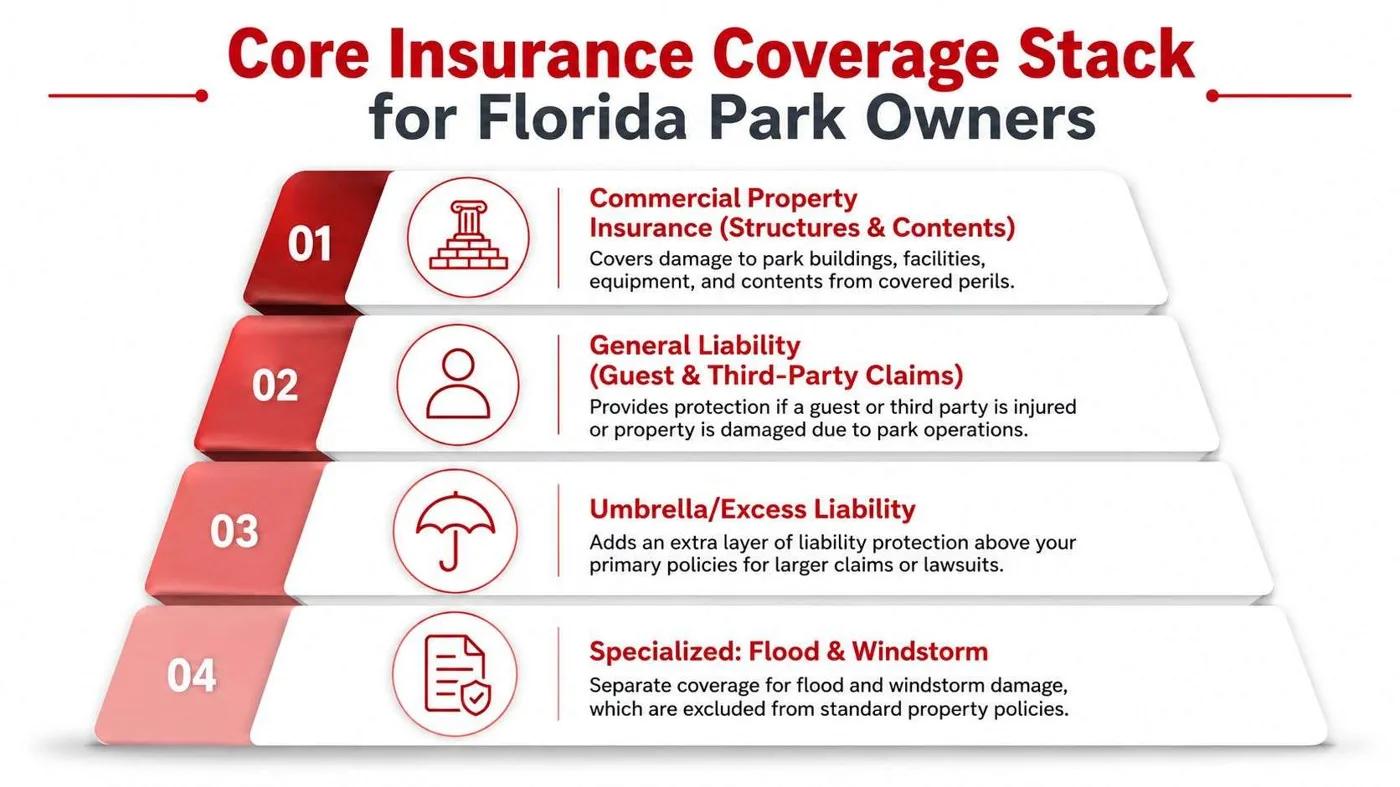
The right park policy is built in layers. Start with the structures and grounds the park owns, then cover injuries and lawsuits, then add excess protection, then address the Florida exposures that a standard property form usually leaves hanging.
Start with property and liability, not wishful thinking
Commercial property insurance is the base layer for owned structures and fixed assets. That usually includes the office, clubhouse, maintenance buildings, signage, and other improvements the park owner controls. If a storm damages a shared structure or a fire hits an owned building, this is the policy that should respond first. Too many owners underfund this layer because they focus on lot income instead of the physical assets that keep the park running.
General liability comes next. This is the coverage that responds when a guest slips on a wet common-area walkway, a contractor gets hurt near a work zone, or a resident says the park failed to maintain a dangerous area. Some park owners stop there and assume they are covered. They are not. Liability does not repair buildings, and property coverage does not pay third-party injury claims.
For a plain-English look at how liability sits above the rest of the stack, Edinhart's insurance coverage guide helps explain why park owners need a real liability structure, not just a bare policy with a low limit.
My rule for Florida parks: if the property has guests, contractors, tenants, or vendors on it, the liability limit deserves the same seriousness as the property limit.
Add the layers that actually matter in Florida
Commercial umbrella is the next layer for many parks. It does not replace liability, it sits on top of it. That matters because Florida claims can get ugly fast once lawyers get involved. If you want a clear explanation of how that excess layer works, this commercial umbrella guide is a useful reference point.
Commercial auto belongs on the list if the park owns vehicles. Workers' compensation matters if there are employees. Flood and windstorm need separate attention because standard property forms rarely give you the protection you assume they do. Pollution liability deserves a hard look if the park has aging septic systems, fuel storage, or older utility infrastructure. Park-model endorsements come up when the park rents units or manages park-model inventory.
If you are reading policy language and comparing proposals, focus on what each layer pays for. The right quote is not the cheapest one. It is the one that matches the park's real exposures without leaving the owner exposed to a claim gap that shows up after a storm or injury.
How Florida Hazards and Statutes Shape What You Can Insure
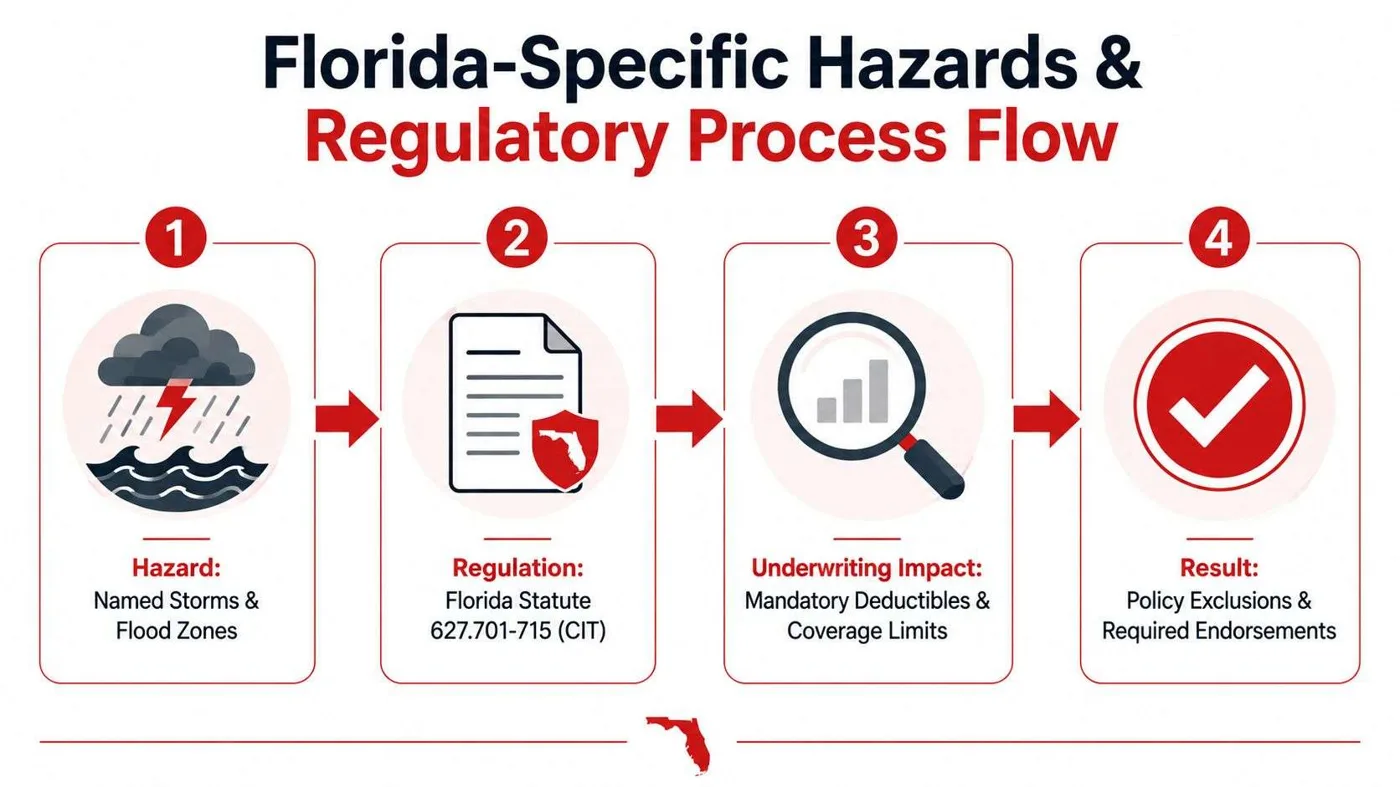
Florida law and Florida weather are a package deal. Park insurance gets harder here because the hazards are real, the statutes are specific, and underwriting ties coverage eligibility to compliance in ways many owners don't expect. Wind, flood, installation standards, and permitting all affect whether a carrier will write the risk and what it will exclude.
Windstorm and foundation standards are not optional
Florida Statutes section 320.8325 says mobile homes, manufactured homes, and park trailers subject to windstorm insurance rules must be installed on a permanent foundation that resists wind, flood, flotation, overturning, sliding, and lateral movement (Florida Statutes 320.8325). It also says licensed insurers in Florida may issue windstorm insurance only if the home has been installed according to state standards. That linkage matters because it connects installation compliance directly to underwriting eligibility.
Flood is handled separately, and the rule isn't guesswork. For Florida mobile-home parks, flood insurance is not universally mandatory, but it is required when the property is in a FEMA-designated Special Flood Hazard Area and has a federally backed mortgage. Independent Florida guidance also notes that a separate flood policy may come through FEMA's National Flood Insurance Program or a private flood carrier. Park owners who treat flood as a casual add-on usually find out after a loss that the carrier meant “not included.”
Compliance documents matter more than most owners think
Florida's Mobile Home Park law requires every park owner to pay an annual fee of $4 per mobile home lot to the state division on or before October 1 each year, and the owner must provide a flood disclosure to a prospective lot lessee before the rental agreement is signed or at occupancy, whichever comes first (Florida Mobile Home Park law). That's not paperwork for the file cabinet. It's compliance evidence.
Florida health regulations also require a park applicant to submit a plan to the county health department with the area and dimensions of the tract, space numbers or designations, the location and size of all proposed spaces, the location of roadways, and the location of any added service buildings. The application must also include information on the water system, sewage disposal system, and any swimming pools, and the permit fee is based on the number of spaces in the park (Florida Department of Health mobile home and RV park requirements).
The carrier sees all of this as underwriting proof. If a park can't show it understands flood disclosure, site planning, and foundational compliance, the quote conversation gets harder. Florida doesn't reward loose operations.
Underwriting Factors and Common Exclusions That Catch Park Owners Off Guard
Carriers do not just price a Florida park. They inspect it for loss potential, and they do it fast. Underwriters want to know whether the property is orderly, maintained, and less likely to turn into a claim after a storm or an injury.
What underwriters actually look at
They look at infrastructure condition, road and lot maintenance, fencing, lighting, the age of water and sewer systems, and whether the park has pools or playgrounds that add liability exposure. Loss history matters too, along with how close the property sits to wind and flood exposure. A clean, well-run park with written tenant rules is easier to place than a property where maintenance only happens after complaints.
A park that looks neglected in photos usually gets treated that way in the quote.
They also want documents. An underwriter wants to see how the park handles screening, lease enforcement, and evictions, because weak operations often show up later as liability problems. That is the part many owners miss. The policy is not judged only by the address. It is judged by how the park is run, how the paperwork is kept, and whether the owner can show basic control.
Exclusions that surprise owners
Standard property policies usually exclude flood, and wind often comes with separate deductibles or tighter terms. Pollution tied to underground storage tanks or older systems can be excluded or sharply limited. Mold from long-term leaks is another common issue. On the liability side, punitive damages may be excluded or limited depending on the form.
Those exclusions are why a quote review should never stop at the premium. Read the exclusions page first, then the declarations page, then the endorsements. If a carrier is vague about the flood piece or the wind wording, treat the gap as real until someone proves otherwise.
For a plain-English reference point on what a commercial property form usually covers and where the gaps show up, this property coverage guide helps frame the right questions before a binder is issued.
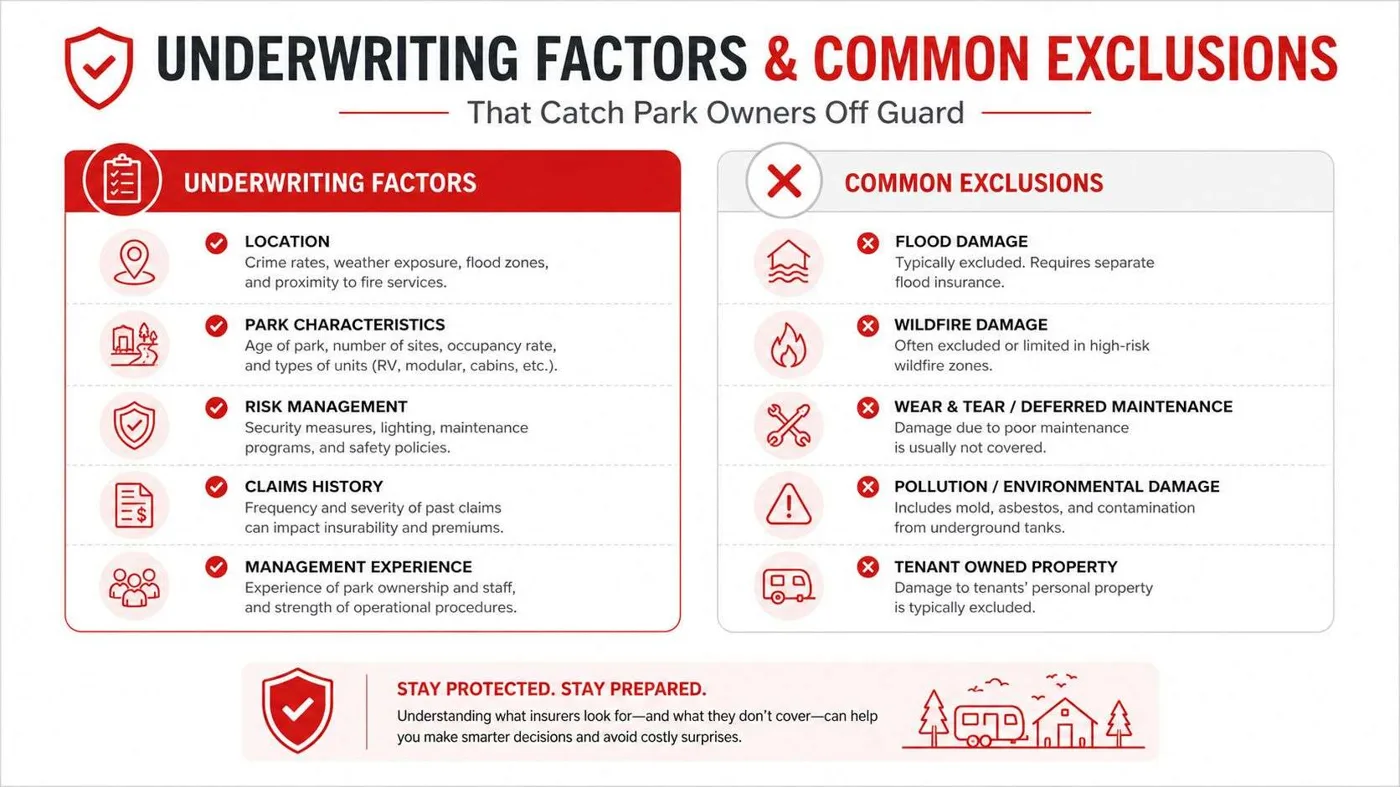
Do a practical self-audit before you shop. Check the lighting, look at the pavement, review the fence line, confirm the utility age, and gather the loss history. If the property would look bad in a claims file, it will look bad to an underwriter too. Florida carriers reward parks that can show clean operations, clear records, and maintenance that happened before the loss instead of after it.
What Mobile Home Park Insurance in Florida Actually Costs
Pricing is driven by size, location, construction quality, claims history, and how much of the Florida risk stack you're trying to insure at once. A small inland park with limited amenities is a very different buyer than a larger coastal property with more common-area exposure and more weather pressure.
Indicative annual premium ranges for Florida mobile home parks
| Park Size | Liability Only | Property + Liability Package | Full Program with Umbrella, Flood, and Pollution |
|---|---|---|---|
| Small, under 50 lots | Lower entry point than larger parks, often quoted first on liability strength | Higher than liability only because owned structures enter the picture | Highest of the three structures because every added layer brings more underwriting scrutiny |
| Mid-size, 50 to 150 lots | More expensive than a small park because there are more people, more roads, and more common areas | A typical step-up when the park owns visible infrastructure | Usually the most balanced option for parks that want real storm and claim protection |
| Larger parks | Premiums rise with complexity, amenities, and operational exposure | Often requires more documentation and more property detail | The most demanding structure to place, especially if flood and pollution are in play |
The range is not a math exercise. It's a risk conversation. An inland park in Alachua County is usually easier to place than a comparable park in coastal Pinellas or Brevard because location still matters more than almost anything else. If the property sits in a harder wind or flood area, the carrier will price that reality into the quote no matter how good the maintenance looks.
What you can influence, and what you can't
You can influence wind mitigation details, fencing, lighting, cleanup standards, and how well the park documents emergency contacts and maintenance routines. You can't change the map. A park in a rough flood or wind area is never going to price like a park inland.
The smartest owners don't chase the lowest number. They improve the property where it helps, then they compare like for like. That's how you avoid paying for coverage you don't need while still protecting the park from a claim that could wreck cash flow.
How to Get Quotes and File a Claim in Florida
The quote process gets easier when you hand the agent a clean story. Build a one-page park summary with the lot count, common-area square footage, amenities, prior claims, and employee count. Then attach the documents that matter, site plan, health permit, lease form, flood disclosure language, and current photos.
My advice: if a carrier has to chase basic facts, the quote will usually take longer and cost more.
Use a Florida-only independent agent who can shop more than one market. One carrier may like the property but dislike the roof age. Another may accept the liability but cap the wind piece differently. Comparing quotes on price alone is a trap. Compare limits, exclusions, deductibles, and endorsements first.
When a hurricane or major claim hits, call the agent first and document everything before cleanup starts. Take timestamped photos, separate wind damage from flood damage, and keep repair invoices organized. If flood coverage is involved, file it through the appropriate flood carrier path, because wind and flood are not the same loss.
For a step-by-step claims reference, this Florida insurance claim guide is helpful when you're trying to avoid the usual mistakes after a storm. The goal is simple, preserve evidence, notify quickly, and don't let anyone blur the line between covered wind damage and excluded flood damage.
Schneider and Associates Insurance Agencies writes insurance in Florida and helps park owners sort out the mix of property, liability, flood, and umbrella coverage that makes sense for a specific community. If you own or are buying a park, visit Schneider and Associates Insurance Agencies and ask for a Florida-only review of your park insurance program.
Have questions about your coverage?
Our Newberry and Micco, FL team can walk through your policy and find the right coverage at the right price.
Get a Free Quote