Modular Home Insurance Gainesville Area: Complete 2026 Guide

You just got a renewal notice, the premium is higher again, and now you're wondering whether your Gainesville modular home is really insured the way your lender expects. That's the exact moment people discover the difference between a home that's built modular and a file that's documented correctly, because the claim outcome often turns on paperwork, flood status, and wind terms, not on what the house looks like from the driveway.
For modular home insurance Gainesville area coverage, the right move is simple. Make sure the carrier sees the home as a permanently installed residential structure, make sure flood is handled separately, and make sure the wind deductible is something you can survive after a storm. Florida-only underwriting is the whole game here, and the right quote starts with proof, not assumptions.
Why Gainesville Modular Homeowners Need the Right Policy
A Gainesville owner once called after a hurricane claim went sideways. The house was modular, permanently installed, and built to code, but the insurance file still described it in a way that made the carrier treat it like a different risk class. That mismatch didn't matter when the bill was paid each month, it mattered when the adjuster started asking for documents.
Practical rule: if the policy file doesn't prove what the house is, the insurer may not pay it the way you expected.
That's the hard lesson in Florida. The word modular does not automatically guarantee the right form, the right limits, or the right deductible treatment. A properly written modular home in Gainesville is usually insured like a standard residence when it's permanently affixed to a foundation, but the underwriting decision still depends on how the home is recorded, installed, and exposed to wind and flood risk, not on the owner's description of it. Florida pricing also isn't gentle, because a 2026 analysis put Gainesville homeowners insurance at $3,940 per year for a $300,000 dwelling policy and $2,897 per year for $200,000 in dwelling coverage, which shows how expensive residential property can get even away from the coast, according to the Florida insurance market analysis on Schneider's Gainesville and Florida pricing page.
The goal is to get the policy aligned before a loss. That means the carrier should see the home as a permanently installed residential structure, flood should be addressed separately, and the wind structure should match Gainesville's storm reality. If any one of those pieces is off, the claim file gets harder to defend and the settlement gets slower.
Florida-only carriers and Florida-only agencies understand that distinction. They're not guessing at coastal loss patterns or outside-state rules, they're working from Florida's actual underwriting habits. That's why the next step is never “buy the cheapest quote.” It's “prove the home, then quote the home.”
Modular vs Manufactured vs Mobile Homes Explained
Carriers price these homes differently because the construction and title trail are different. A home built before June 15, 1976 sits on the pre-HUD side of the line, so insurers often treat older mobile homes as harder risks or decline them entirely, while homes built after that date generally fit more standard manufactured-home programs, as explained in Realtor.com's overview of mobile home insurance. For owners comparing options, a separate manufactured home insurance page is the right place to study how those programs differ from a modular setup.
The classification that actually changes the policy
A modular home is the cleanest category for insurance. When it is permanently affixed to a foundation and meets local building codes, it is usually written like a site-built home, so a standard HO-3 homeowners policy is often the correct form instead of a mobile-home-specific policy. That changes how the insurer sets replacement cost, wind and hail deductibles, and lender acceptance, because the risk is tied to a permanent dwelling rather than a unit that can be moved, as outlined in Tri-Town Construction's modular home insurance guide.
A lender does not care what the home is called in casual conversation. It cares what the deed, installer paperwork, and county record say.
That is the point many homeowners miss. If a home is called modular in conversation but the file looks like a manufactured home, the quote can come back on the wrong policy form or at a worse price. The paper trail matters more than the label people use at the kitchen table.
What to verify before anyone binds coverage
- Construction date: pre- and post-HUD homes are treated differently by carriers.
- Permanent installation: the foundation and affixation records should show the home is real property.
- Policy form: standard residential coverage is usually appropriate for a properly installed modular home.
- Flood handling: flood is separate no matter how the home was built.
For Gainesville owners, that is the takeaway. The deed, installer documents, and county file carry more weight than the word “modular” by itself.
Required and Recommended Coverages
Start with dwelling and contents
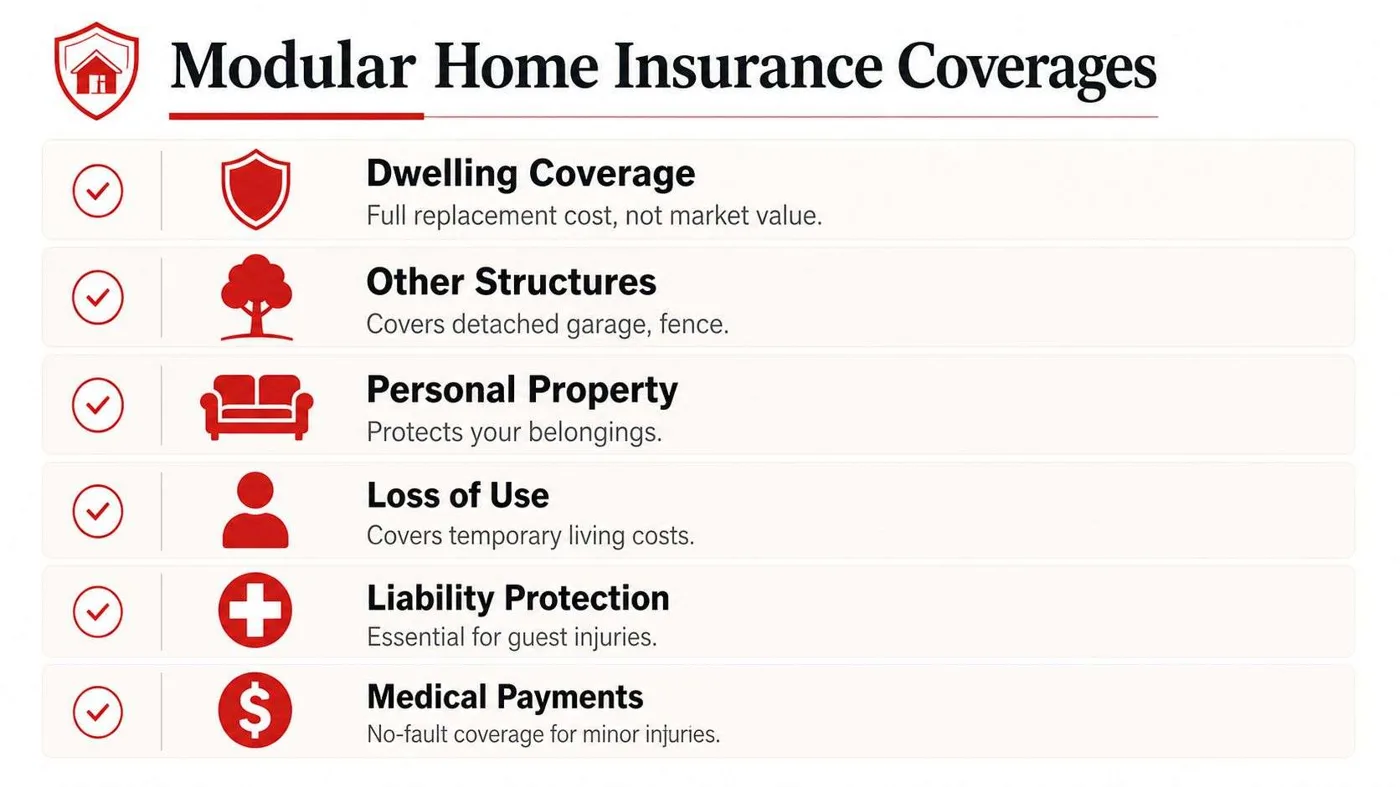
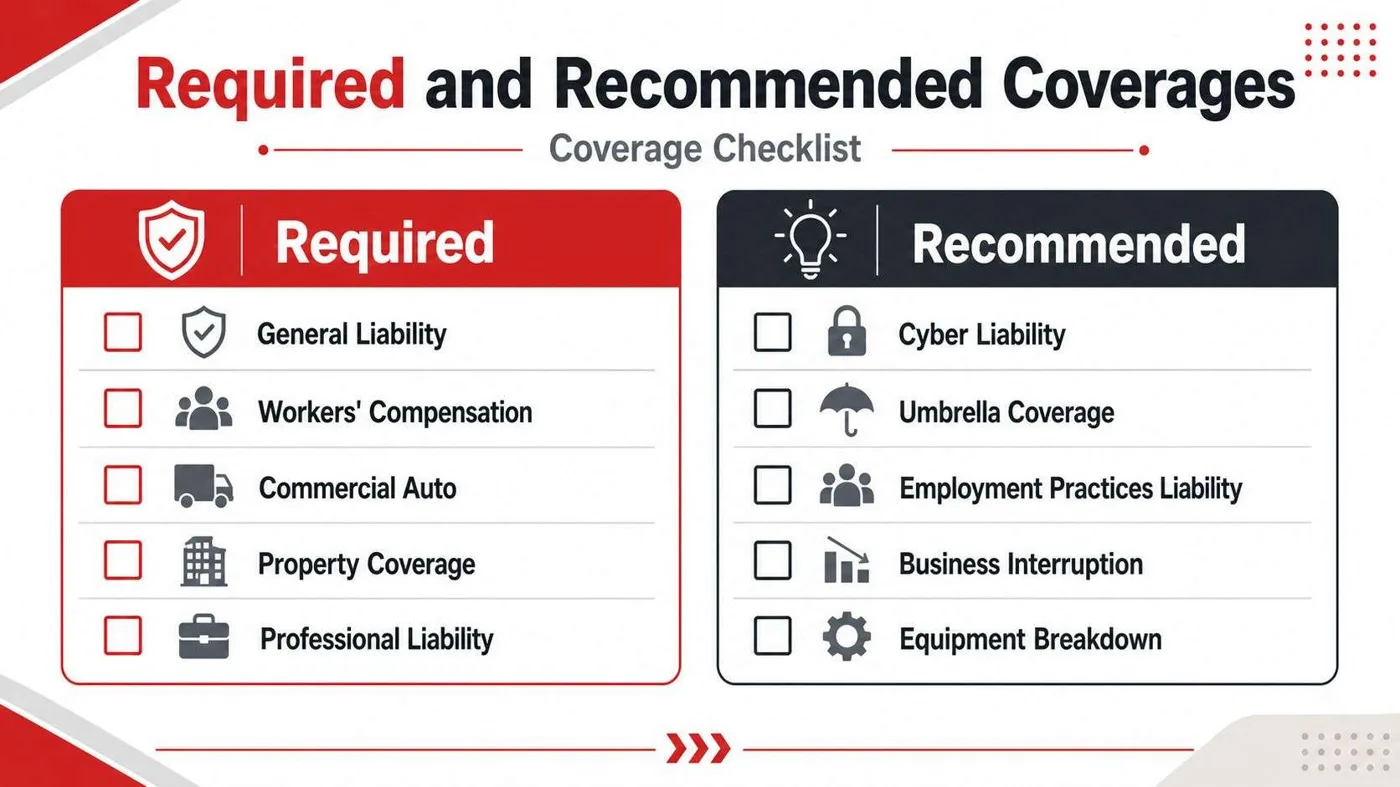
The first number you should care about is dwelling coverage. Set it to full replacement cost, not market value, because a payout based on what the home could sell for is the wrong benchmark after a loss. For Florida modular homes, the structure is the main asset, so the policy has to rebuild that structure, not just reflect a resale figure.
Personal property comes next. This coverage usually sits as a percentage of the dwelling limit, and the only smart way to set it is against actual contents, not a vague guess from the quote screen. If the home holds quality furnishings, electronics, tools, or seasonal items, the contents limit needs to reflect that reality.
Liability and the coverages people forget
Liability coverage should be taken seriously, because guest injuries and property damage claims can get expensive fast. In Florida, $300,000 is the practical floor I recommend for most owners, especially if you have frequent guests, a pool, or a detached structure on the lot, and the market context in Gainesville makes that higher floor sensible, according to Florida pricing benchmarks on Kin's Gainesville mobile-home insurance page.
Loss of use matters too. If a covered loss makes the home unlivable, the policy should help with temporary housing and related living costs. Debris removal is another line people skip reading, then regret later when a storm leaves the lot covered in cleanup work.
The two protections standard homeowners forms do not bundle
Flood is separate. Standard homeowners and modular-home policies do not include flood damage, and Florida owners should plan on a separate flood policy through the NFIP or a private carrier, as noted in Bankrate's Florida mobile home insurance guide. Wind is also where homeowners get surprised, because Florida HO-3 forms often use a percentage deductible for hurricane or wind losses rather than a flat deductible.
One more blunt point. Mortgage lenders can demand minimums that are stricter than the law, so the policy has to satisfy the loan file, not just the state minimums. If you're comparing quotes, ask what pays after fire, wind, hail, and flood, because those are the claim events that decide whether the policy was worth buying.
Gainesville Area Flood Zones and Hurricane Exposure
Gainesville sits inland, but inland does not mean low risk. The Santa Fe River system, the Newnans Lake basin, and a network of creeks can put specific neighborhoods into flood-sensitive territory, which is why a modular home in a mapped floodplain can still need flood insurance even if it has never taken water. If the lender requires it, the map controls the rule, not the owner's past experience.
Why a separate flood policy is essential
A standard homeowners policy does not cover flood damage. That is true whether the home is modular, site-built, or manufactured. The separate flood policy can come through the NFIP or a private carrier, and Gainesville homeowners should not assume the mortgage company will waive that requirement just because the house is inland, as explained in Schneider's Florida flood zone AE page.
A good flood file starts with the map and, when needed, an elevation certificate. That certificate gives the insurer a better read on how the structure sits relative to flood risk, which matters a great deal in Florida's inland basins. Hurricane landfall often weakens before reaching Alachua County, but tropical systems still bring damaging wind and heavy rain.
What to do with a 32601 property
If a modular home in 32601 sits inside a mapped flood zone, treat flood as part of the purchase, not a later add-on. The home's construction type does not cancel the flood requirement, and it does not bundle flood into the homeowners form. That mistake leads to ugly surprises after a claim.
| Coverage Type | Annual Premium Range | Notes |
|---|---|---|
| Basic Florida mobile-home coverage | $350 to $500 | Typical Central Florida band for basic coverage, according to Schneider's Florida mobile-home pricing analysis |
| Florida mobile-home coverage with wind | $1,200 to $1,600 | Wind coverage pushes the price higher in storm-exposed areas, according to the same analysis |
| Broader Florida mobile-home average | About $1,921 | Statewide benchmark for annual mobile-home premium, same source |
| Gainesville mobile-home average | $1,028 | Local pricing benchmark from Kin's Gainesville page |
That table tells the story. Gainesville is not coastal, but it is still a Florida wind market, and flood stays separate no matter how the house is built.
What Drives the Cost of Modular Home Insurance
The biggest pricing levers
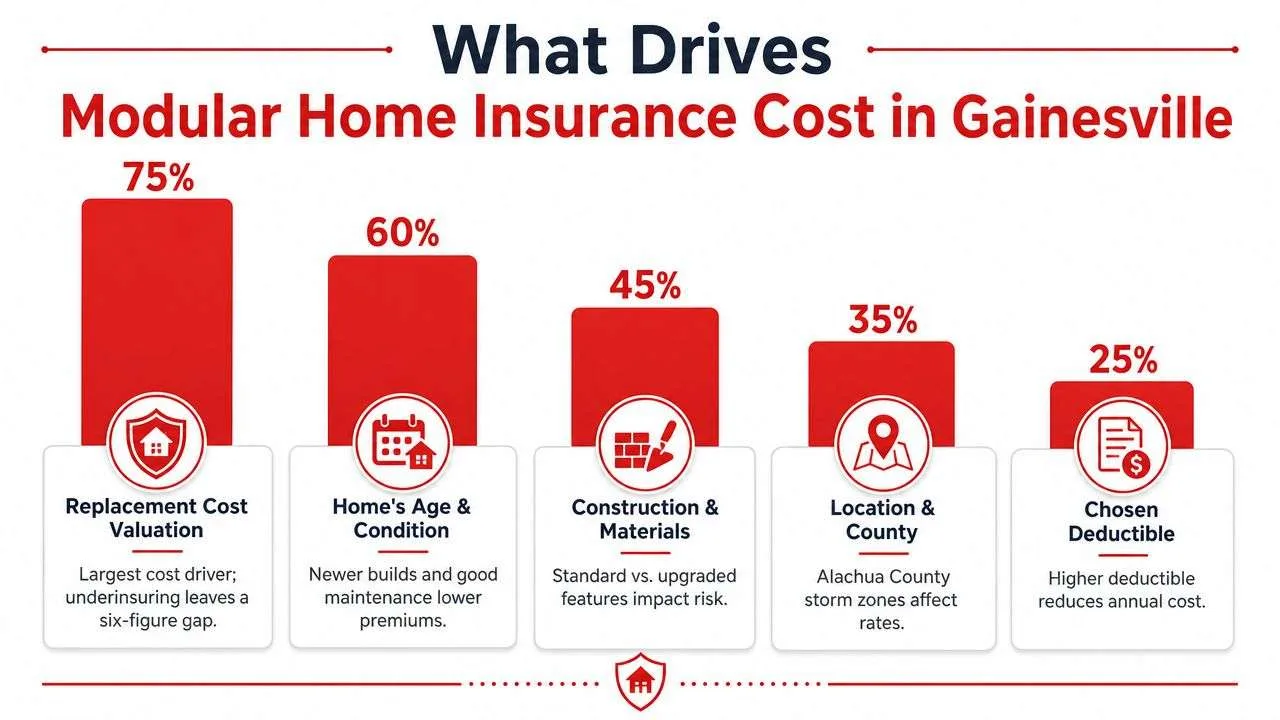
Replacement-cost valuation sets the tone for the whole policy. If the dwelling limit is too low, the claim check will not come close to what it takes to rebuild a modular home after a serious loss. A cheap premium does nothing for an owner who has to fund the shortfall out of pocket.
The next driver is the wind or hurricane deductible. Florida policies often use a percentage deductible, and that percentage sits apart from the ordinary deductible. On a $250,000 dwelling limit with a 2% wind deductible, the homeowner pays $5,000 before wind coverage starts responding. That single choice can matter as much as the premium itself.
What carriers inspect closely
Roof age gets attention fast. Carriers also look at the condition of the structure, the anchoring, and any mitigation features that reduce storm losses. Opening protection, secondary water resistance, and a clean installation file all affect the decision. They do not just change the price. They determine whether the carrier is willing to write the risk at all.
Practical rule: the cheapest quote is usually the one with the hardest deductible or the weakest valuation.
ZIP code and claims history also shape where the home lands in the market. Gainesville's broader residential insurance situation reflects Florida's high property-insurance costs, so the underwriting file needs to be clean before you request quotes. A messy record gives carriers a reason to tighten terms or walk away.
The advice I give owners
Do not chase the lowest annual premium until you know the wind deductible and the replacement-cost basis. A low number with a severe deductible is not savings, it is deferred pain. In Gainesville, the right policy is the one that stands up in the first serious storm, not the one that only looks friendly on the invoice.
Documents to Gather Before Requesting Quotes
Build the file once, then use it for every quote
Start with the recorded deed or affidavit of affixation. That document helps prove the home is treated as real property, and it can keep the carrier from placing the file in the wrong housing category.
Next, gather the manufacturer's data plate and HUD label if the home has one. Then add the installer's certification of permanent foundation, because the carrier wants to see that the unit isn't just sitting on a lot, it's anchored and installed the way Florida underwriting expects.
The photos and inspections that speed things up
Take clear photos of the tie-downs and anchoring. Add the most recent wind-mitigation inspection, Form 1802, if you have it. A clean wind-mitigation file can help secure meaningful discounts, and the flood side can improve too when the structure is documented correctly.
An elevation certificate is the most useful document if the home sits in a flood zone. In many Gainesville flood situations, that one paper can change how the flood carrier prices the risk, and it can be the difference between an expensive file and a manageable one. You should also prepare a contents inventory with values, because your personal property limit should not be set blind.
The checklist I want in front of me before I quote a home
- Recorded deed or affidavit of affixation: proves the home is real property.
- Manufacturer and installation records: confirms how the home was built and set.
- Foundation and anchoring photos: shows the insurer the home is secured.
- Wind-mitigation report: helps identify discount opportunities.
- Elevation certificate: helps the flood side of the quote.
- Contents inventory: keeps personal property from being underinsured.
An independent Florida agent should pre-review that package before sending it to market. Incomplete files are a common reason quotes stall, and that delay is avoidable if the documents are gathered first.
Three Policy Pitfalls Gainesville Owners Should Avoid
Mislabeling the home
The first trap is simple and expensive. If the home is modular but the deed, county record, or insurance application still shows it as manufactured or mobile, the carrier may write the wrong form or price it as a harder risk. That mistake is fixable before binding, but after a loss it becomes a coverage fight.
Skipping flood because the house has never flooded
Never confuse personal history with map reality. A house can sit dry for years and still be in a floodplain, and the lender doesn't care that nothing bad has happened yet. The flood requirement is driven by FEMA mapping and lender overlays, not by how long the owner has lived there.
Buying the cheap wind deductible
The third trap is picking a premium that looks comfortable and a wind deductible that's brutally high. That structure can leave the owner staring at a large out-of-pocket amount after the first major storm, and the policy may still be technically correct while being practically painful. In Florida, the deductible structure is part of the claim outcome.
Don't buy a policy you can't use. That's the whole test.
These problems are easiest to fix before the policy is bound. After a storm, the carrier will follow the file, not the story, so Gainesville owners should clean up the category, the flood position, and the deductible before anything goes live.
Discounts, Mitigation, and How a Florida Independent Agency Helps
Mitigation is where Florida owners get some control back. Hip roofs, reinforced garage doors, impact glass, and secondary water resistance can help lower a homeowners premium when the carrier recognizes them, and a strong mitigation file makes the policy easier to defend later. The best discounts are the ones tied to actual loss reduction, not marketing language.
Bundling can also help. When the modular home is packaged with auto, flood, or umbrella coverage on the same account, the carrier may apply a multi-policy discount, and that can make an annual review worth the time. If you want to reduce premiums without weakening coverage, start with the basics in this Florida premium-reduction guide.
A Florida-only independent agency is useful because it can quote the risk against multiple carriers that accept modular construction. That matters when one insurer likes the file and another wants a different foundation proof or wind condition. Schneider and Associates Insurance Agencies is one Florida option that writes in-state policies and can also place coverage with Citizens when the private market won't take the risk.
The smart move is straightforward. Pull the deed, affixation papers, foundation photos, wind-mitigation report, and flood documents together, then request comparative quotes instead of one-off pricing. That's how you get a policy that fits the home, the lender, and the way Gainesville weather really behaves.
Have questions about your coverage?
Our Newberry and Micco, FL team can walk through your policy and find the right coverage at the right price.
Get a Free Quote