Replacement Cost Coverage for Mobile Homes in Florida

Replacement cost coverage for mobile homes in Florida typically rebuilds the structure at today's prices without deducting depreciation, usually costs about 20% more than actual cash value, and is most accessible for homes 25 years old or newer. If your place took wind damage, that difference can be the gap between a repairable loss and a payout that leaves you short on the rebuild.
A lot of Florida owners only realize the issue after a storm, when the adjuster's number doesn't match what local contractors are charging. If your home is older, has changed over time, or sits in a higher-risk part of Florida, the coverage limit on your policy may deserve a closer look before renewal.
What Replacement Cost Coverage Means for Your Mobile Home
A Florida mobile-home owner usually asks one thing first, will the policy pay enough to rebuild the home, or will it just pay what the home is worth after age and wear? Replacement cost coverage answers that first question in a much stronger way than actual cash value. It pays to rebuild or replace the structure without deducting depreciation, and one industry guide says it typically adds about 20% to premiums compared with actual cash value, which is why many owners hesitate until they see what a partial payout can leave behind. Read more about mobile-home insurance in Florida
That difference matters in Florida because the loss is rarely just “the structure.” After wind, roof damage, or a major storm claim, the cost of labor, materials, and scheduling pressure can all move faster than a policy that was set months earlier. A mobile home also sits in a more specialized insurance lane than a site-built house, so the wording on the policy matters just as much as the price.
Practical rule: if your policy only pays depreciated value, you're taking on more of the rebuild burden yourself.
Older homes deserve extra scrutiny. Homes built before June 15, 1976 fall outside the federal HUD construction standard that still serves as a dividing line for insurers, and those homes are more likely to face stricter underwriting or reduced access to replacement-cost terms. Newer manufactured homes tend to have more coverage options, but the actual policy form still decides whether the claim follows a new for old standard or a depreciated one. Florida mobile-home insurance guidance helps explain that divide, while the pricing backdrop for replacement cost comes from current rebuild pricing and not the home's age alone.
The cleanest way to think about it is this. Replacement cost is about what it takes to rebuild the home now, not what the home would fetch after years of use. If that's the coverage you want, the rest of the article is about how to qualify for it, how carriers calculate it, and how to keep the limit from drifting out of date.
Replacement Cost vs Actual Cash Value Explained
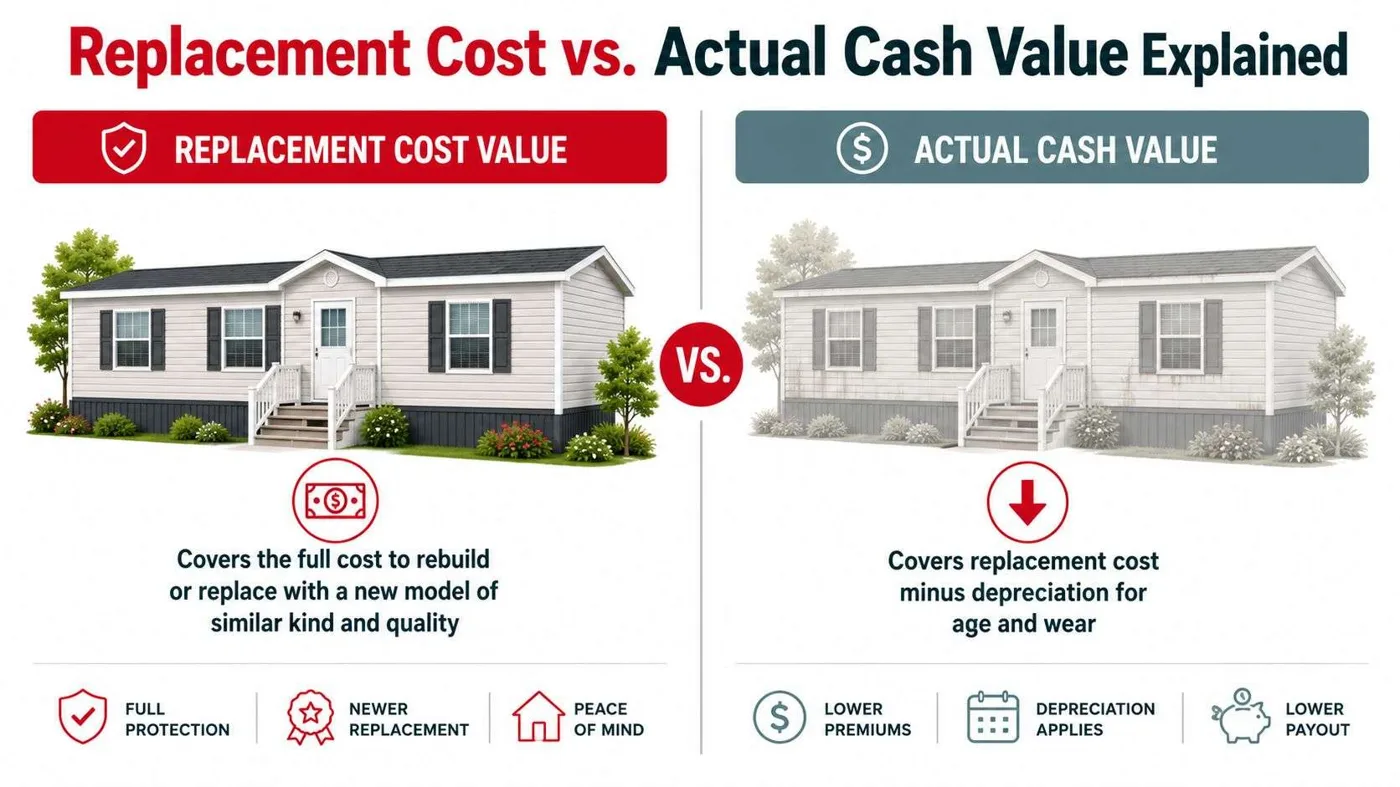
The easiest analogy is a toaster. If your five-year-old toaster dies, replacement cost buys a new toaster of similar kind and quality, while actual cash value gives you cash based on wear, age, and what the old toaster was worth before it failed. Mobile-home insurance works the same way, except the appliance is your dwelling, and the difference can be much bigger than a kitchen gadget. A Florida mobile-home policy often sits on an HO-7-style form, which is designed for manufactured housing rather than a site-built home.
The replacement-cost side is straightforward. It pays the amount needed to rebuild or replace a mobile or manufactured home with new materials of similar kind and quality without deducting depreciation, and a Florida-focused source explains that insurers use this approach to pay at today's prices rather than the home's reduced depreciated value. Replacement cost versus actual cash value spells that out plainly. ACV, by contrast, starts with the same property but subtracts age and wear, which means an older unit can produce a noticeably smaller claim check.
Here's the part many owners miss. Replacement cost doesn't cover land, and it doesn't mean the insurer upgrades you to a better home than the one you had. It covers a comparable structure, not a luxury version. Personal property and liability usually sit in their own parts of the policy, so a solid dwelling limit still needs to be paired with the right contents and liability choices.
A strong replacement-cost policy can still leave a gap if the dwelling limit is too low or if a separate coverage, like contents, was set too tightly.
That's why policy language matters more than the headline premium. Two policies can look similar on paper, but if one pays depreciated value and the other pays full rebuild cost, the claim outcome can land in very different places. For a Florida homeowner, the question isn't just “Am I insured?” It's “Am I insured in a way that matches the cost of rebuilding this specific home?”
Florida Underwriting Rules That Decide Whether You Qualify
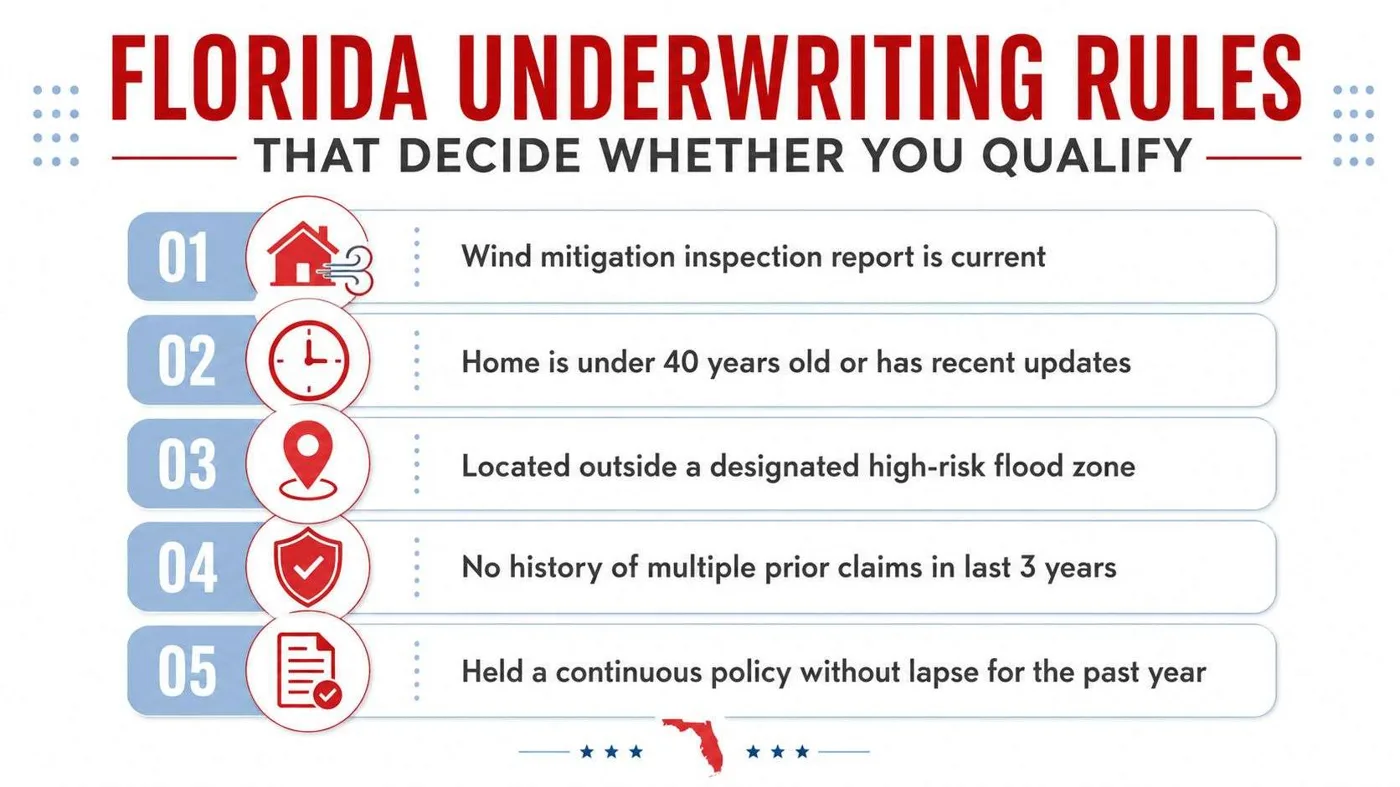
Florida carriers don't offer replacement cost on every mobile home, and the reason is simple. They use underwriting rules to decide whether the risk is stable enough to insure on a full rebuild basis. One of the clearest rules in the market is age, since carrier guidance shows that replacement cost treatment is often tied to homes 25 years old or newer with proper skirting installed, and Florida carriers typically cap replacement cost coverage at about 80% to 100% of full replacement cost. Florida mobile-home rules
The age line still matters
The federal HUD code took effect on June 15, 1976, and insurers still use that date as a dividing line. Homes built after that date are in the modern manufactured-home category, while earlier homes often face tougher eligibility standards and may have to rely on specialty markets or actual-cash-value terms. That's one reason a newer home can qualify for stronger coverage even when the older home is still structurally sound.
A practical Florida example helps. A 1995 single-wide in Gainesville may be looked at very differently from a 2018 double-wide near Newberry, even if both are maintained carefully. The newer home generally has a better path to replacement cost because its construction vintage, condition, and underwriting profile fit what carriers want to see.
Condition still affects the decision
Age isn't the only factor. Proper skirting, anchoring, roof condition, and overall maintenance all feed into the underwriting decision because they reduce loss severity and make the structure easier to insure. If a home has visible wear, poor anchoring, or a roof that's nearing the end of its useful life, the carrier may move it toward a stricter coverage form or a smaller limit.
Practical rule: the more a carrier has to worry about total-loss severity, the more likely it is to tighten eligibility.
The useful takeaway is not to guess. Ask whether your home's age, skirting, anchoring, and roof condition still support replacement-cost treatment, especially if your policy has been renewed more than once without a fresh inspection. If your home is near the cutoff, documentation from repairs or upgrades can make a real difference.
How Insurers Calculate Your Replacement Cost in Florida
A Florida carrier usually starts with square footage, then layers in condition, roof type, finish quality, and local rebuild costs. For manufactured-home rebuilds, a practical benchmark is about $50 to $125 per square foot, while traditional site-built homes are often cited at $150 to $300 per square foot. This manufactured-home replacement-cost guide helps show the range without pretending every home should be priced the same way.
A policy limit can drift fast if the carrier's valuation tool is using older assumptions. That is why two homes with the same floor plan can end up with different replacement-cost numbers, especially after a storm season or a round of material price changes.
A simple rebuild example
A 1,200-square-foot home priced at $50 per square foot points to about $60,000 in rebuild cost. At $125 per square foot, the same home points to about $150,000. The gap between those numbers is wide, and it shows why the same policy form can produce very different Coverage A limits.
Now add Florida realities. A home with a simple roof line, standard finishes, and straightforward access for contractors may stay closer to the lower end. A home with higher-end finishes, a more complex roof system, or a location that makes labor and materials harder to line up can move toward the higher end. The estimate is not just about size, it is about how expensive it would be to put that exact home back together.
The limit matters as much as the formula
A replacement-cost policy only works if the dwelling limit stays close to the rebuild cost. Florida policy guidance shows that carriers can recalculate Coverage A with valuation tools and may also change deductible or contents settings when the estimated replacement cost changes, so the number on the declarations page is not frozen in place. Florida policy change guidance
If your limit was set a while ago, do not assume it still lines up with what it would cost to rebuild today.
A quick sense check helps. Compare your dwelling limit with a rough square-foot estimate, then ask whether roof work, storm repairs, interior upgrades, or structural changes should move that figure. For a quick estimate, you can use our replacement cost calculator. If the number looks stale, a review can show whether the policy is lagging behind the current rebuild cost before a claim forces the issue.
| Home profile | Size (sq ft) | Low rebuild ($/sq ft) | High rebuild ($/sq ft) | Estimated total |
|---|---|---|---|---|
| Smaller single-wide | 1,000 | 50 | 125 | 50,000 to 125,000 |
| Mid-size manufactured home | 1,200 | 50 | 125 | 60,000 to 150,000 |
| Larger double-wide | 1,800 | 50 | 125 | 90,000 to 225,000 |
The Coverage Drift Problem Most Florida Owners Miss
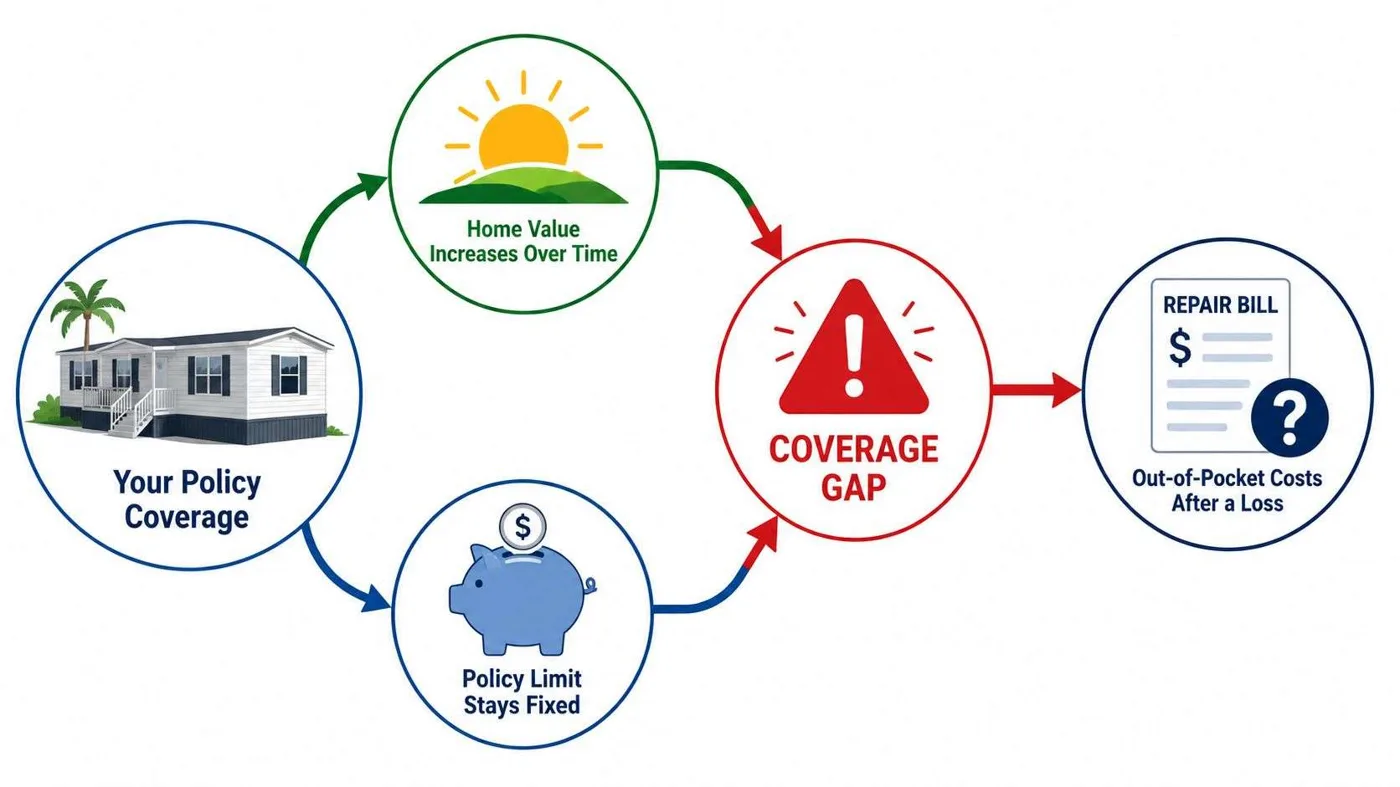
A lot of owners treat replacement cost like a fixed promise. In Florida, it can shift under your feet. Carriers may recalculate Coverage A with valuation tools and may also adjust deductible or contents settings when the estimated replacement cost changes, so the number on the declarations page can drift away from the rebuild cost before you notice it. The result is simple, and expensive. Your policy can look current while the limit falls behind what it would take to rebuild the same home after a storm.
That drift matters more in Florida because rebuild costs move with storm damage, material shortages, and local labor pressure. A mobile home in one county can cost more to replace after a rough season than it did at the last renewal, even if nothing about the policy changed on paper. The gap is not about depreciation. It is about a stale limit meeting a newer, higher rebuild bill.
Florida owners often see the same problem after storm seasons because the repair market changes faster than a policy does. If you want a plain-English example of how wind damage and rebuild costs can interact, see our Florida hurricane damage insurance guide. A number set from an older valuation can lag behind the current cost of labor, materials, debris removal, and structural work, especially when demand spikes after widespread losses.
A warning sign is easy to miss. If you have not reviewed Coverage A since a major storm season, the limit may already be stale.
The best renewal habit is straightforward. Ask whether the carrier used a valuation tool, ask for the new dwelling estimate, and compare it with what it would take to rebuild your specific mobile home in Florida today. If the answer sounds generic, ask for a more detailed review. Replacement cost only helps when the limit still matches reality.
Endorsements and Add-Ons Worth Asking About
Once the dwelling limit is set correctly, the next question is what sits around it. A mobile-home policy can look fine on paper and still leave real gaps if personal property, code upgrades, or utility-related losses are underinsured. Start with replacement cost on personal property. If contents are paid on depreciated value, the same kind of shortfall you were trying to avoid on the dwelling side can show up inside the home.
Ask about ordinance and law coverage too. If a covered loss leads to repairs that must meet newer code requirements, that add-on can help pay for the upgrade work instead of leaving you to cover it yourself. In Florida, that matters because repair work often triggers compliance issues that were not part of the original structure.
Water backup, sewer backup, and equipment breakdown also deserve a close look, especially if your home has systems that would be expensive to replace after a localized failure. For residents in mobile-home parks, loss assessment coverage can matter when the community shares certain repair responsibilities. Those are the claim details that feel easy to skip at quote time, then become expensive later.
Florida wind and storm damage can change the size of the repair bill fast. For more on how standard policies handle those losses, see our guide on homeowners insurance and hurricane damage. If a policy leaves out the wrong add-on, the gap may show up right when the home is hardest to replace.
Tie-down and anchoring documentation can also help. Florida wind mitigation features and proper installation records may improve eligibility or pricing, and they give the carrier a clearer picture of how the home is secured against wind loss. If you do not have those documents, gathering them before renewal can help more than waiting for the insurer to ask.
Keep the file together. Roof records, skirting details, and anchoring paperwork often matter more than a memory of when the work was done.
If you want help comparing the practical tradeoffs, a Florida-licensed independent agency such as Schneider and Associates Insurance Agencies can review mobile-home coverage options alongside the rest of your property program. The goal is not to buy every add-on. The goal is to choose the few that close the biggest gaps for your home.
Smart Steps Before You Buy or Renew
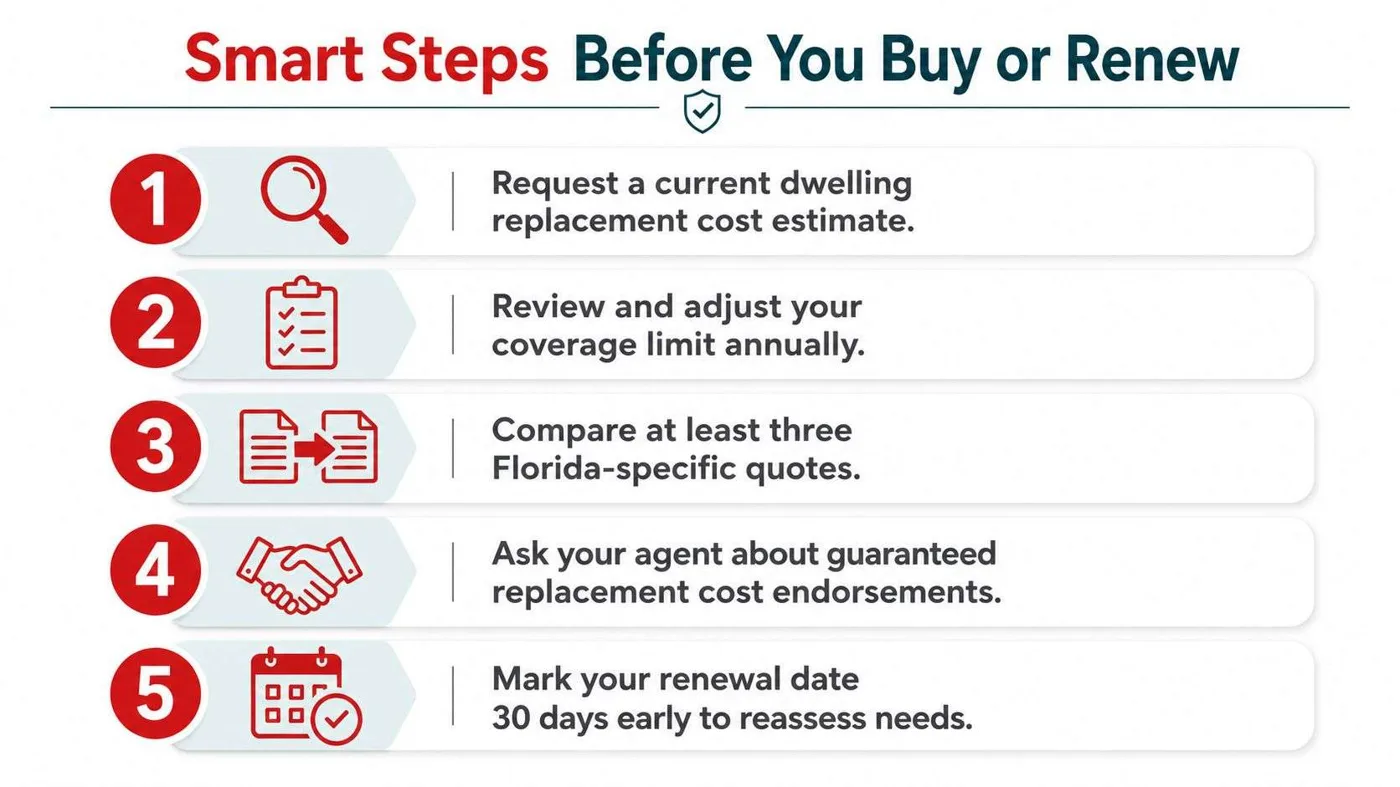
The renewal process is where most Florida owners can fix problems cheaply, before a storm makes them expensive. Use a simple checklist, and don't let the policy auto-renew just because it's familiar.
| Action | Why it matters | When to do it |
|---|---|---|
| Request a current dwelling replacement cost estimate | Keeps Coverage A aligned with today's rebuild cost | At every renewal |
| Review and adjust your coverage limit | Helps reduce coverage drift | Before the policy renews |
| Compare at least three Florida-specific quotes | Surfaces differences in underwriting and limits | When shopping or renewing |
| Ask about guaranteed replacement cost endorsements | Can improve claim protection if available | During the quote review |
| Mark your renewal date early | Gives time to fix documentation gaps | About 30 days before renewal |
Four questions Florida owners ask most
What if replacement cost is less than 80% of true value? The policy may not fully protect you if the limit is too low, and Florida carrier rules often tie eligibility to a limit that sits near 80% to 100% of replacement cost.
Is flood insurance separate? Yes, flood is separate from mobile-home dwelling coverage.
Can older pre-1976 homes ever qualify? Sometimes, but they usually face tougher underwriting and less access to replacement-cost treatment.
How are claims paid? On replacement-cost coverage, the home is paid to rebuild or replace with new materials of similar kind and quality, not at a depreciated value.
If you're renewing soon, don't guess at the right number. Pull your current declarations page, look at the dwelling limit, and ask whether it still matches what it would cost to rebuild the same home in Florida today.
Have questions about your coverage?
Our Newberry and Micco, FL team can walk through your policy and find the right coverage at the right price.
Get a Free Quote